
AI support agents are autonomous AI systems that handle customer inquiries end-to-end—triaging tickets, drafting responses, and resolving issues—without human involvement, delivering response times measured in minutes rather than business days. Data from EV.energy's deployment of Ability AI agents showed that replacing human-first support with governed AI increased CSAT scores from 50% to 70%, proving that for routine inquiries, speed is the primary driver of customer satisfaction.
AI support agents are frequently viewed by customer success leaders with a mix of intrigue and hesitation. The prevailing narrative suggests a trade-off: you can either have the efficiency of automation or the high satisfaction scores of human interaction, but rarely both. However, emerging data from the energy sector challenges this binary view, suggesting that for modern consumers, speed is quality.
Recent operational data from EV.energy, a leading platform managing electric vehicle (EV) charging and virtual power plants, demonstrates a counter-intuitive reality. By deploying governed AI agents to handle Tier 1 support inquiries, the company didn't just cut costs or reduce backlog — they actually increased Customer Satisfaction (CSAT) scores by a staggering 20 points.
This shift represents a fundamental change in how operations leaders must view AI implementation. It is no longer merely a tool for deflection or cost savings; it is becoming the primary driver of superior customer experience in complex, high-volume industries. By analyzing EV.energy's implementation strategy — spearheaded by CEO Nick and Customer Support Lead Sandy — we can identify a replicable framework for scaling operations without sacrificing trust.
Why AI support agents outperform human-only support teams
To understand why AI support agents are becoming a necessity rather than a luxury, one must look at the operational fragility inherent in manual support systems, particularly in complex industries like energy management.
EV.energy operates at the intersection of utility grid management and consumer behavior. They manage Virtual Power Plants (VPPs), aggregating thousands of electric vehicles to balance grid load. This creates a high-stakes support environment. If a driver's car doesn't charge overnight because of a grid event or a software disconnect, that user cannot get to work the next morning. The urgency is immediate.
In a traditional human-staffed model, service levels are dictated by capacity, not demand. EV.energy found that their support quality was vulnerable to standard workforce variables: staff sickness, annual leave, and unexpected spikes in ticket volume. When demand outpaced human capacity, backlogs grew, response times lagged, and customer satisfaction dipped.
This is the "resilience gap" that plagues many mid-market companies. As you scale, the complexity of queries and the sheer volume of users often outpace the speed at which you can hire and train qualified support staff. The result is a support organization that is perpetually reactive rather than proactive.
The introduction of AI agents was not driven solely by a desire to reduce headcount, but by the need to decouple service quality from human availability. An agent does not get sick, does not take holidays, and can scale instantly to meet volume spikes that would otherwise drown a human team.
The "crawl-walk-run" framework for building trust
One of the most critical insights from the EV.energy case study is the methodology of deployment. A common failure mode in AI adoption is the "big bang" approach — turning on a chatbot overnight and hoping for the best. This often leads to hallucinations, customer frustration, and eventual rollback.
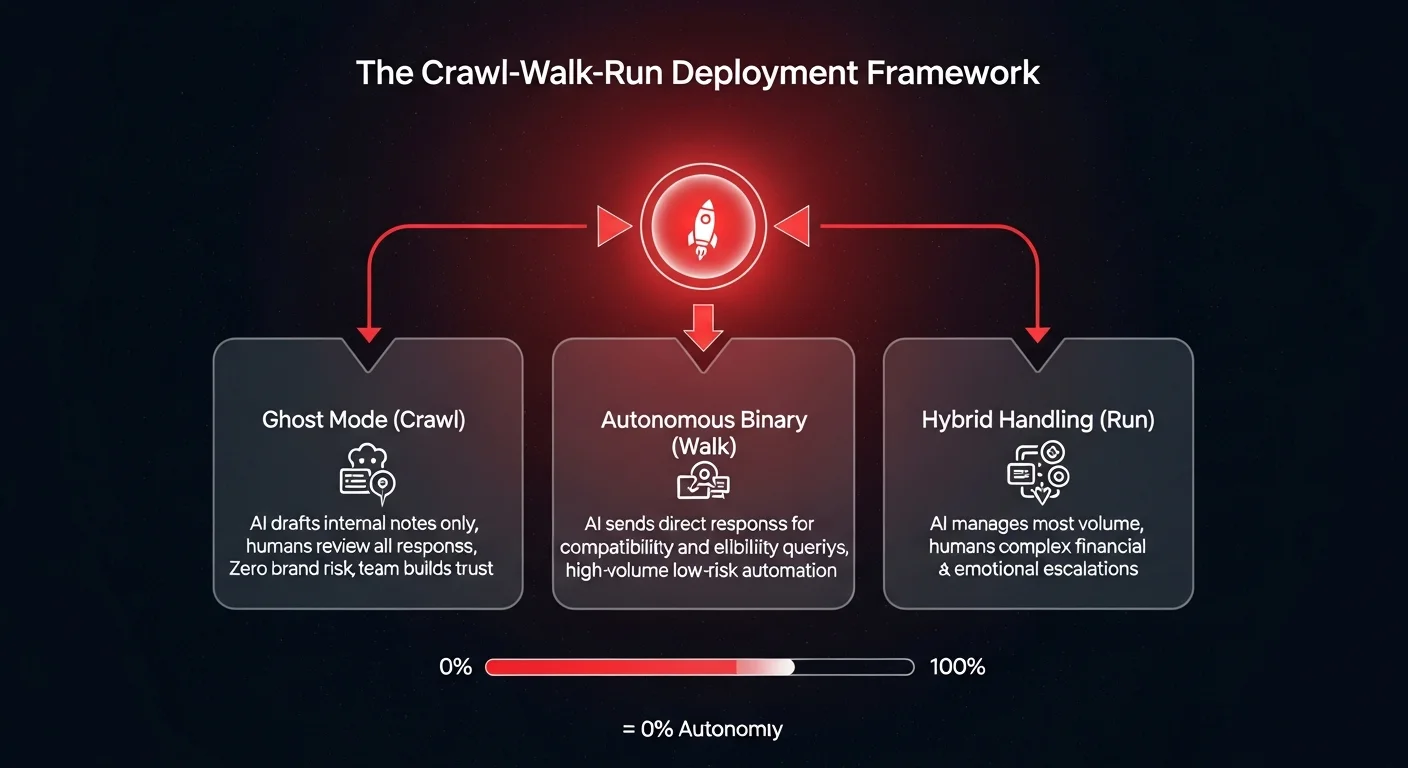
Instead, successful implementation requires a phased approach that builds organizational confidence before the AI ever speaks to a customer. This process follows a specific maturity curve:
Phase 1: helper notes and "ghost mode"
Before the AI agent was allowed to send a single message, it was deployed in a "helper" capacity. It would analyze incoming tickets and draft a response, saving it as an internal note rather than sending it. Human agents would then review these notes.
This phase serves two critical operational functions:
- Risk-free training: It allows the operations team to tune the agent's logic and prompts without any risk to the brand. If the agent hallucinates or misses nuance, it happens privately.
- Team buy-in: It shifts the internal narrative. Support staff see the AI as a tool that does 80% of their drafting work, rather than a replacement. They become the "editors" of the AI, providing the feedback loop that improves the system.
Phase 2: autonomous execution for binary queries
Once accuracy targets are met in the ghost phase, the system moves to direct responses for specific, low-risk categories. For EV.energy, this meant targeting "compatibility" and "eligibility" queries — questions with objective, binary answers (e.g., "Is my charger compatible with this program?").
These queries are high-volume but low-complexity. They are tedious for humans but perfect for agents. By automating these, the system provides instant value to the customer without risking complex errors.
Phase 3: hybrid handling for high-stakes issues
Complex inquiries, particularly those involving financial incentives or disputes, remain human-led or operate in a hybrid model. The agent might gather preliminary data or draft a response for approval, but a human makes the final decision. This "human-in-the-loop" architecture ensures that empathy and judgment are applied where they matter most, while speed is applied where it matters most.
Hard metrics: why speed drives CSAT
The most compelling argument for this operational shift lies in the hard data. The metrics from EV.energy's deployment of Ability AI agents reveal a stark improvement in performance across the board. For a broader look at how to track and govern agent performance, see our analysis on agent reliability metrics and governance.
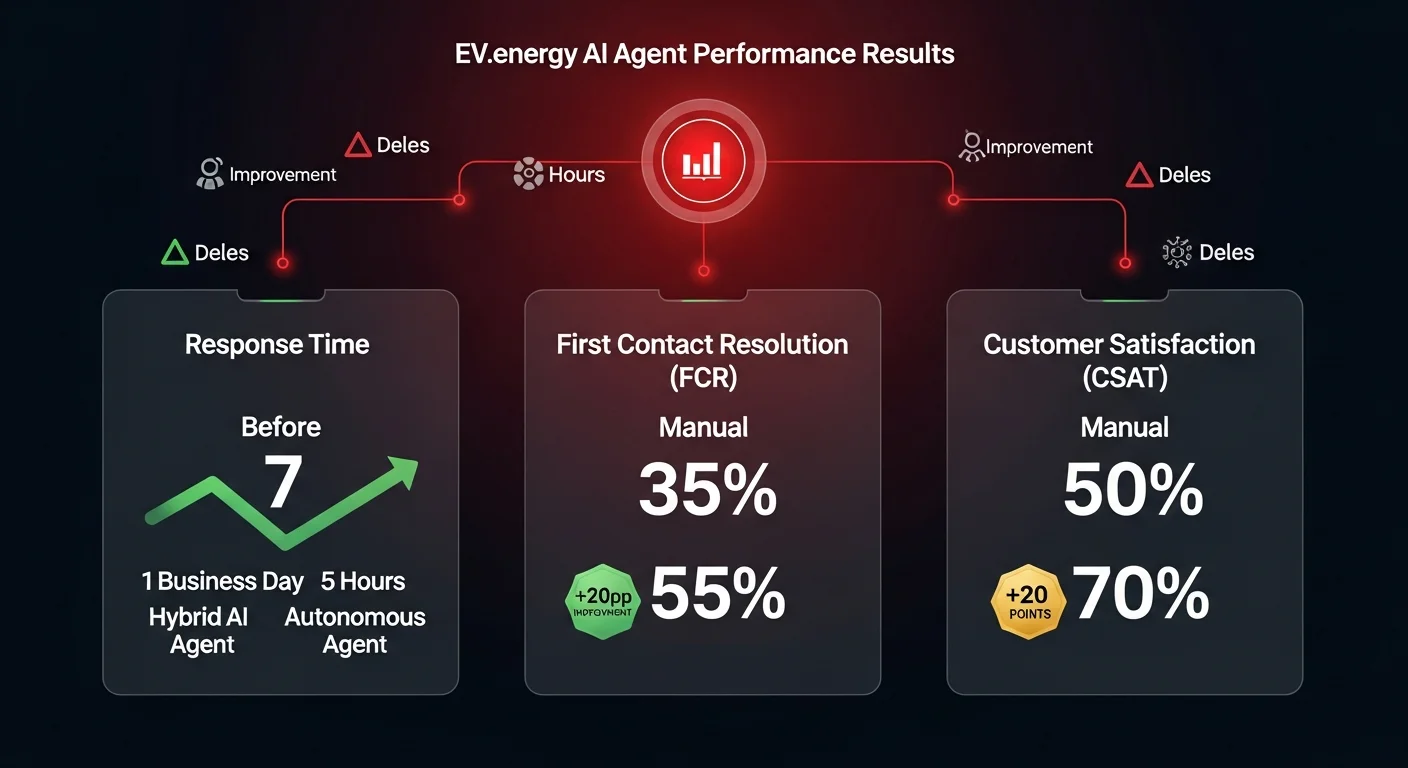
Response time reduction:
- Manual process: 1 business day
- Hybrid AI assistance: 5 hours
- Fully autonomous agent: 7 minutes
First contact resolution (FCR):
- Manual process: 35%
- With AI agents: 55%
Customer satisfaction (CSAT):
- Manual process: 50%
- With AI agents: 70%
The correlation between response time and CSAT is undeniable. For routine queries, customers do not want a conversation; they want a resolution. A human response that takes 24 hours is objectively less valuable to a user than an AI response that resolves the issue in 7 minutes.
The 20-point jump in CSAT suggests that the "empathy gap" often cited by AI skeptics is largely a myth for transactional interactions. Users perceive "care" through the lens of efficiency. If an agent named "Eve" can solve a problem instantly, the user is more satisfied than they would be waiting a day for a human to type the exact same text.
Furthermore, the increase in First Contact Resolution (from 35% to 55%) indicates that agents are often more consistent than humans at following protocol and providing complete information on the first try, reducing the back-and-forth friction that kills customer loyalty.
Sovereignty: the governance imperative
As operations leaders evaluate AI infrastructure, data sovereignty has emerged as a non-negotiable requirement, particularly for companies operating in regulated markets like the EU.
EV.energy, headquartered in the UK/EU, faces strict GDPR requirements. Entrusting customer data — which includes home addresses, vehicle details, and energy usage patterns — to generic, black-box LLM providers creates unacceptable compliance risks. The "wrapper" approach, where businesses simply pipe data through a public model's API, offers little control over how that data is stored or trained upon.
The strategic shift here is toward sovereign agent installations. This architecture places the "perimeter" around the AI, ensuring that the logic, data processing, and memory live within the company's controlled environment. As Nick, CEO of EV.energy, noted, sovereign installation is the "only way" to truly protect privacy and security in a post-AI world. We've explored this shift in depth in our guide on local AI agents and sovereign execution.
For VPs of Operations and COOs, this dictates a procurement strategy that prioritizes infrastructure control over convenience. The ability to audit why an agent made a decision, and to guarantee that customer data never leaves the secure environment, is becoming a prerequisite for enterprise adoption.
The future: the agent-to-agent economy
Looking beyond the immediate gains in support efficiency, this deployment signals a broader shift toward an agent-to-agent economy. We are rapidly approaching a future where consumer-side agents (like advanced versions of Alexa, Siri, or Claude) will interact directly with business-side agents.
In the near future, a user will not log into a portal to sign up for a virtual power plant program. They will simply tell their personal assistant, "Optimize my energy usage and sign me up for the best programs." The personal agent will then negotiate with the utility's business agent to handle enrollment, verification, and setup.
Companies that have not established robust, governed agent infrastructure will be invisible in this new economy. If your business requires a human to answer the phone or process an email application, you will be unable to interface with the automated agents representing your customers.
Operational takeaways for leadership
The success of AI support agents at EV.energy offers a clear blueprint for mid-market and scaling companies. The key takeaways for leadership are:
- Reframe the value: Stop looking at AI solely as a cost-cutting mechanism. Its primary value is operational resilience and improved customer experience through speed.
- Audit for binary friction: Identify high-volume, low-complexity tasks (like compatibility checks) that are consuming your expensive human talent. These are your immediate targets for autonomous execution.
- Prioritize sovereignty: Do not compromise on data governance. Ensure your AI infrastructure offers the same security guarantees as your core software stack.
- Adopt a phased rollout: Build internal trust through "ghost mode" implementation before exposing the AI to customers. This protects your brand and wins over your staff.
The data is clear: the risk is no longer in deploying AI, but in failing to deploy it. When automation can deliver a 7-minute response time and a 70% satisfaction rating, manual support processes are not just inefficient — they are a competitive liability. Explore how Ability AI's customer support automation solutions help mid-market companies deploy governed AI agents that deliver the speed and consistency your customers expect. For the full technical breakdown of this deployment, see the Ability AI EV.energy case study.