
AI agent pricing is the new commercial model where SaaS vendors charge for autonomous work performed by AI agents - metering discrete business actions instead of human seats. Salesforce's Agentforce alone has hit an $800 million run rate processing over 2.4 billion agentic work units, signaling a seismic shift in how enterprise software is monetized.
The enterprise software landscape is quietly undergoing its most drastic commercial restructuring in two decades. At the center of this shift is a profound change in AI agent pricing, driven by SaaS vendors who are realizing that autonomous systems threaten their fundamental business models. For years, the SaaS industry relied on a simple proxy - turning human work into billed seats. As long as humans needed to log in, click around, and update records, the vendor could reliably forecast revenue.
Today, autonomous agents break that model entirely. A machine can now retrieve a customer record, summarize a case history, and trigger a resolution workflow without ever occupying a traditional user seat. In response, major platforms are erecting new toll booths, shifting from human-centric seat licensing to granular consumption meters based on delegated AI tasks.
For CTOs and internal AI champions at scaling companies, this creates an immediate architectural and financial crisis. Organizations risk getting trapped in a "double tax" - paying for legacy human seats while simultaneously footing the bill for unpredictable, rapidly scaling agentic work units. This is the same AI vendor lock-in risk playing out in real time across the industry. Understanding this shift is critical before your next vendor renewal.
Why AI agent pricing kills the human seat proxy
Before the agentic workflow revolution, every vendor could point to a group of employees and definitively state how many licenses an organization required. The human was the undeniable unit of software value. If ten people managed customer support, you bought ten CRM seats.
Agents dismantle this 1:1 ratio. An agent can operate entirely outside the primary application interface. It can read from a CRM, update a support ticket, ping an HR system, and close a Jira issue in seconds. The core work still happens, and the vendor's database still handles the permissions, data storage, and audit trails. However, the concept of "logging in" no longer captures the value exchange.
Software giants are acutely aware of this vulnerability. If an AI agent can resolve a massive volume of customer requests or keep sales records perfectly updated, organizations will naturally look to downgrade their human users to lighter, cheaper access tiers. To protect their revenue multiples, the companies formerly known as SaaS providers are fundamentally changing the definition of a billable action. This dynamic is accelerating what many call the SaaS apocalypse driven by AI agents.
The new SaaS toll booth: agentic work units and AI agent pricing models
We are currently watching the largest software vendors establish distinct, parallel pricing meters designed specifically for autonomous work. They are moving aggressively past API token counting and instead charging for business outcomes.
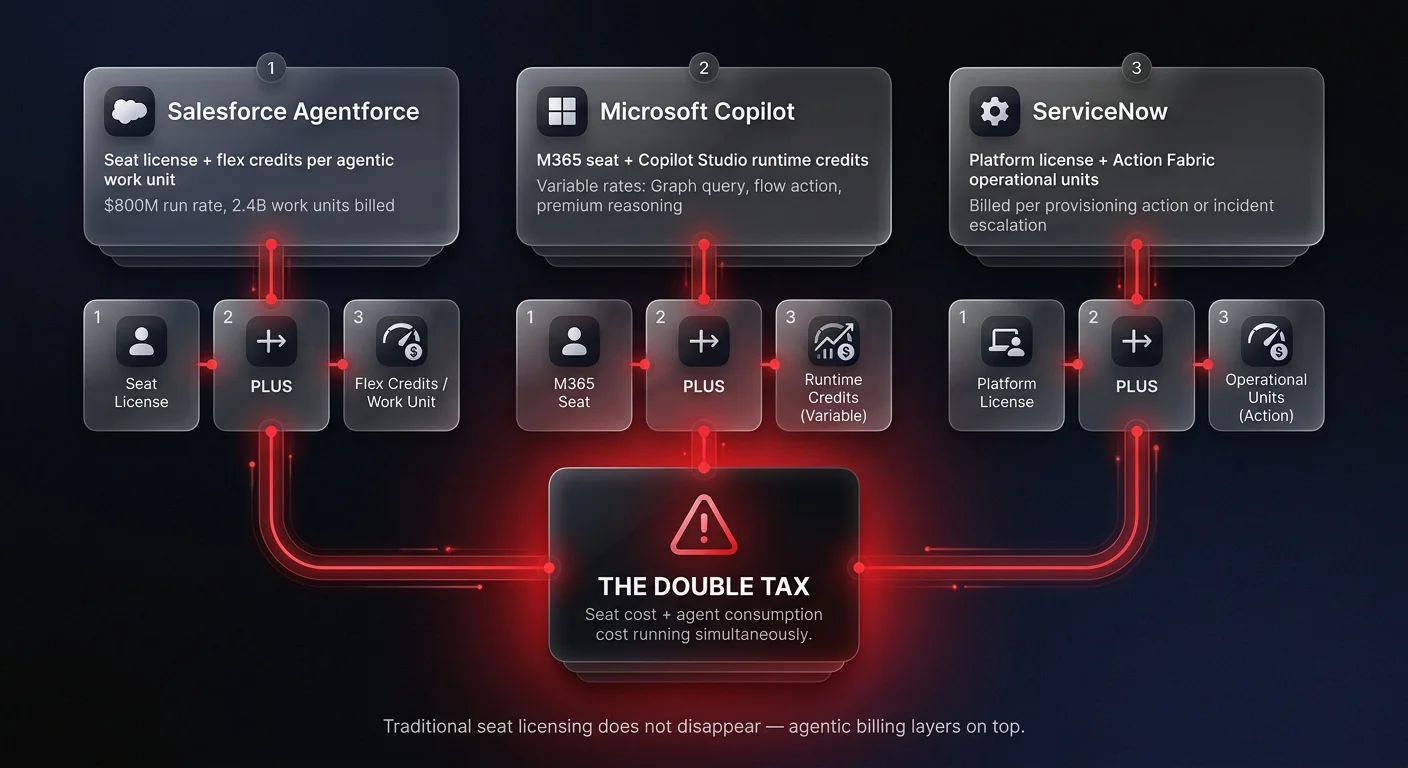
Salesforce provides the most transparent example of this transition. The company recently reported that its Agentforce product hit an $800 million run rate, processing over 2.4 billion "agentic work units." These are not token counts - they are discrete business actions. When an agent updates a record, answers an inquiry, or executes a prompt, it draws from a consumption meter. Under this new model, the sales rep still requires a paid seat, but the agent assisting them simultaneously burns through flex credits.
Microsoft has adopted a similar hybrid approach at a massive scale. While Microsoft 365 Copilot maintains traditional seat pricing, Copilot Studio introduces a secondary meter via credits. Different autonomous actions consume credits at entirely different rates. Grounding a query in the Microsoft Graph, executing a flow action, or utilizing "premium reasoning" all carry unique, often opaque costs. For an organization running modest agent workloads, this runtime billing scales up rapidly and unpredictably.
ServiceNow approaches this from the operational side. By positioning its Action Fabric as the governed substrate for enterprise workflows, ServiceNow can claim it provides the reliability, identity management, and audit trails necessary for AI actions. When an agent provisions software access or escalates an incident, ServiceNow bills for that operational unit of work, not just the API call.
Vendor walled gardens and the API lock-out
The most concerning trend for technical operators is not just the new AI agent pricing meters - it is the policy language being used to enforce them. Pricing follows platform control. The vendor that defines the new unit of work believes it has the right to price that work, and they are using contractual restrictions to lock out third-party competition.
Take SAP's recent 2026 API policy updates as a prime example. The policy draws a hard line around how external AI systems can interact with SAP data, placing severe restrictions on agents that plan, select, or execute sequences of API calls outside of SAP-endorsed architectures.
In practical terms, this means if you want a custom internal agent to act on your SAP data, your first hurdle is not technical - it is contractual. Vendors are using security and governance language to dress up commercial lock-ins. They are ensuring that their own native agents are the only financially and contractually viable route, treating outside agents as hostile entities.
Meanwhile, the scale of internal agent usage is exploding. In recent industry discussions, it is entirely common to find enterprise developers whose agents consume upwards of 8 billion tokens in a single month. When you combine this hyper-growth in consumption with strict SaaS API walled gardens, you have a recipe for runaway procurement costs that CTOs cannot accurately forecast. For a deeper analysis of how these procurement dynamics play out, see our guide on agent economy risks and procurement.
Spotting rent-seeking in AI agent pricing contracts
As you navigate this new landscape, it is vital to distinguish between fair usage-based pricing and pure rent-seeking behavior. A fair agent license is transparent. The buyer can see the meter, forecast their usage, set department-level caps, and confidently understand the difference between an agent reading data versus executing a high-stakes workflow.
Conversely, a rent-seeking pricing model is designed to trap you. Look for these red flags in your upcoming contracts:
- Charging for vague "AI access" without defining the underlying consumption metrics
- Billing failed or low-value agent attempts at the same rate as successfully completed workflows
- Bundling massive pools of credits that expire unused, while instantly billing for overages
- Refusing to provide exportable usage logs that allow your team to audit agent behavior
- Maintaining full-price legacy seat counts while adding a secondary consumption bill for the exact same workflow
If you have a confusing contract with overlapping seat counts, vague bot policies, and pilot programs scattered across departments, you do not have an AI strategy - you have a financial liability. The hidden costs compound quickly, as we explored in our analysis of AI token spend and the shadow budget crisis.
Reclaiming control with sovereign infrastructure
The solution to SaaS rent-seeking is not to negotiate harder for API credits - it is to change your architectural approach entirely. Organizations must stop building their autonomous capabilities inside hostile vendor ecosystems and instead move to sovereign AI infrastructure.
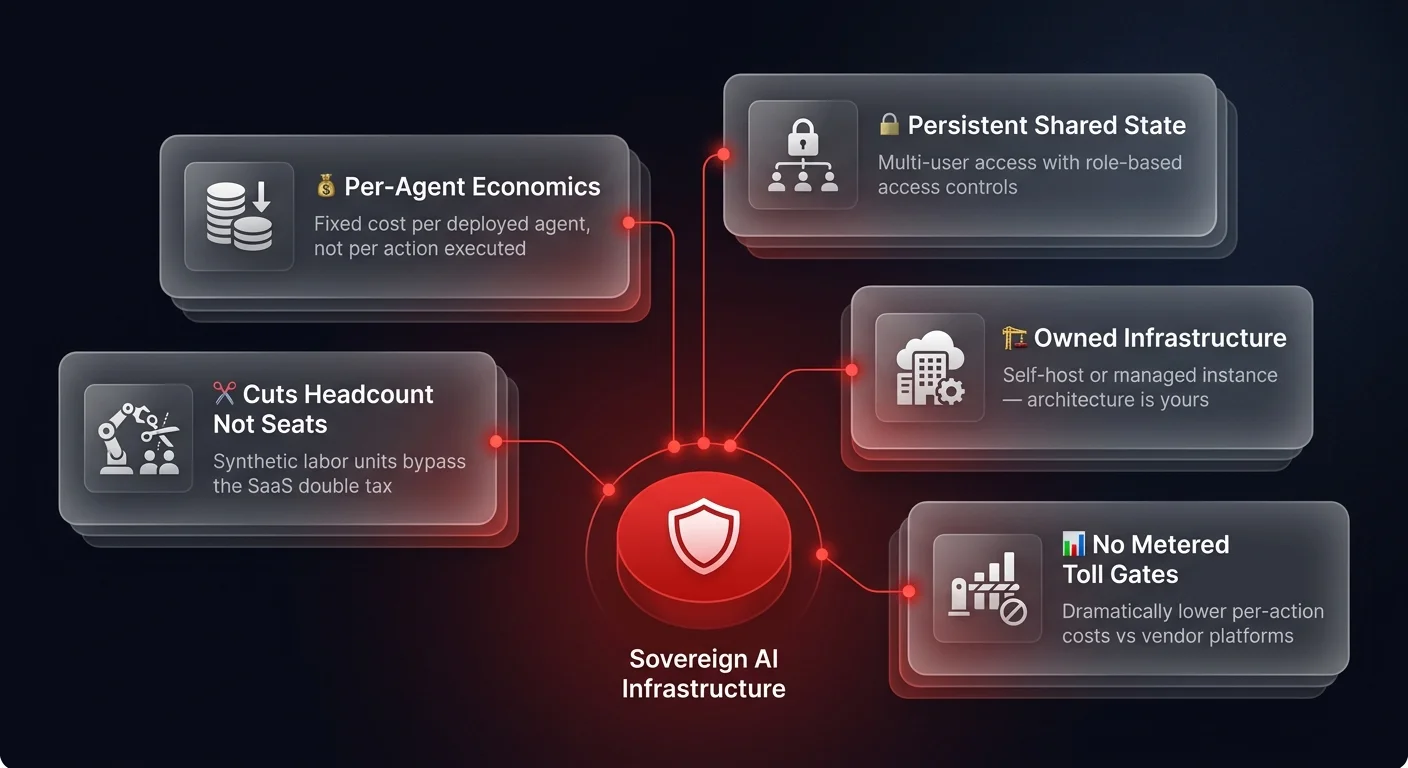
This is where the architecture fundamentally changes the enterprise equation. As an infrastructure layer for autonomous intelligent systems, sovereign deployment allows CTOs to deploy one managed instance that the entire company operates from.
Unlike SaaS workflow wrappers that meter every step of a process, sovereign infrastructure operates on a model of per-agent economics. The pricing is aligned with synthetic labor units, not legacy seat counts or arbitrary "premium reasoning" API taxes. Whether you self-host using open-source runtimes or deploy enterprise-grade managed instances, the architecture is yours.
Crucially, sovereign infrastructure provides the persistent shared state, multi-user access, and role-based access controls required for production deployments - without acting as a toll booth on your own data. Organizations building operations automation on owned infrastructure report dramatically lower per-action costs compared to vendor-metered alternatives. It cuts headcount, not seats, bypassing the SaaS double tax entirely.
The pre-renewal checklist for AI agent pricing negotiations
The worst strategic move a CTO can make right now is waiting until agent usage is deeply embedded in company workflows before discussing pricing with SaaS vendors. Once an agent is mission-critical, you lose all leverage. Before your next vendor renewal, you must force the conversation around agentic work units.
Demand clear answers to these operational questions:
- Does an independent, third-party agent require its own paid entitlement, or can it use existing API pathways?
- Can our custom agents utilize the same governed paths as your native vendor agent without penalty?
- Are we billed for successfully completed work, or merely attempts at work?
- Is the rate card fixed for the duration of the term, or can "premium reasoning" costs fluctuate?
- Most importantly - if our AI agents resolve 40 percent of our customer support volume, can we structurally reduce our human seat counts?
If a vendor refuses to allow seat reductions while simultaneously charging you for agentic work units, they are actively punishing your operational efficiency. Teams evaluating procurement automation should explore how finance and procurement solutions can streamline this vendor management process.
Moving toward predictable per-agent economics
The agent era has permanently altered the commercial unit of software. Builders who understand the distinction between how human work is billed and how agent work is metered will design far more resilient systems. Those who ignore it will successfully ship prototype agents that work beautifully - right up until the catastrophic SaaS bill arrives.
To build a sustainable operational layer, companies need to centralize their autonomous systems. By adopting sovereign infrastructure, technical leaders can isolate their agent logic from SaaS vendors' pricing games, ensuring that as their automation scales, their margins scale with it.
The next phase of enterprise AI is not about buying more intelligent SaaS seats. It is about deploying your own synthetic workforce on infrastructure you actually control. Take back your architecture, reject the double tax, and ensure your agent economics belong to you.