
AI native services deliver completed business outcomes using autonomous AI systems - replacing traditional software tools, co-pilots, and outsourced labor. The global BPO market exceeds $300 billion annually, and organizations are shifting from renting software seats to owning systems that do the work.
The enterprise technology landscape is undergoing a massive realignment. For the past decade, organizations have been locked in a cycle of purchasing increasingly complex software to manage operational overhead. However, the emergence of AI native services is fundamentally changing how business outcomes are delivered. Instead of buying software tools or paying subscription fees for AI co-pilots that your team forgets to use, the market is shifting toward solutions that simply do the work.
This transition from software provisioning to outcome delivery represents a critical turning point for operations leaders. As AI models rapidly improve, their capabilities now extend far beyond basic software engineering or content generation. We are entering an era where entire service categories are being natively rebuilt on autonomous systems, challenging the long-standing dominance of traditional Business Process Outsourcing (BPO) and administrative bloat. Understanding this shift is essential for any leader navigating the AI adoption gap between experimentation and real workflow automation.
The evolution from software to AI native services
To understand the magnitude of this shift, we must look at the historical progression of business services. Historically, critical business functions like accounting, tax preparation, and general administration began as purely manual services. Organizations hired large teams of humans to move paper, reconcile ledgers, and manage compliance.
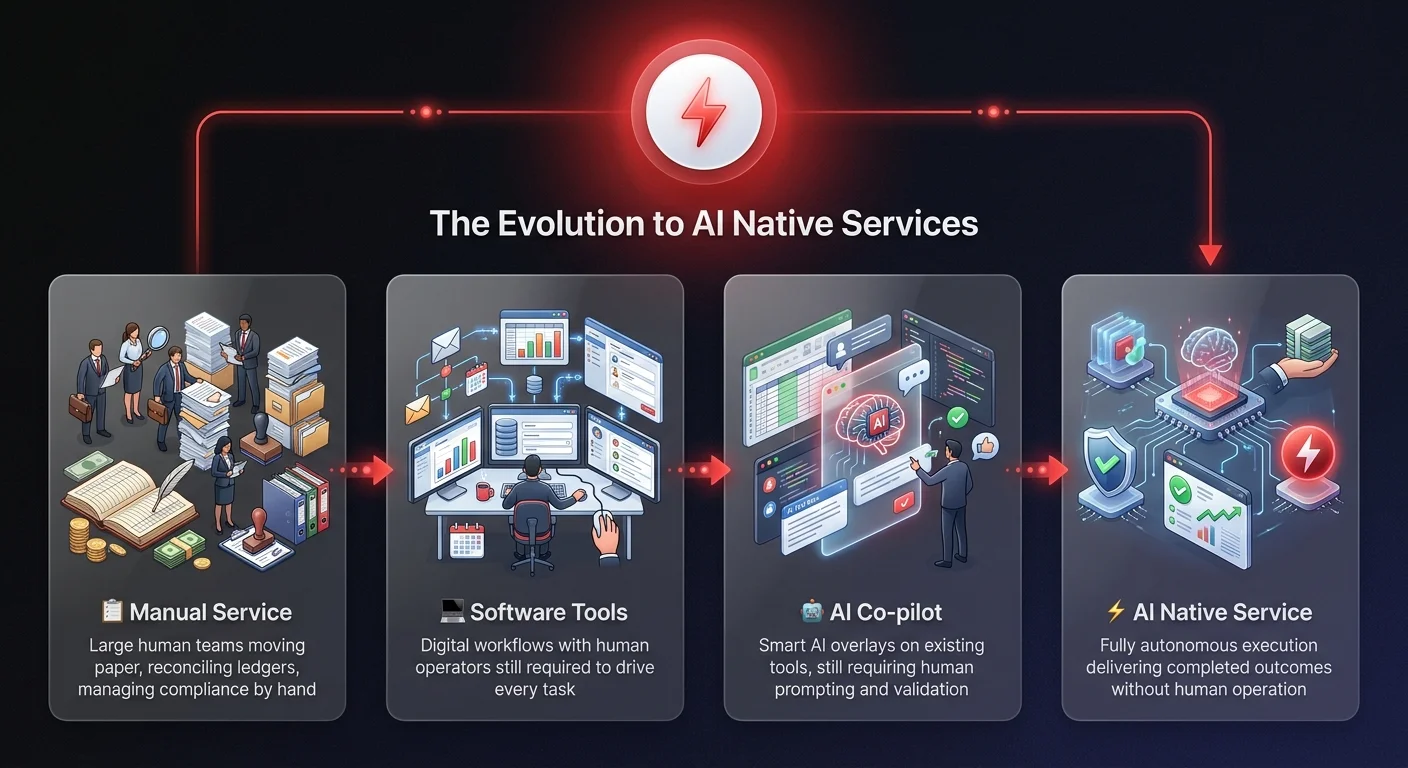
Over the last two decades, the software revolution transformed these manual services into digital workflows. We digitized the paper, but the fundamental operational model remained the same - a human operator was still required to sit at a desk and drive the software.
Between 2023 and 2025, the generative AI boom introduced a new layer to this stack: the AI co-pilot. Startups rushed to build smart overlays for existing industry tools. While helpful, co-pilots are still just tools. They require a human pilot to prompt them, guide them, and validate their outputs.
The next step in this evolution is the AI native company. These organizations do not sell software or co-pilots - they sell the service itself. Instead of handing your operations team a new application to learn and manage, an AI native service provider simply executes the workflow and delivers the final outcome. They are replacing the tool entirely with a system that does the heavy lifting autonomously - a shift that mirrors the broader move toward autonomous AI agents functioning as digital employees.
Why service spend is the true total addressable market
The strategic reason behind this massive market shift is rooted in basic economics. The global enterprise spend on services - specifically outsourced operational and administrative work - is exponentially larger than the total spend on software.
For years, scaling organizations have relied on BPOs and offshore agencies to handle data entry, compliance audits, and administrative workflows. While outsourcing was originally a cost-saving measure, it has introduced new layers of friction. Operations leaders currently suffer from high costs, latency, quality control inconsistencies, and significant security risks when handing sensitive corporate data to third-party offshore teams.
However, because these administrative functions are already outsourced, the organizational muscle to hand over the work already exists. Business leaders are already accustomed to packaging up a process, sending it out the door, and receiving a completed result. This makes outsourced services the easiest, most logical entry point for AI native products. Replacing a slow, error-prone BPO contract with a rapid, highly accurate AI agent system requires almost zero behavioral change from the core internal team.
High-value targets for AI native service replacement
Certain industries and business functions are perfectly positioned for immediate disruption by AI native services. These are typically operations-heavy sectors characterized by dense administrative requirements, complex regulatory adherence, and massive document processing workloads.
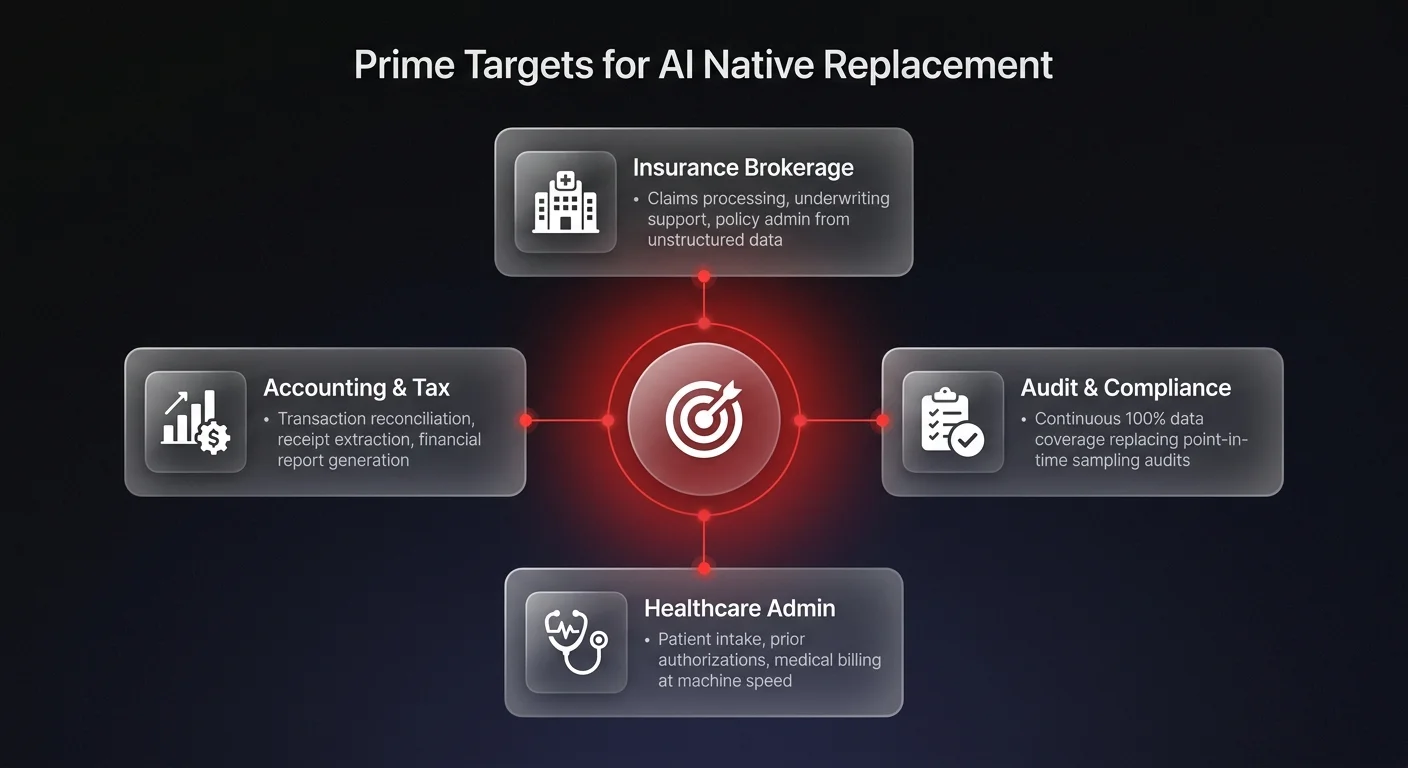
The most lucrative and high-value target areas include:
- Insurance brokerage: Processing claims, underwriting support, and policy administration require synthesizing massive amounts of unstructured data - a perfect use case for autonomous reasoning systems.
- Accounting and tax: Reconciling thousands of transactions, extracting data from receipts, and generating financial reports are rules-based processes that AI can execute with near-perfect accuracy. Organizations looking to automate these workflows can explore finance and procurement automation as a starting point.
- Audit and compliance: Moving from point-in-time sampling to continuous, 100% data coverage audits using AI agents ensures total compliance without the staggering billable hours of external consulting firms.
- Healthcare administration: Patient intake, prior authorizations, and medical billing are notoriously slow and manual. AI native services can process these workflows instantly, reducing latency in critical care environments.
If a business function involves moving data from one system to another based on a specific set of rules, it is no longer a software problem - it is an AI automation opportunity.
The human-in-the-loop professional model
Interestingly, the rise of AI native services does not mean the complete elimination of human expertise. In fact, the most effective implementations often embed a human professional within the service loop.
The architecture of a successful AI native service relies on a clear division of labor. The AI handles the bulk of the repetitive, data-heavy, and administrative tasks. It can read thousands of documents, cross-reference compliance frameworks, and prepare preliminary findings in seconds. However, for complex reasoning, critical edge cases, and final strategic validation, a human professional remains in the loop.
This hybrid approach guarantees exceptional quality while fundamentally restructuring the cost and speed of delivery. By embedding human oversight at the very end of the workflow, operations leaders get the speed and scale of machine execution combined with the critical thinking and accountability of a seasoned professional. See how Reply.io achieved a 45-minute to 5-minute reduction in knowledge search workflows by deploying governed AI agents alongside their existing team.
Strategic implications for operations leaders
For CEOs, COOs, and operations leaders at scaling companies, this market evolution demands a strategic pivot. Organizations are frequently caught between two bad options. On one side is the risk of Shadow AI sprawl - where employees use random, ungoverned consumer AI tools, creating massive data security and consistency nightmares. On the other side are massive, slow-moving consulting projects that cost millions and take years to show ROI.
The shift toward AI native services validates a more pragmatic, solution-first model. Rather than paying endless platform fees for software tools your team must learn to operate, the future belongs to organizations that pay for solutions and outcomes. This represents a fundamental shift in the AI business model toward outcome-based delivery.
The most effective way to capitalize on this is by initiating a focused starter project. By isolating one specific, highly manual outsourced workflow - such as compliance checking, invoice processing, or CRM data entry - organizations can deploy a governed AI agent with a fixed scope and fixed cost. This approach proves immediate business value in weeks, not months. Once the AI agent successfully assumes the workload of the legacy BPO, it establishes trust and paves the way for a broader, long-term transformation partnership. Explore how operations automation delivers this exact approach with built-in governance guardrails.
Moving from shadow AI to sovereign AI agent systems
The transition from SaaS tools to AI native services marks the end of software as a primary operational bottleneck. As the enterprise market moves definitively from DIY tools to done-for-you outcomes, operations leaders must aggressively rethink their approach to outsourcing, process orchestration, and AI workflow automation governance.
The goal is no longer to buy the best software for your team to use. The goal is to deploy sovereign AI agent systems - centrally governed, highly secure AI architectures that you own and control long-term. By replacing fragmented, ungoverned AI experiments and legacy BPO contracts with autonomous agent systems, organizations can reclaim control of their operational destiny. The mandate for modern business is clear - stop paying for platforms, and start investing in outcomes.