
Desktop AI agents are locally-run AI automation tools that marketing teams deploy to create content, manage campaigns, and publish to live systems — all without IT oversight. When these ungoverned pipelines run on individual laptops rather than centralized infrastructure, they create a category of operational and security risk that most mid-market companies have not yet measured.
Marketing teams are quietly building highly sophisticated automation engines right on their laptops. Driven by the pressure to produce content at scale, growth professionals are leveraging desktop AI agents to bypass traditional IT bottlenecks. They are stitching together local project folders, spreadsheets, and external APIs to create complex, multi-agent workflows that write, design, and publish content autonomously.
While the ingenuity is impressive, it presents a massive blind spot for operations and technology leaders. When complex business processes run entirely through desktop applications, companies face a new iteration of the shadow AI risk crisis.
To understand the magnitude of this operational risk, we must first look at exactly what these teams are building, why these workflows are so valuable, and why leaving them on local machines is a critical failure in enterprise governance.
The anatomy of modern marketing desktop AI agents
Recent industry research reveals that advanced users are no longer just treating AI as a conversational chatbot. Instead, they are architecting fully functional, local content systems using advanced desktop applications like Claude Co-pilot and Claude Core.
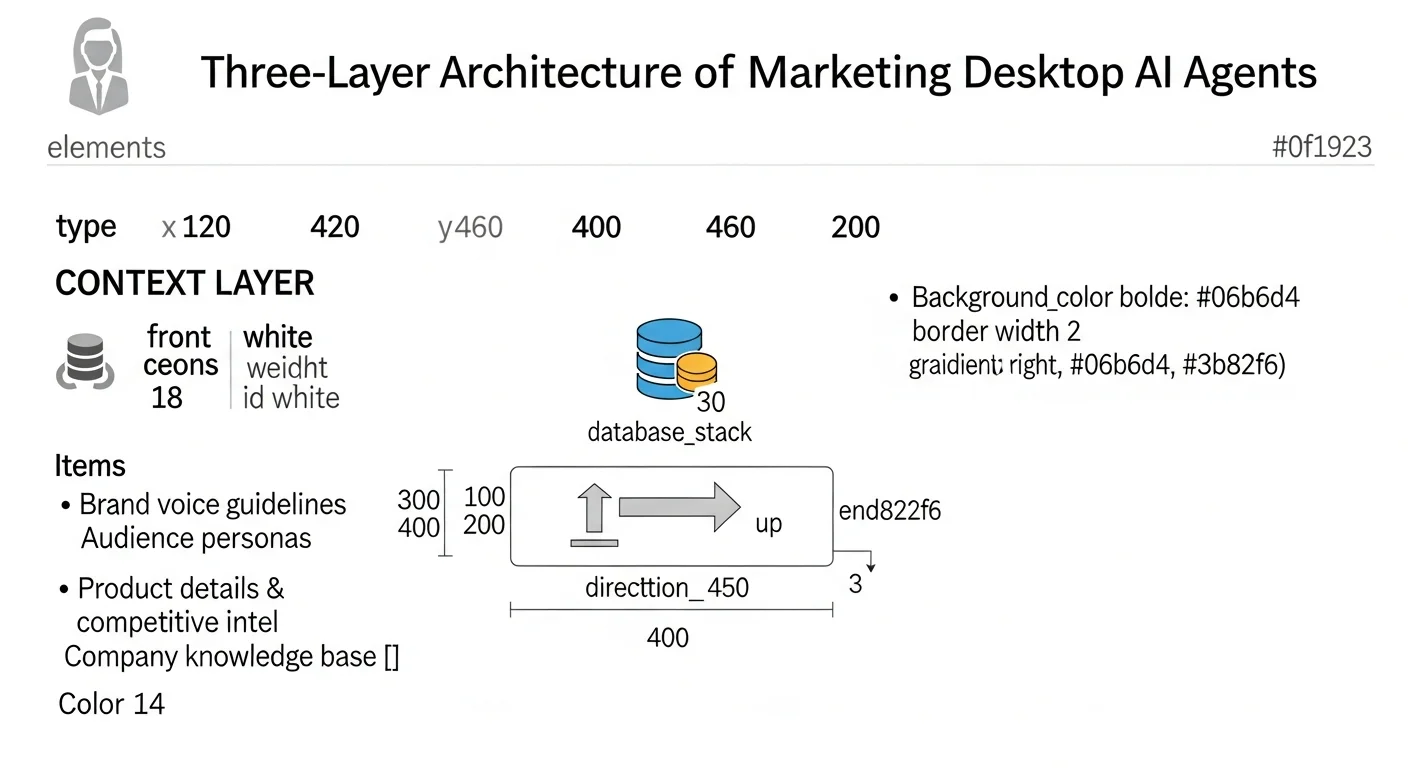
These local systems are typically built on a three-layer architecture:
- The context layer: A centralized repository of brand knowledge, voice guidelines, audience personas, and product details. This ensures the AI output actually sounds like the brand, rather than a generic machine.
- The skill layer: A library of reusable instructions and prompt frameworks that tell the system exactly how to execute specific tasks, such as designing an ad creative or formatting an SEO blog post.
- The orchestration layer: The desktop AI application itself, connected to external tools via the Model Context Protocol (MCP), reading inputs from local files, running the right skills, and pushing out finished content.
Remarkably, marketers are controlling these sophisticated multi-agent systems using nothing more than local project folders, a master system prompt file, and a standard spreadsheet acting as a command center.
High-ROI workflows driving desktop AI adoption
Operations leaders must recognize that marketers are adopting these local systems because the return on investment is undeniable. The speed and scale achieved through desktop orchestration are staggering.
Automated content repurposing
Content repurposing is widely considered the highest ROI task in marketing because it extracts more value from existing assets. Using parallel sub-agents, a user can point their desktop AI at a folder containing three local blog posts and immediately generate nine social media posts, six visual generation prompts, and multiple newsletter drafts. The AI automatically matches each output to the correct brand hook and post structure — all in a matter of seconds.
Ad creative scaling and variations
Ad creation traditionally requires a creative brief, visual directions, and extensive manual design work. In these new desktop systems, the AI reads a spreadsheet containing campaign goals and target audiences, spins up parallel agents to write distinct creative briefs, and then utilizes visual generation MCPs to render dozens of ad variations. By referencing local product images as anchors, the system can generate 25 unique, stylized ad creatives across five different campaign themes in a single run.
Direct-to-CMS publishing pipelines
Perhaps the most advanced local workflow involves organic search content. Users are building systems that read standardized SEO content briefs, generate comprehensive blog drafts with formatted tables of contents and key takeaways, and even generate featured header images.
Using Python scripts and MCP integrations natively running on the desktop, the AI then pushes these drafts directly to a WordPress backend and logs the completion status in a Notion content calendar.
If your team is ready to harness this productivity power in a governed environment, explore Ability.ai's AI-powered marketing content automation — the same high-impact workflows, running on always-on, enterprise-grade infrastructure.
The critical flaw of local desktop execution
Looking at these capabilities, it is easy to see why marketing teams are eagerly adopting desktop AI. However, beneath the surface of this productivity boom lies a fragile, ungoverned architecture that cannot scale at the enterprise level.
There is one critical constraint that exposes the fatal flaw of these systems: scheduled automation tasks will only run while the user's desktop application remains open.
If a marketer builds a brilliant pipeline to generate and publish carousel posts every Friday morning, that system entirely depends on their laptop being powered on, connected to the internet, and running the specific desktop application. If the employee goes on vacation, their laptop goes to sleep, or the application crashes, the entire marketing automation engine grinds to a halt.
This is the definition of operational fragility. You cannot build a resilient company infrastructure on the back of an individual employee's local hardware.
The shadow AI governance crisis
Beyond the physical limitations of desktop scheduling, these local workflows introduce severe security and data sovereignty risks.
To make these systems work, users are storing critical company IP — brand strategies, competitive intelligence, and customer data — in fragmented local folders. More alarmingly, to achieve direct-to-CMS publishing, marketers are keeping unmanaged API keys for platforms like Notion and WordPress directly on their local machines. They are running locally stored Python scripts to bridge the gap between their desktop AI and the company's live production environments.
This creates a decentralized web of ungoverned access points. If an employee leaves the company, their intricate web of prompts, scripts, and API connections leaves with them. There is no central observability, no audit trail of what the AI is pushing to the company website, and no way for IT to revoke access to these hidden automated pipelines.
For a broader view of how this governance gap is growing across organizations, read our analysis of desktop AI agents: the new productivity boom or governance crisis.
Upgrading to sovereign, always-on AI infrastructure
At Ability.ai, we view this current state of desktop AI as an inevitable, but temporary, phase of enterprise adoption. The workflows themselves — automated repurposing, ad scaling, and CMS publishing — are highly valuable. The problem is the deployment environment.
The strategic mandate for operations leaders is not to ban these tools, which would only drive the behavior further underground, but to provide a secure, enterprise-grade alternative. Companies must transition from fragile local experiments to governed, server-side AI agent systems.
By deploying Ability.ai's operations automation infrastructure, organizations can take the exact logic built by their marketing teams and elevate it to a resilient, always-on platform. A proper sovereign system operates entirely independent of local hardware. It runs 24/7 in a secure cloud environment. It features centralized API management, meaning credentials for WordPress or Notion are securely vaulted rather than sitting on a marketer's hard drive. Most importantly, it provides observable logic — a clear, auditable trail of exactly what data the agent accessed, what decisions it made, and what actions it took.
Strategic takeaways for operations leaders
As AI continues to blur the lines between strategic ideation and technical execution, operations leaders must take a proactive stance on how these systems are deployed within their organizations.
Audit your local AI footprint Have transparent conversations with your marketing and growth teams. Find out exactly what workflows they are running locally, what Python scripts they are executing, and what API keys are sitting on their local machines. You will likely be surprised by the sophistication — and the risk — of what is already operating in the shadows.
Standardize the architecture Embrace the three-layer architecture — context, skills, and orchestration — but move it to a centralized, shared environment. Brand context and prompt skills should be accessible enterprise assets, not isolated files living on one person's desktop.
Implement server-side orchestration If a workflow provides recurring business value, it must be decoupled from individual hardware. Transition high-value pipelines from desktop applications to always-on, governed infrastructure that guarantees uptime and consistent execution.
The future of operational efficiency relies on multi-agent systems. The companies that win will be those that successfully capture the ingenuity of their teams' desktop experiments and scale them into secure, sovereign AI operations. Understanding what AI governance leadership actually looks like is the critical next step for every operations executive.