

AI skill engineering is the practice of building permanent, self-learning agent workflows that autonomously execute complex business processes from a single command. Unlike prompt engineering — which produces one-time outputs — skill engineering creates reusable automations that improve with every execution, reducing hours of manual work to seconds.
We are witnessing a massive transition in how knowledge work is executed. Rather than treating AI as a highly capable typewriter that requires constant manual prompting, sophisticated teams are using desktop agent frameworks like Claude to build permanent, reusable automations known as "skills."
While this represents a massive leap in productivity, it also introduces profound new challenges for operational leaders. When employees start building complex, interconnected agent workflows on their local machines, it fundamentally changes how work is done — and how business data is governed.
Here is a comprehensive look at how AI skill engineering is reshaping marketing and operational workflows, and what leaders must understand to transition these fragmented experiments into reliable, governed systems.
The shift from prompt engineering to AI skill engineering
Prompt engineering was about getting a good output once. AI skill engineering is about onboarding an "intelligent intern" once, ensuring a specific process is permanently delegated and automated.
Building an effective AI skill requires a software engineering mindset applied to natural language. The most effective methodology is not to simply ask the AI to build an automation from scratch. Instead, operators manually map out a complex process alongside the AI step-by-step, correcting it along the way. Once the perfect output is achieved, the AI is instructed to reverse-engineer that entire session into a permanent, repeatable skill.
This fundamentally changes the ROI of AI usage. An operator might spend an hour meticulously crafting a workflow — complete with data scraping, analysis, and formatting — but once saved as a skill, that exact workflow can be executed indefinitely with a single command. This is the core principle behind scalable operations automation — building once, running forever.
The anatomy of a self-learning agent
A high-functioning AI agent does not rely on a single, massive prompt. It relies on a carefully architected ecosystem of reference documents. Research into high-performing marketing agents reveals that producing truly brand-aligned outputs requires up to seven distinct context files, including:
- Ideal Customer Profile (ICP) documentation
- Voice and personality guidelines
- Brand visual guidelines (hex codes, styling rules)
- Personal or company background documents
- Specific writing frameworks and examples
- Business offering and call-to-action details
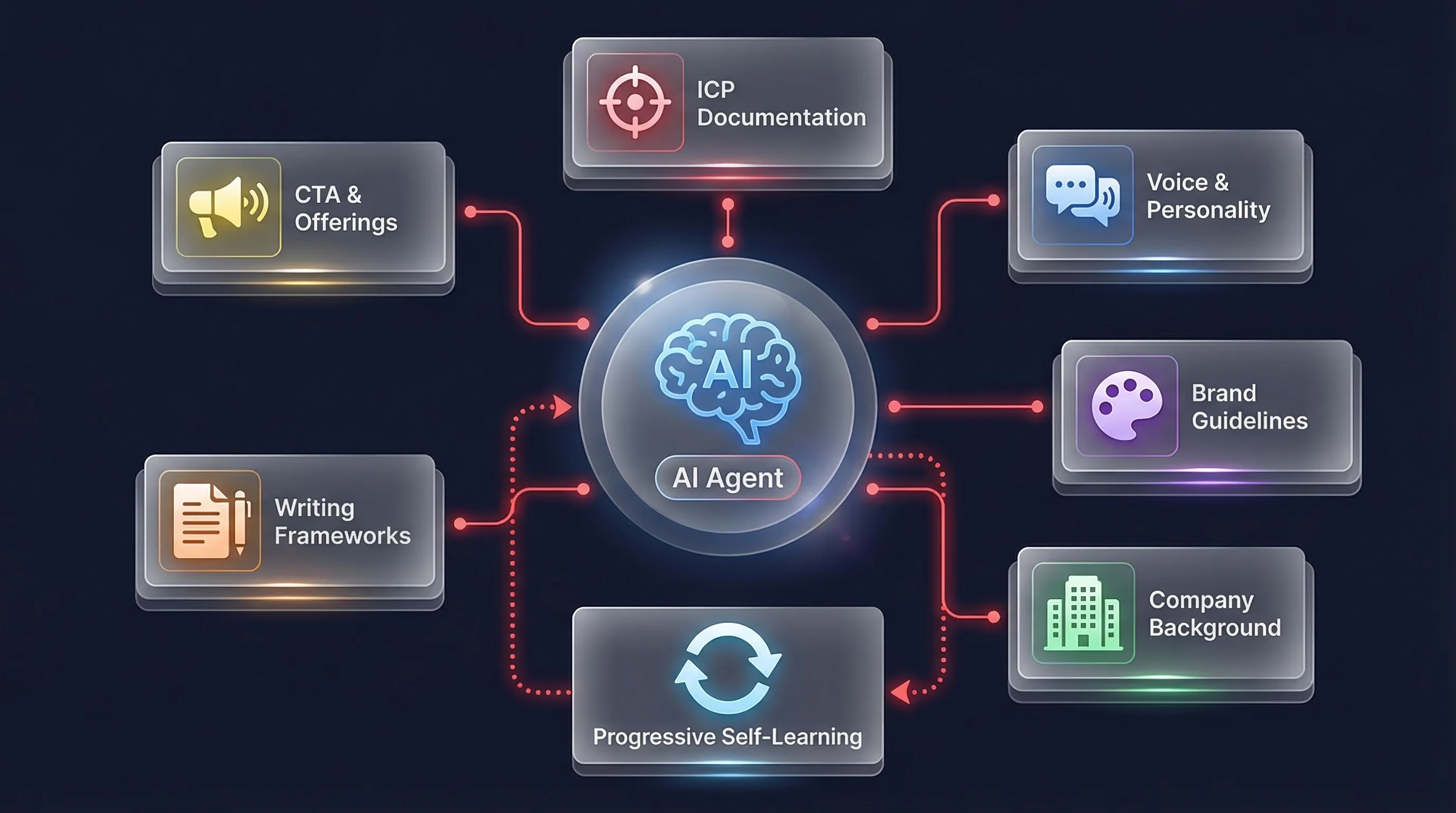
When a skill is invoked, the agent is hard-coded to sequentially read these reference files before it generates a single word. For example, when tasked with writing a newsletter, the agent cross-references the ICP document with the voice guidelines, ensuring it uses specific signature phrases and ends with a contextually aware call-to-action.
The true breakthrough in skill engineering, however, is the implementation of "progressive updating." Advanced skills are programmed with self-learning mechanisms. If a human operator reviews an agent's output and says, "These subject lines are too long, keep them between three to eight words," a progressively updated agent doesn't just apologize and rewrite the current batch. It actually opens its own underlying instruction file, writes a new rule about subject line length, and saves it. The agent permanently learns from the correction, ensuring the mistake is never repeated in future executions.
For a practical walkthrough of building and organizing these reusable skills at scale, see our Claude skills guide: building scalable agent workflows.
Connecting the dots: MCPs and API integrations
An AI agent isolated in a chat window has limited utility. The operational unlock happens when these skills are connected to the outside world via Model Context Protocol (MCP) integrations.
MCPs act as the nervous system for desktop AI agents, allowing them to autonomously operate external software, scrape data, and generate rich media. Two critical use cases demonstrate this capability:
Data extraction: Native AI models cannot easily watch a YouTube video or read a dynamic LinkedIn feed. By integrating scraping tools like Apify via MCP, an agent can be commanded to autonomously navigate to a specific URL, bypass scraping protections, extract the full raw transcript or social feed, and pull it back into the local environment for analysis.
Visual asset generation: While text models cannot natively generate high-quality PNGs or vector graphics, MCPs bridge this gap. An agent can be connected to external image models via API keys. The agent reads the company's brand guidelines, calculates the exact prompt required to match the corporate aesthetic, and autonomously commands the external image model to render infographics, charts, or social media assets.
Commands, scheduling, and autonomous execution
As organizations mature in their AI adoption, individual skills are increasingly being bundled into complex, multi-step "commands."
A command acts as an orchestrator. For example, a single "repurpose" command can be engineered to trigger four distinct skills simultaneously. When a user inputs a single video link, the command directs the agent to scrape the transcript, trigger a newsletter writing skill, trigger a LinkedIn post writing skill, format a presentation, and generate a brand-aligned graphic — entirely in parallel.
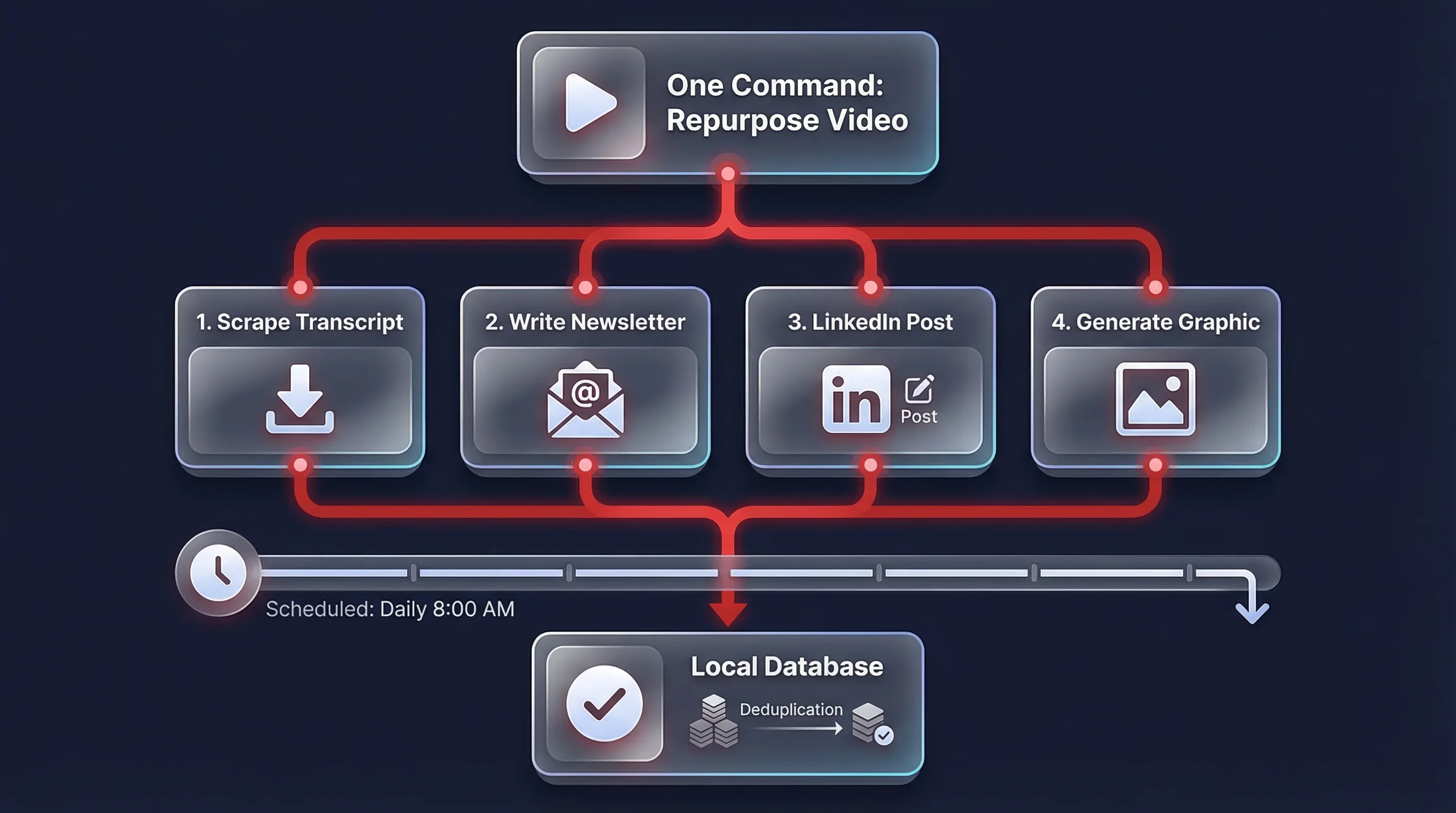
Furthermore, these commands are no longer waiting for human activation. Desktop agents now feature localized task scheduling. An agent can be scheduled to wake up daily at 8:00 AM, scrape specific competitor blogs or news sites, evaluate the new content against the company's ICP, and generate an HTML dashboard of actionable insights before the marketing team logs on.
To prevent the agent from duplicating work during these daily runs, operators are instructing agents to build and manage their own local databases. The agent creates a localized CSV file, logging every URL it has ever processed, the date of execution, and its qualification status. Before running its daily web scrape, the agent consults its own database to ensure it only processes net-new information.
The hidden governance crisis of desktop AI
While the capabilities of AI skill engineering are undeniably powerful, they reveal a massive, looming crisis for mid-market operations leaders. The workflows described above are brilliant, but they are currently being built and executed entirely on individual employees' local desktop environments.
This localized approach to agentic AI creates immediate operational and security risks:
Data sovereignty and shadow IT: Employees are feeding proprietary corporate strategy documents, customer profiles, and financial analytics directly into local desktop clients. They are independently connecting third-party scrapers to their machines and hard-coding personal API keys to generate assets. This completely bypasses corporate IT governance and security protocols.
Fragile, siloed infrastructure: When an employee builds a complex web of self-learning skills, localized CSV databases, and chained commands on their laptop, that automation is tied exclusively to that individual. If the employee leaves the company, or if their machine crashes, the entire automated workflow dies with them. There is no central repository, no version control, and no observable logic for leadership to audit.
Cost and rate limit blindness: When multiple employees set up autonomous, scheduled agents that scrape the web and ping external APIs every morning, operations leaders have zero visibility into the computational costs being racked up in the background.
Understanding why autonomous agents require governed local infrastructure is the first step toward moving beyond these risks and building systems your whole organization can rely on.
From fragmented experiments to governed systems
The insights from the bleeding edge of AI skill engineering prove that autonomous, multi-step agents are no longer theoretical — they are actively running marketing and analytics workflows today. However, the path forward for scaling companies is not to encourage a wild west of desktop automations.
For businesses to truly harness this power, these workflows must be lifted out of the local desktop environment and deployed into governed agent infrastructure. Operations leaders need centralized systems where agent logic is observable, where progressive updates and self-learning rules can be audited, and where data sovereignty is guaranteed.
The future belongs to organizations that can take the ingenuity of AI skill engineering and wrap it in the security, reliability, and governance of an enterprise-grade operational system. By transforming fragmented AI experiments into reliable operational infrastructure, companies can achieve the scale and efficiency promised by AI — without compromising their security or operational stability. See how one team made this transition in our AI content system case study, where skill engineering cut content production time by 80%.