
Inbox AI agents are AI workers assigned unique email addresses that receive forwarded messages, execute tasks autonomously, and reply with completed work — without requiring executives to leave their inbox. Unlike chat interfaces that demand context-switching and prompting, inbox agents mirror natural delegation: forward an email with a brief instruction, and the agent handles the rest. This architecture meets operations leaders where they already spend two to three hours a day.
By assigning unique email addresses to specific AI agents, organizations can transform the inbox from a communication clutter bucket into a command center for autonomous work. This shift represents a move away from "chatting with data" toward true operational delegation. However, implementing this architecture requires navigating the tension between productivity and data sovereignty.
The failure of chat-based delegation
For the past two years, the primary interface for AI has been the chat box. Whether it's ChatGPT, Claude, or Gemini, the workflow remains identical: switch tabs, copy context, paste context, write a prompt, wait for generation, and refine. For a mid-market CEO or VP of Operations, this is not delegation; it is micromanagement via text box.
Major tech conglomerates have attempted to solve this by integrating AI directly into their suites. OpenAI has Gmail connectors; Google has Gemini sidebar integration; Claude has "projects." Yet, these solutions share a common flaw: they are "bolted on" to the inbox. They are read-only assistants that require the user to initiate a chat session alongside their email. They do not function as independent workers.
True delegation requires an agent to possess identity and agency. In a traditional human workflow, you do not paste an email into a separate chat window to ask an employee to handle it. You forward the email with a brief instruction. The emerging "Mail Manus" pattern — assigning a bespoke email address to a specific AI agent — replicates this exact human behavior. It transforms the AI from a tool you use into a worker you message.
How inbox AI agents transform workflows
The mechanics of an inbox AI agent are deceptively simple but operationally profound. Instead of a generalist assistant, you configure specialized agents for distinct roles — a "Deal Flow Agent," a "Competitive Intelligence Agent," or a "Content Strategist Agent." Each possesses a unique email address.
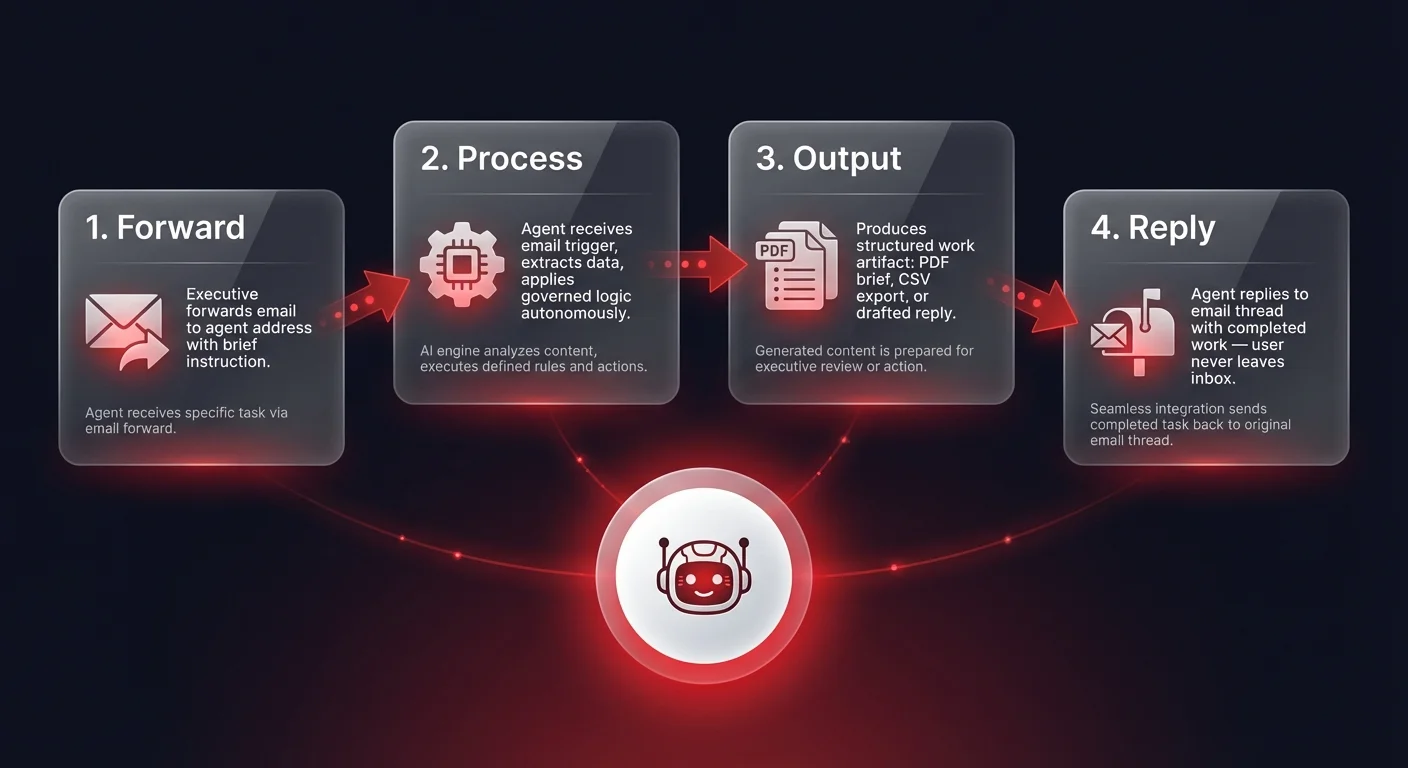
When a relevant email hits your inbox, you forward it to the specific agent. The agent receives the email as a trigger, processes the content according to its governed logic, and — crucially — replies to the thread with the completed work. The user never leaves their email client. There is no login, no prompt engineering, and no context switching.
Use case: automated competitive intelligence
Consider the workflow of a marketing leader or COO tracking market shifts. Typically, when a stakeholder spots a competitor's press release or product launch, they forward it with a note: "Did you see this?" The recipient then has to read, analyze, and manually summarize the impact.
With an inbox agent architecture, this process changes:
- The Trigger: You forward the competitor's announcement email to
analysis-bot@yourdomain.com. - The Process: The agent extracts key product announcements, pricing changes, and messaging shifts. It compares these data points against your internal positioning documents.
- The Output: The agent replies to your email with a one-page PDF brief attached, summarizing the threat level and recommending specific actions for the product team.
This turns a passive "FYI" email into an active intelligence product without the executive typing more than the agent's email address.
Use case: zero-touch content operations
The utility of inbox agents scales significantly when combined with standard email automation rules. Most executives subscribe to dozens of industry newsletters to stay informed, but rarely have time to process them all.
By setting up a Gmail or Outlook filter, you can auto-forward specific newsletter subscriptions directly to a "Content Repurposing Agent." The agent reads the newsletter, extracts "spicy takes," data nuggets, or contrarian viewpoints, and formats them into a list of potential social media posts or internal memos.
In this scenario, the human is removed from the loop entirely until the final review. The agent monitors the inbound flow of information and presents only the synthesized value. This is the difference between having an assistant and having a system.
The sovereign data risk
While tools like Mail Manus demonstrate the power of this UX, they introduce a critical governance flaw for enterprise operations: data leakage.
When an executive forwards an email regarding a confidential investment opportunity ("Deal Flow") or sensitive competitor strategy to a third-party AI SaaS, that data leaves the company's secure perimeter. It is processed on external servers, potentially trained upon, and stored outside the organization's virtual private cloud (VPC).
This presents a Shadow AI crisis. The utility of the inbox agent is so high that employees will inevitably use these tools, bypassing IT security protocols to get work done faster. For a company generating $50M+ in revenue, forwarding M&A data or proprietary strategy to a startup's black-box agent is an unacceptable risk. We've written a deeper analysis of how this pattern escalates in our post on shadow AI risks for operations managers.
Building governed inbox AI infrastructure
To capture the efficiency of inbox agents without sacrificing security, operations leaders must look toward sovereign architecture. The goal is to replicate the "forward-to-agent" workflow using internal infrastructure.
This is achievable by connecting governed orchestration platforms (like n8n or proprietary agent frameworks) directly to your enterprise mail server (Microsoft Graph API or Gmail API). For a broader look at the governance challenges organizations face when deploying agent systems at scale, see our guide on agentic AI risks and governance challenges.
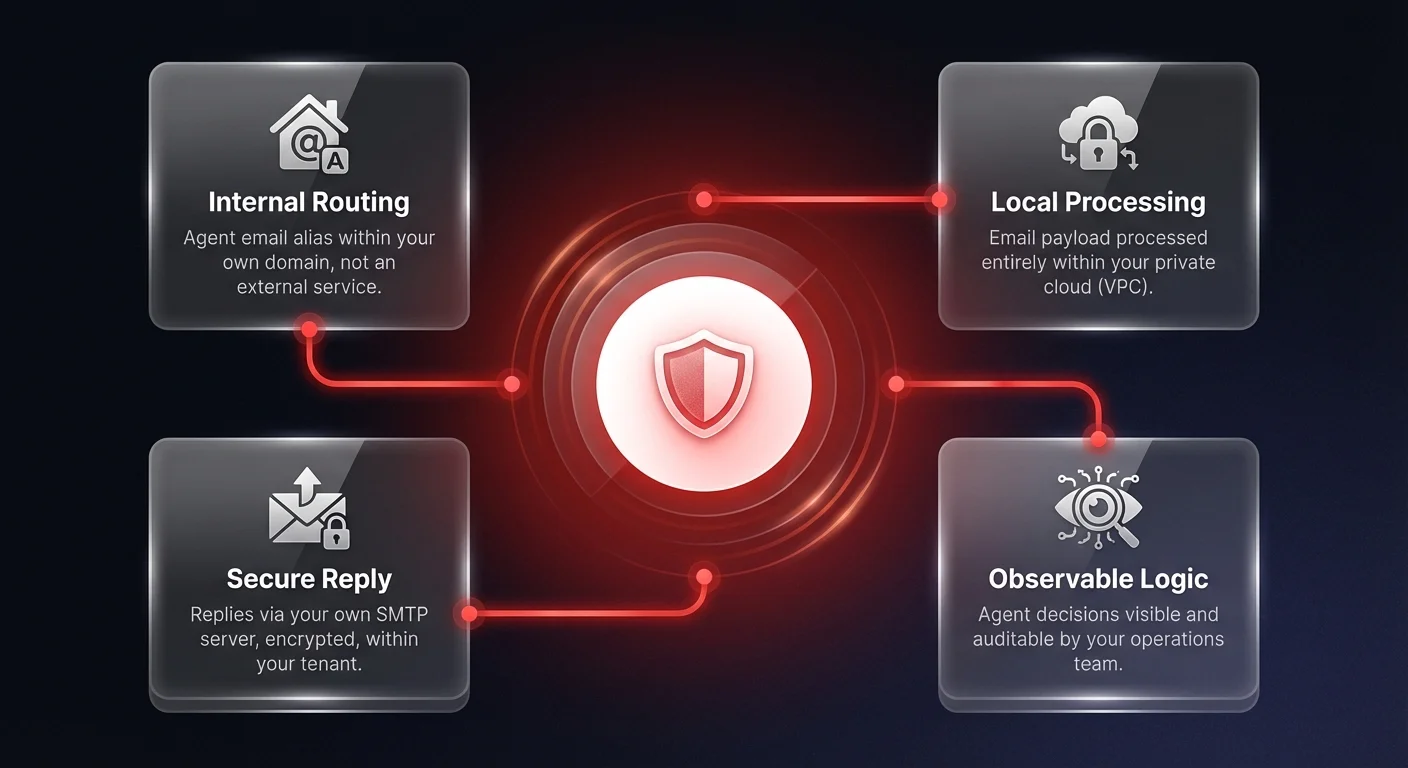
The architecture of a sovereign inbox agent
- Internal Routing: The agent's email address is an alias within your own domain, not an external service.
- Local Processing: When an email is received, the payload is processed within your private cloud environment.
- Observable Logic: Unlike a black-box SaaS, the logic determining how the agent analyzes the email is visible and auditable by your internal operations team.
- Secure Reply: The agent uses your own SMTP server to reply, ensuring the entire conversation loop remains encrypted and within your tenant.
Strategic implementation for operations leaders
For COOs and VPs of Operations looking to deploy this capability as part of a broader executive AI automation strategy, the focus should shift from "buying a tool" to "designing a workflow."
1. Audit the forwarded email: Look at your own sent folder. Identify the emails you forward most frequently with instructions like "handle this," "summarize this," or "add this to the tracker." These are your initial candidates for agent inputs.
2. Define the output format: Chat bots give you text blocks. Inbox agents should deliver work artifacts. Define whether you want the output as a PDF brief, a CSV file, or a drafted reply. The value of the agent is often defined by the structure of its output.
3. Establish the identity: Give the agents distinct internal email addresses (e.g., research@internal.ai or scheduling@internal.ai). This psychological distinction helps the team treat the AI as a specialist worker rather than a software feature.
4. Governance first: Before enabling these agents, establish the boundaries. What data classification levels are permitted to be forwarded? Ensure your architecture allows you to see exactly why an agent made a specific decision or summary.
The future of work is asynchronous
The obsession with real-time chat has obscured the reality of effective management: asynchronous delegation. Inbox agents restore this dynamic. They allow leaders to offload cognitive tasks without engaging in a synchronous back-and-forth session with a bot.
By integrating AI into the email protocol — the backbone of business communication — organizations can achieve high adoption rates that dashboard-based tools effectively never reach. The technology to build a team of AI specialists that live in your inbox exists today. The challenge is no longer capability; it is ensuring that when your team forwards that email, the data remains yours.