
Autonomous marketing agents are AI systems that independently research competitors, produce ad creative, execute campaigns, and iterate based on performance data — all without manual production workflows. The primary bottleneck for scaling revenue in 2026 is no longer media buying or audience targeting: it is creative velocity. Sophisticated agent architectures are democratizing capabilities once reserved for Nike-scale budgets, allowing lean operations teams to produce and test thousands of ad variations in minutes rather than weeks.
At Ability AI, we see this shift as a critical evolution in how businesses must think about AI implementation. We are moving away from the "copilot" era, where a human clicks a button to generate one image, toward the "agent" era, where a human assigns a broad outcome — such as "market my mobile app against these competitors" — and the system autonomously handles research, strategy, production, and analysis.
How autonomous marketing agents replace traditional tools
For the past few years, marketing teams have utilized AI primarily as a toolset. A designer might use generative fill to expand an image, or a copywriter might use an LLM to brainstorm headlines. While helpful, this workflow still requires significant human manual labor to stitch the pieces together. The human remains the bottleneck in the production line.
The new generation of autonomous marketing agents operates differently. Platforms like Superscale are demonstrating that agents can function as digital employees rather than passive software. When tasked with a campaign, these agents execute a multi-step workflow that mirrors human cognition:
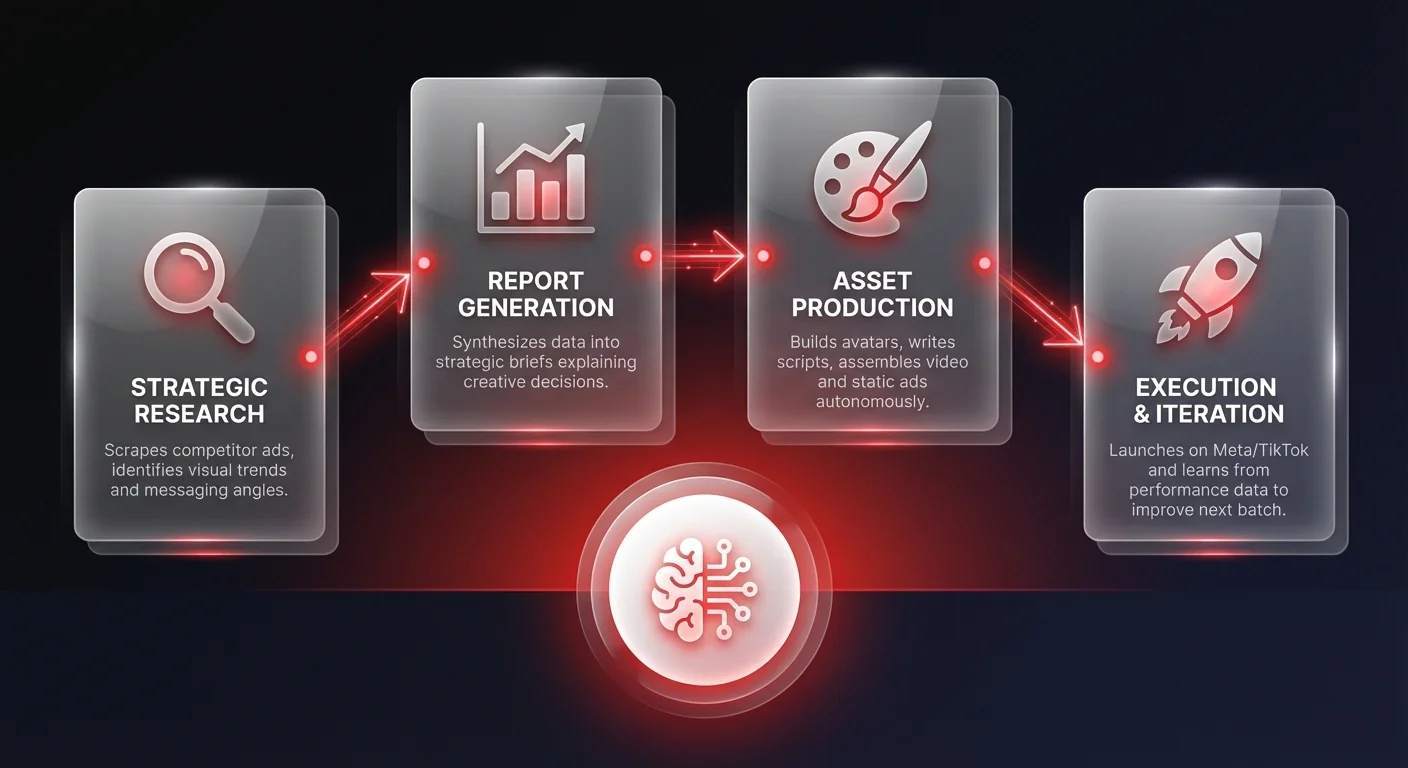
- Strategic research: The agent scrapes the web to analyze competitor ads, identifying visual trends and messaging angles.
- Report generation: It synthesizes this data into a strategic report, explaining why certain creative decisions should be made.
- Asset production: It autonomously builds the assets — generating avatars, writing scripts, selecting footage, and assembling video or static ads.
- Execution and iteration: It prepares the ads for platforms like Meta or TikTok and, crucially, learns from the performance data to inform the next batch.
For operations leaders, this distinction is vital. You are no longer purchasing software seats for productivity; you are deploying infrastructure that performs labor — the same model behind AI marketing content automation that scales output without scaling headcount. This requires a shift in mindset from "how do I use this tool?" to "how do I manage this workforce?" For a closer look at how this team structure evolves, see our guide on building an AI marketing team architecture.
The video arbitrage opportunity
One of the most immediate operational impacts of autonomous agents is the ability to exploit price arbitrage in video advertising channels. Historically, text and image-based channels like Google Search have been expensive because the barrier to entry is low — any business can write a text ad. Consequently, competition is fierce, and customer acquisition costs (CAC) are high.
Video channels like TikTok, Instagram Reels, and YouTube Shorts have maintained lower costs per impression because high-quality video production is significantly harder. Producing a compelling video ad typically requires actors, cameras, lighting, editing, and weeks of lead time. This friction kept smaller competitors out of the market.
Autonomous agents remove this friction entirely. Innovative workflows allow companies to utilize AI-generated avatars that serve as the persistent "face" of the brand. These digital actors can speak multiple languages, express emotion, and deliver scripts without a single camera being turned on. By generating video assets at scale — potentially 1,000 ads in 10 minutes — companies can flood these lower-cost channels with high-quality creative, effectively competing with enterprise budgets on a fraction of the spend. This is precisely why many forward-thinking teams are now building a video-first content automation strategy alongside their agent deployments.
The confidence score: a framework for agent governance
The most critical insight for operations leaders implementing these systems is that autonomous agents are not magic boxes — they require "onboarding" just like human employees. If you hire a brilliant junior marketer but give them zero context about your brand voice, color palette, or value proposition, they will fail. AI agents are no different.
Leading agent platforms are now quantifying this process through a "confidence score" or "agent score" — a metric that indicates how well-trained the agent is on your specific business context.
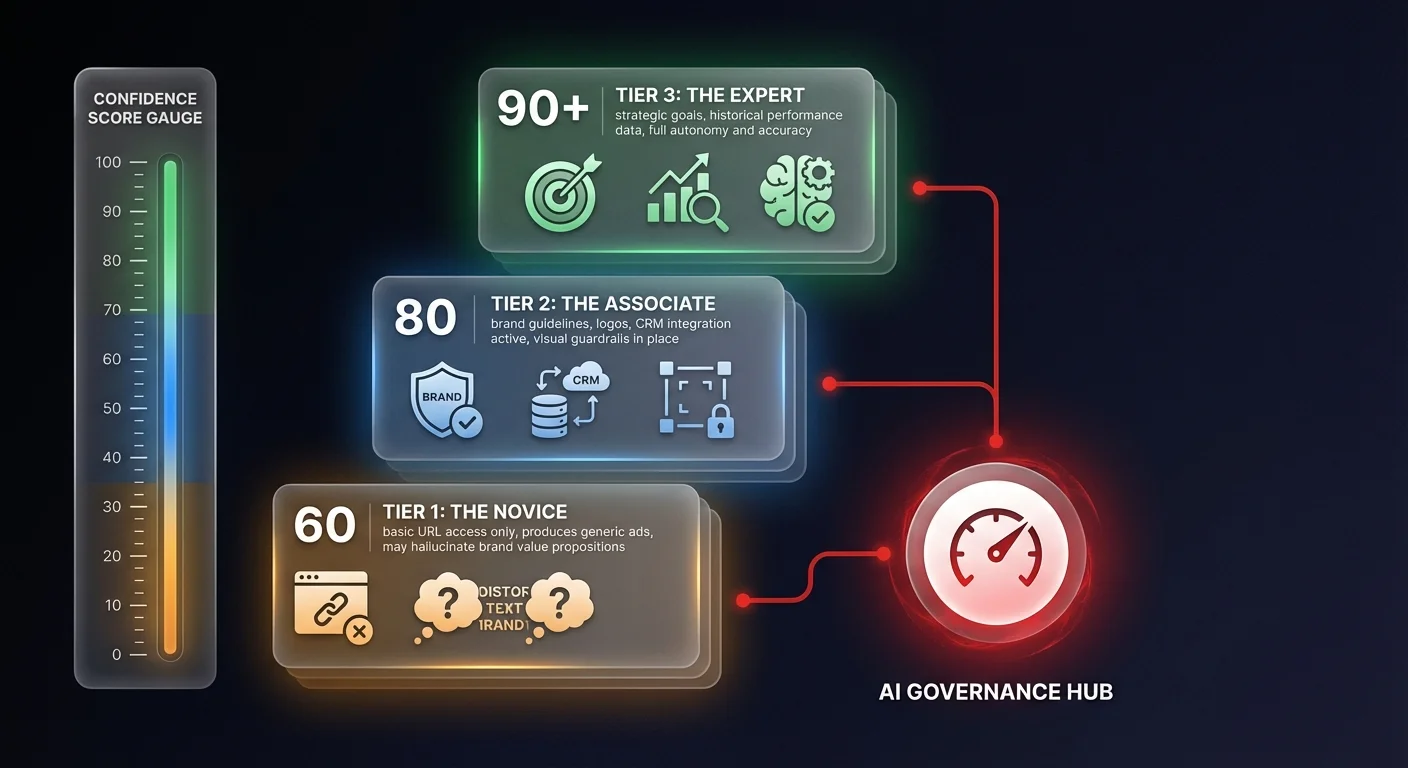
- Score 60 (The Novice): The agent has basic access to your URL. It can make generic ads, but they may feel off-brand or hallucinate value propositions.
- Score 80 (The Associate): You have uploaded brand guidelines, hex codes, logos, and product catalogs via Shopify or CRM integration. The agent now acts within visual guardrails.
- Score 90+ (The Expert): You have provided deep context — strategic goals, specific "do not use" phrases, historical performance data, and nuanced persona details. The agent now operates with a high degree of autonomy and accuracy.
This framework validates the necessity of data sovereignty and governed infrastructure. The competitive advantage is no longer the AI model itself (which is a commodity); it is the proprietary context and data you feed the agent. Companies that build robust "onboarding" pipelines for their agents — ensuring they have real-time access to inventory, brand assets, and performance data — will achieve significantly higher ROI than those treating the agent as a generic tool.
Recursive improvement loops
The true power of an autonomous marketing system lies in its ability to close the loop. A human marketer might run a test, wait a week for data, analyze a spreadsheet, and then brief a designer for new iterations. This cycle is slow and lossy.
An integrated agent system collapses this loop. It connects directly to ad platforms to ingest performance data. If it sees that "Variation B" with the blue background and the humorous hook is outperforming "Variation A," it doesn't just report that fact — it acts on it. The agent can recursively generate 50 new variations based on the winning elements of "Variation B," launching them into the market while the human team is sleeping.
This capability transforms the marketing function from a series of linear campaigns into a continuous, evolving engine. It enables "loop marketing" where the phases of creation, personalization, distribution, and evolution happen simultaneously and continuously.
Operationalizing the creative workforce
For COOs and VPs of Operations, the rise of creative agents necessitates a restructuring of the marketing org chart. The fear that "AI will replace marketers" is misplaced. Instead, it elevates the marketer's role from production to orchestration.
In this new model, a paid media manager is no longer tweaking bid caps or resizing images. They become the "manager" of a team of AI agents. Their daily workflow shifts to:
- Auditing the agent's logic: Reviewing the "confidence score" and ensuring the agent interprets brand guidelines correctly.
- Strategy and hypothesis: Defining the broad angles the agent should explore (e.g., "Test a fear-of-missing-out angle for our winter sale").
- Performance governance: Monitoring the recursive loops to ensure the agent isn't optimizing for vanity metrics that hurt long-term brand equity.
This shift allows a single talented marketer to do the work of a 20-person agency. However, it also introduces new risks. Without proper governance, an agent could hallucinate offers, violate brand safety standards, or burn budget on low-quality loops. Before deploying at scale, it is worth understanding the risks of automated AI marketing that can undermine even well-designed systems.
Conclusion: velocity through infrastructure
The promise of autonomous marketing agents is not just about saving $50 on a freelancer bill — it is about speed. In an algorithm-driven economy, the company that learns the fastest wins. By deploying agents that can research, build, and iterate at software speeds, businesses can compress years of learning into months.
However, success requires more than just signing up for a tool. It requires an operational commitment to building the infrastructure — the data pipelines, the brand guardrails, and the strategic context — that allows these agents to function safely and effectively, as documented in our AI content system case study. The future belongs to brands that treat their AI agents not as software to be used, but as a workforce to be led.