
An AI adoption strategy is a structured plan for redesigning business operations around artificial intelligence — not simply purchasing AI tools. According to McKinsey, 70% of companies report AI initiatives falling short of expected ROI, a direct consequence of bolting new technology onto legacy workflows rather than redesigning the operational foundation.
When executives sit down to map out their AI adoption strategy, they almost universally focus on the technology itself. They evaluate models, compare context windows, and purchase enterprise licenses for their workforce. Yet, despite massive investments, the promised productivity explosion remains elusive for most mid-market and scaling companies.
To understand why this happens — and how to fix it — we must look backward. AI is frequently compared to electricity as a fundamental, general-purpose technology. But the most valuable lesson from electricity isn't about the invention itself; it is about how long it took businesses to actually benefit from it.
The defining challenge of the coming decade will not be AI model capabilities. It will be the willingness of leaders to completely redesign their operational blueprint.
The electricity paradox: why AI adoption strategy mirrors 1800s factories
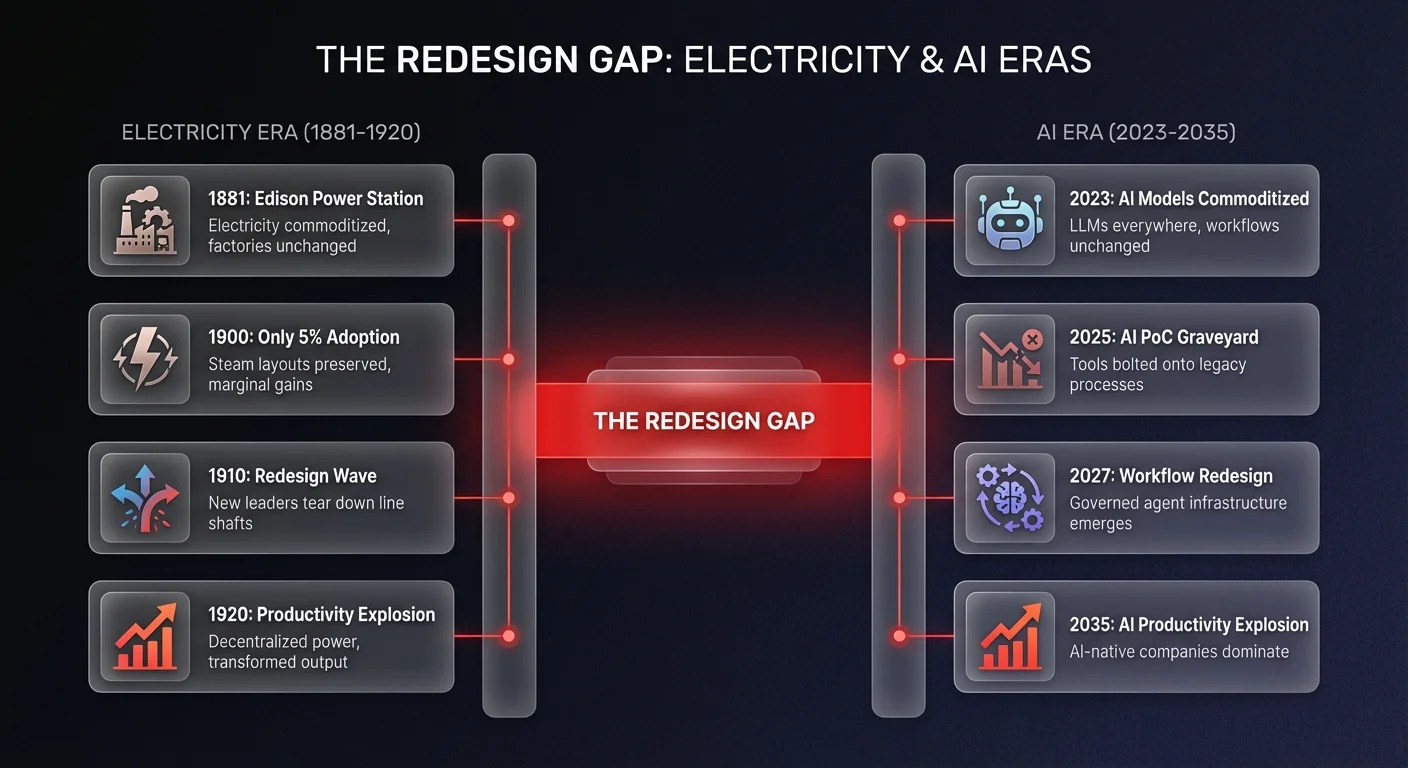
In 1881, Thomas Edison built the first electricity generating stations. Within a single year, electricity was being sold as a widely available commodity. It was a miracle technology that promised to revolutionize industrial production.
Yet, the data reveals a startling reality. By 1900 — nearly two decades after electricity was commoditized — less than 5% of mechanical drive power in American factories came from electric motors. The greatest technological leap in human history had stalled at the factory doors.
Why did adoption lag so severely? The answer lies in the factory layouts.
Before electricity, factories were powered by massive centralized steam engines. Because steam power had to be distributed physically, machines were arranged in dense, dangerous configurations around a central line shaft system of belts and pulleys. When factory owners finally bought electric motors, they simply removed the central steam engine and dropped an electric motor into the exact same spot.
They kept their old layouts. They bolted the new technology onto their legacy workflows. As a result, they saw only marginal improvements in efficiency.
The true productivity explosion of electricity only happened when a new generation of leaders decided to redesign the factory floor itself. They realized that electricity allowed for decentralized power. They could put small electric motors on individual machines, space them out logically based on the flow of materials, improve lighting, and reorganize the entire human workforce.
Only when factories were redesigned around the unique properties of electricity did the productivity gains materialize. The lesson for your AI adoption strategy is identical.
Why legacy workflows choke modern AI investments
Today's business landscape is repeating the exact same mistake. We are stuck in the late 1800s of the AI revolution.
Foundational models like those from OpenAI, Anthropic, and Google are the modern electricity. They have been rapidly commoditized and distributed. Business leaders recognize the power, so they buy the subscriptions and hand the tools to their teams.
But the underlying "factory floor" — your company's team structure, skill sets, and operational workflows — remains completely unchanged.
We are taking highly advanced intelligence and dropping it into legacy, siloed processes. We expect a revolution, but we are just replacing the steam engine with an electric motor while keeping the restrictive line shafts intact.
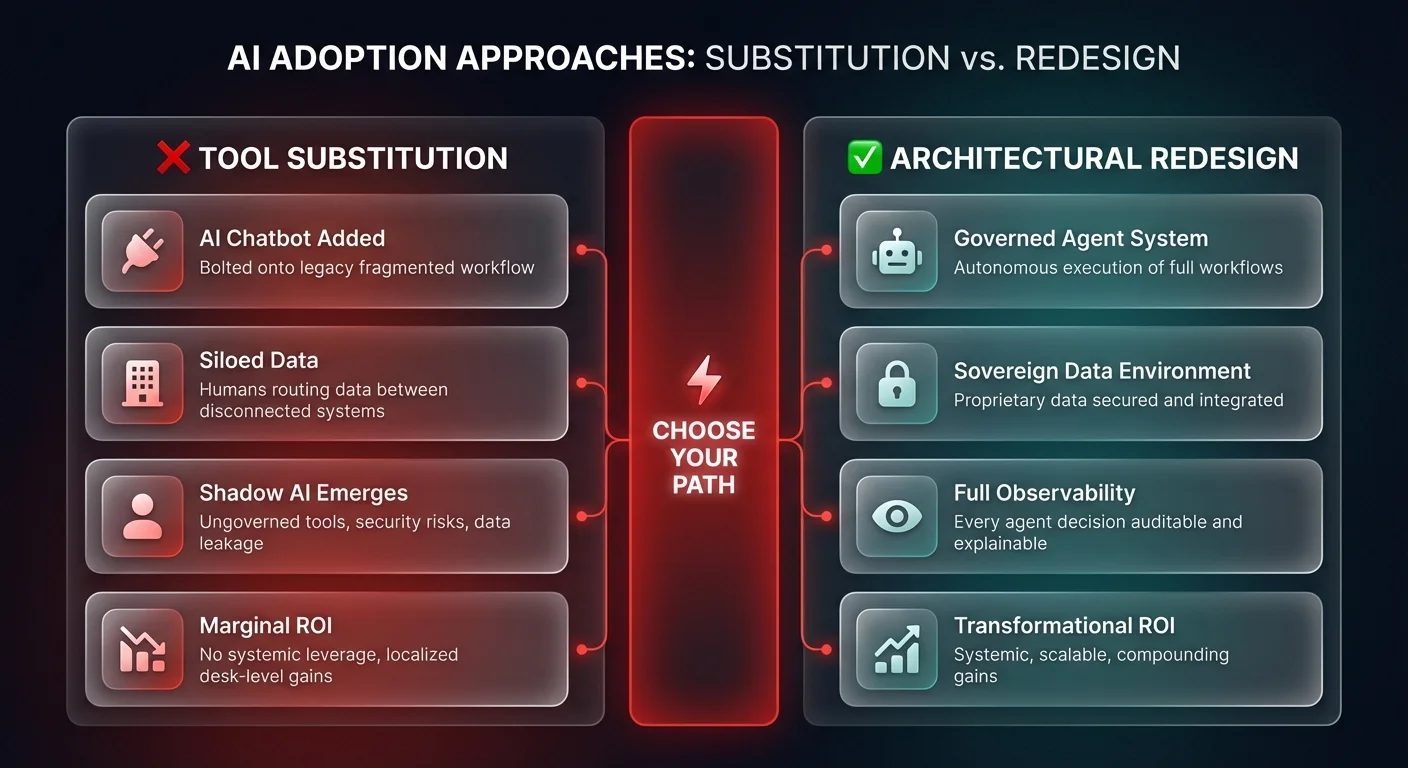
Consider the typical corporate workflow today. It relies on humans acting as routers — pulling data from a CRM, copying it into a spreadsheet, analyzing it, and drafting an email in another tab. Giving a human worker an AI chatbot makes drafting that email slightly faster, but it does not fix the fragmented, disjointed process. The fundamental architecture of the work is still bound by legacy software limitations and human bottlenecks.
This is precisely why the AI PoC graveyard is so full — pilot programs show promise, but fail to scale because the underlying operational infrastructure was never redesigned.
The shadow AI trap: plugging into a broken factory floor
When you introduce a powerful new commodity without providing a governed architecture, chaos ensues. In the 1800s, poorly wired factories faced catastrophic electrical fires. Today, ungoverned AI adoption creates a modern equivalent — shadow AI.
Because the core business systems have not been redesigned around AI natively, employees try to bridge the gap themselves. They feed sensitive customer data into consumer-grade models to summarize meetings. They use unvetted tools to speed up their individual tasks. They wire up their own operational desks in the dark.
This creates massive security risks, operational complexity, and data silos. More importantly, it provides zero systemic leverage to the organization. When an employee builds a clever prompt to process vendor invoices faster, that efficiency is localized to their desk. It is not an organizational capability.
The shadow AI governance crisis is a direct consequence of inadequate AI adoption strategy — organizations that skip the architectural redesign phase invariably end up managing ungoverned AI sprawl.
Overcoming this requires a shift from fragmented AI experiments to reliable, governed operational systems. Leaders must stop buying disconnected tools and start building a new infrastructure.
Redesigning your operational blueprint
Becoming an AI native company means redesigning the enterprise architecture around what the technology makes possible. The actual bottleneck to ROI is organizational redesign, not the capabilities of the AI models.
This redesign requires a shift in how we think about work, human capital, and digital systems.
Reimagining team structures and skill sets
In the AI native company, human workers will no longer be the connective tissue between software applications. The skill sets required will shift from manual data manipulation to system management and strategic oversight.
Instead of teams structured by their functional software usage — like a "CRM management team" — teams will be structured around business outcomes. The operational leaders of the future will manage highly capable digital agents that execute the manual processes, while the human staff focuses on exception handling, strategic relationship building, and continuous workflow improvement.
Transitioning to governed agent infrastructure
Redesigning the factory floor means moving away from conversational AI tools and toward governed agent infrastructure.
Instead of asking a human to use an AI tool to accomplish a task, Sovereign AI Agent Systems are deployed to run the entire operational process autonomously. These systems have deep integrations into your specific business data, governed by strict operational logic.
In this redesigned workflow, data sovereignty is paramount. The "electricity" must be contained within your secure corporate environment, ensuring that proprietary business logic and customer information never leak into public models.
Furthermore, these systems require observable logic. Just as a modern factory floor has control panels monitoring every machine, a modern AI system must provide total visibility into how and why an agent made a specific decision. Without observability, you cannot trust the system to run mission-critical operations in sales, customer support, or supply chain logistics.
See how Ability.ai's AI workflow automation solutions help mid-market companies build this governed infrastructure — without the overhead of assembling an in-house AI engineering team.
Building an AI native company architecture
The historical precedent is clear. The companies that survived the industrial transition weren't the ones who simply bought electricity first. They were the ones who possessed the vision to tear down their line shafts and build a modern factory floor.
Redesigning a company to be AI native will take significantly more time and operational courage than most anticipate. It requires acknowledging that the way your business currently operates is functionally obsolete.
Leaders must shift their focus away from the shiny objects of incremental AI capabilities and turn their attention to operational foundations. You must build a secure, sovereign environment where AI agents can access your data safely. You must map out processes not as they are done today, but as they should be done by autonomous systems. You must implement governed logic that ensures these systems operate predictably and securely.
Buying AI tools will not fix broken workflows. To capture the defining productivity explosion of our era, operations leaders must stop plugging AI into legacy structures and begin the hard, necessary work of architecting a new operational system. The future belongs to those who build the modern grid.