

Forward-deployed AI engineers are specialists embedded directly within enterprise clients to bridge the gap between raw AI capabilities and measurable business outcomes. The hiring patterns of OpenAI, Anthropic, and Google DeepMind confirm that integration — not intelligence — is the real bottleneck in enterprise AI. For operations leaders, this signal is a mandate: stop experimenting with fragmented tools and start building governed AI systems designed for operational scale.
If you want to understand the true trajectory of the enterprise technology market, do not look at product announcements or press releases. Look at the talent acquisition pipeline.
A powerful competitive intelligence exercise reveals exactly where the market is heading: prompt an AI model to aggregate open roles across major players. When you map the hiring patterns of organizations like OpenAI, Anthropic, and Google DeepMind, a distinct and strategic shift emerges. The most critical role in the market today is not the foundational model researcher — it is the forward-deployed AI engineer.
This shift signals a massive change in how businesses must approach implementation. It proves that raw intelligence is no longer the bottleneck; the true challenge lies in operational integration.
Why top AI labs are betting on forward-deployed AI engineers
There is a simple but highly effective research tactic available to operations leaders today. By utilizing tools like ChatGPT or Perplexity, you can instantly generate a comparative table of open positions across top AI laboratories. Asking these models to categorize and analyze who these companies are actively recruiting tells you everything you need to know about their commercial strategies.
Right now, the data points to a singular conclusion: the major players have realized that selling standard API access is no longer sufficient. To achieve real market penetration and ensure their enterprise clients do not churn, they are aggressively scaling teams of forward-deployed AI engineers.
These professionals are not sitting in research silos building next-generation language models. Instead, they are embedded directly within enterprise clients. Their mandate is to bridge the gap between raw computational capability and specific, measurable business outcomes. The fact that the creators of the world's most advanced models are investing heavily in human integration teams validates a core truth — off-the-shelf AI products rarely solve complex, systemic business problems without significant architectural intervention.
The end of simple tool substitution
What exactly does a forward-deployed engineer do, and why is this function suddenly the highest priority for the industry? The answer lies in the fundamental difference between adopting a new tool and adopting a new operational paradigm.
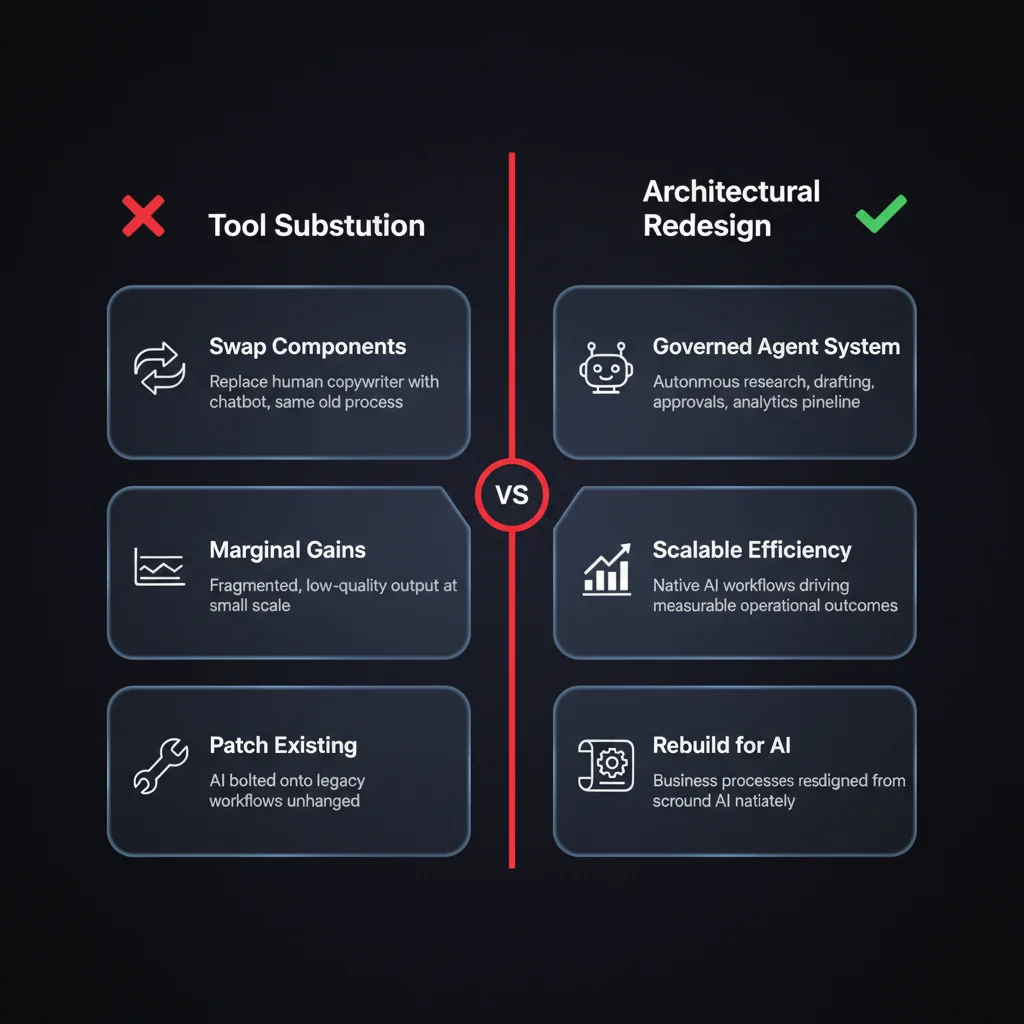
When organizations first encountered generative AI, the immediate instinct was simple substitution. In historical terms, this is the equivalent of swapping a steam engine for an electric motor while keeping the rest of the factory layout exactly the same. You might see a marginal increase in speed, but you fail to unlock the transformative potential of the new technology.
Forward-deployed engineering exists because the simple substitution model fundamentally fails at scale. True transformation requires redesigning the business around these models. It involves looking at core operations — sales pipelines, customer support matrices, marketing workflows, and internal data processes — and architecting governed systems that leverage AI natively.
For example, swapping a human copywriter for a chatbot is tool substitution. Redesigning a marketing department around a governed agent system that autonomously researches industry trends, drafts content against strict brand guidelines, routes approvals to human editors, and analyzes publication metrics is architectural redesign. The former creates fragmented, low-quality output. The latter creates scalable operational efficiency. This is precisely the kind of operations automation that mid-market companies need to remain competitive.
Why operations leaders must pay attention
For CEOs, COOs, and VPs of Operations, this industry hiring trend is a glaring validation of a massive operational risk. If you are currently encouraging your teams to simply "find ways to use AI" without an overarching architectural strategy, you are building a fragile infrastructure.
Ungoverned experimentation leads directly to shadow AI. This occurs when employees use fragmented, consumer-grade tools to bypass slow internal processes. While it may feel like innovation in the short term, shadow AI creates immense operational complexity and severe data security risks. Customer data is pasted into public prompts, intellectual property is exposed, and operational logic becomes completely opaque. The shadow AI governance crisis is already affecting thousands of mid-market organizations that moved fast without building proper governance frameworks.
The forward-deployed strategy utilized by top labs proves that sustainable success requires governed agent infrastructure. It requires data sovereignty, ensuring your proprietary information remains under your strict control. Most importantly, it requires observable logic — the ability for operations leaders to look under the hood of an automated workflow and understand exactly why a specific decision was made or a specific action was taken.
The talent scarcity crisis in the mid-market
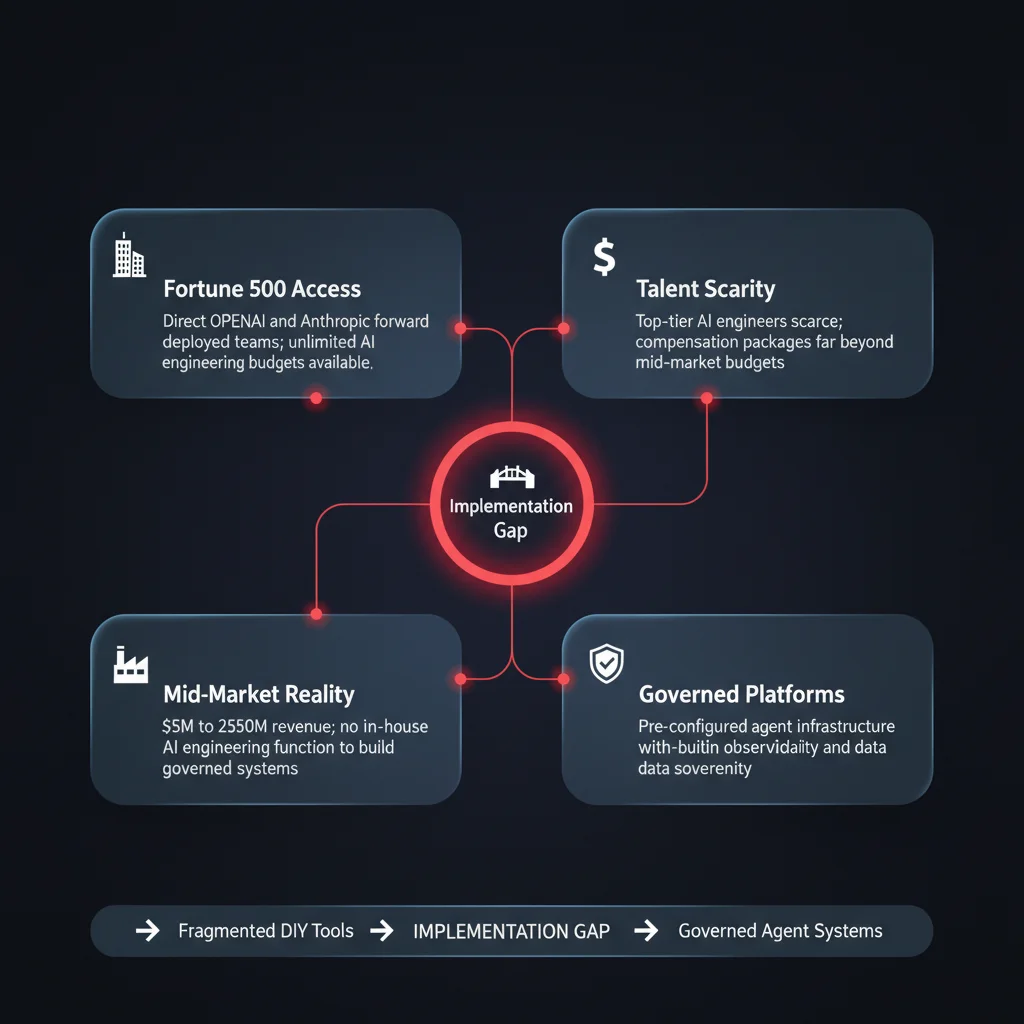
While Fortune 500 companies might possess the capital to partner directly with OpenAI's or Anthropic's enterprise deployment teams, scaling organizations face a distinct challenge. Mid-market companies generating $5M to $250M in revenue typically lack the internal talent and the massive budgets required to hire their own specialized AI engineering teams.
Recruiting dedicated architects to completely overhaul your operations is a multi-million dollar endeavor fraught with hiring risks. Top-tier forward-deployed engineers are incredibly scarce, and their compensation packages reflect that scarcity. Furthermore, relying on generic IT consultants often leads to basic tool implementation rather than the deep, outcome-driven system redesign that true operational efficiency requires.
This creates a dangerous implementation gap — the same gap that drove the enterprise AI agents SaaS-pocalypse, where companies that tried to bolt AI onto existing SaaS workflows found themselves with fragile, expensive, and ultimately ineffective systems. Mid-market organizations are left struggling to operationalize AI safely and effectively, caught between the high costs of custom deployment and the high risks of ungoverned, off-the-shelf tools.
Closing the implementation gap
To remain competitive, scaling companies must find alternative ways to access the strategic value of a forward-deployed engineering approach without the associated overhead.
This requires shifting your focus away from simply purchasing fragmented software licenses. Instead, leaders must prioritize governed agent systems designed explicitly for specific business outcomes. The goal is to find infrastructure that inherently provides the architectural redesign you need. You need systems that come pre-configured with the operational observability, logic controls, and data sovereignty that a dedicated engineer would build for you from scratch.
By adopting platforms that act as an extension of your operational leadership, you can bypass the talent scarcity crisis. You gain the ability to deploy complex, multi-agent workflows in customer support, sales, and marketing while maintaining strict governance over how those agents interact with your business data. See how Ability.ai delivers this approach through outcome-driven operations automation — governed agent infrastructure built for mid-market scale, without the cost of hiring your own engineering team.
Building for operational scale
The hiring strategies of top AI laboratories provide a clear roadmap for the future of business operations. The era of casual AI experimentation is ending, replaced by an urgent, industry-wide need for deep, structural integration.
The takeaway for operations leaders is clear — stop trying to swap steam for electricity. Recognize that the true value of artificial intelligence lies in systemic business redesign. By prioritizing governed agent infrastructure over fragmented tools, you can transform chaotic AI experiments into reliable, scalable operational systems that drive tangible business outcomes. Forward-deployed AI engineers exist precisely because this work is too important — and too complex — to leave to casual experimentation.