
Autonomous AI agent workflows are self-improving automation systems where an orchestrator agent continuously generates, tests, and refines business processes — without human intervention. Unlike static automations that execute the same task repeatedly, these pipelines measure objective metrics, accumulate learnings, and iterate around the clock, compounding small efficiency gains into massive operational advantages over time.
Every day, operations and revenue teams lose thousands of hours to manual optimization. At Ability.ai, we see teams launch a campaign, wait for the data, analyze the results, and manually deploy a new iteration. But this human-in-the-loop bottleneck is rapidly becoming obsolete. The operational landscape is shifting toward autonomous AI agent workflows that do not just execute static tasks — they actively and continuously improve them.
By applying advanced machine learning research principles to daily business workflows, operations leaders can build self-improving pipelines. These governed agent systems optimize revenue-generating assets 24 hours a day, requiring zero manual intervention while strictly adhering to corporate guardrails. The shift from fragmented AI experimentation to reliable, self-evolving operational systems represents the next major competitive advantage for the scaling mid-market enterprise.
The evolution from static automation to self-improving AI
Recent developments in machine learning research have revealed a powerful new framework often referred to as "auto research." Pioneered by leading AI researchers, the core concept is elegantly simple — instead of humans training models, we can deploy models to train other models autonomously.
In a laboratory setting, this involves giving an AI agent a small training environment and letting it experiment autonomously overnight. The agent modifies the code, runs a brief training cycle, checks if the validation loss improved, keeps or discards the changes, and repeats the loop. By morning, the researcher wakes up to a detailed log of automated experiments and a measurably smarter model.
For business operations, this exact architectural framework translates directly to revenue and efficiency metrics. Instead of optimizing a machine learning model's validation loss, an orchestrator agent can optimize a company's cold email reply rates, landing page conversions, or advertising costs. The AI formulates a hypothesis, deploys a test, measures the objective business metric, and iterates.
This fundamentally transforms how businesses scale. You are no longer constrained by the working hours of your operations team. An automated pipeline can run parallel AI workflows simultaneously, compounding small efficiency gains into massive operational advantages over time.
Autonomous AI agent workflows: the architecture of continuous optimization
Building a self-improving AI workflow requires a specific structural hierarchy, beginning with an orchestrator agent. Think of the orchestrator as the conductor of a symphony — it manages the high-level logic and delegates specific actions to sub-agents or specialized tools.
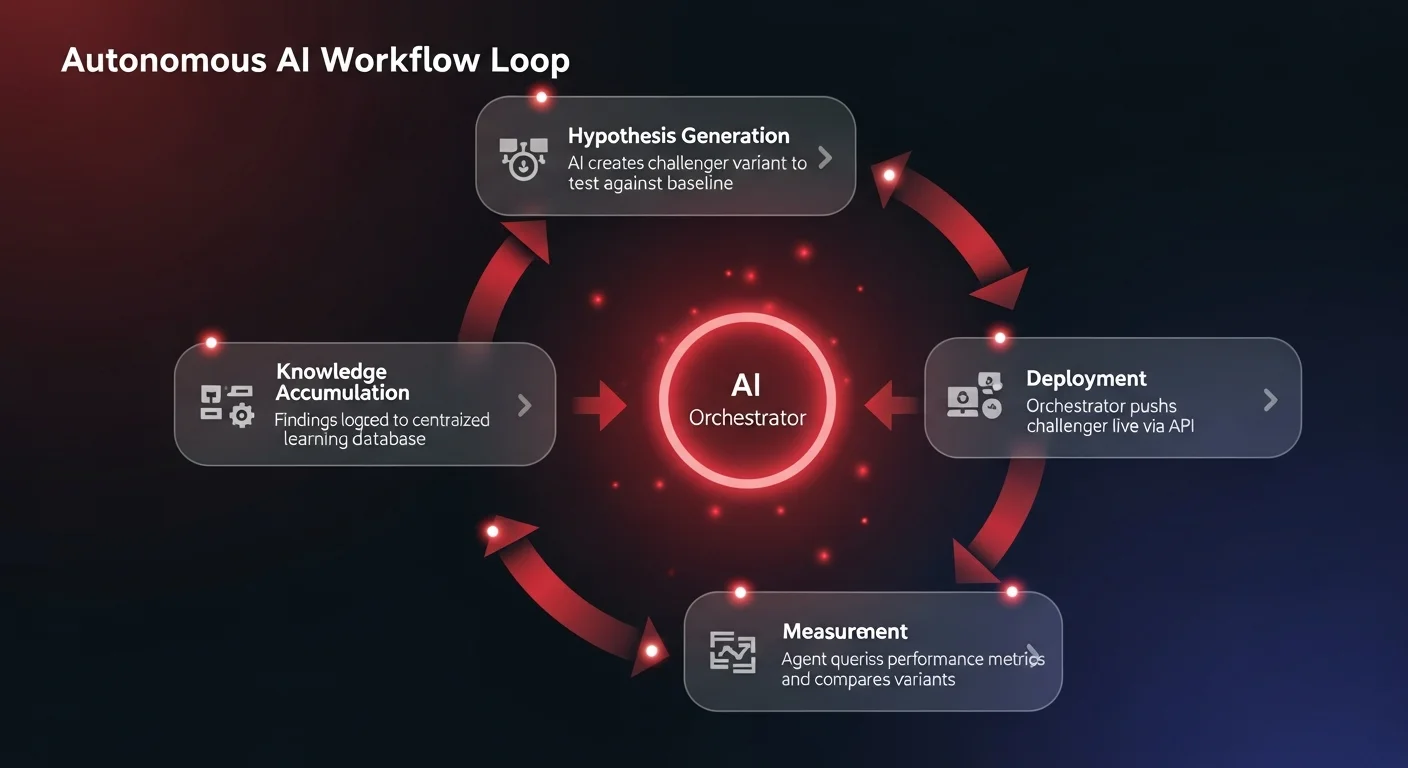
To operate autonomously, the orchestrator follows a strict, repeating loop:
- Hypothesis generation: The system generates a "challenger" to compete against the current "baseline." For example, if the baseline is a standard sales email, the challenger might be a variant rewritten to be under 75 words, front-loading the value proposition, and ending with a specific chronological call-to-action.
- Deployment: Using application programming interfaces (APIs), the orchestrator deploys the challenger into a live environment alongside the baseline.
- Measurement: After a predetermined time, the agent queries the platform's API to harvest the results, comparing the performance of both variants against a strictly defined metric.
- Knowledge accumulation: This is the most critical step. The agent logs its findings — both successes and failures — into a centralized knowledge document.
This accumulated intelligence ensures the system never starts from scratch. As the workflow matures, the orchestrator references a constantly growing database of proven, company-specific best practices, allowing future challengers to launch from an increasingly sophisticated baseline. This mirrors the hierarchical AI agent structure that the most effective enterprise deployments use to manage complexity.
Three prerequisites for autonomous experimentation
While the concept of self-improving systems is compelling, not every business process is suitable for autonomous optimization. To successfully deploy this architecture, operations teams must ensure three non-negotiable prerequisites are met.
First, the workflow must have a fast feedback loop. The mathematical advantage of autonomous agents lies in volume. If an experiment takes three months to yield results — such as an enterprise sales cycle — the agent cannot iterate fast enough to provide compounding value. Conversely, workflows with rapid feedback loops allow an agent to run dozens of experiments daily, accelerating the path to optimization.
Second, the system requires an objective, quantifiable metric. Autonomous agents cannot optimize for subjective concepts like "brand warmth" or "customer happiness" unless those concepts are tethered to hard data proxies. Reply rates, click-through rates, and conversion percentages are ideal because they provide an indisputable mathematical signal for the agent to follow.
Third, the orchestrator must have direct API access to manipulate inputs. If an agent formulates a brilliant optimization strategy but requires a human to log into a dashboard and manually change the text, the autonomous loop is broken. The agent must be authorized to pull metrics, generate assets, and push those assets live programmatically.
Real-world applications for revenue operations
When these three prerequisites align, the applications for autonomous AI agent workflows become highly lucrative, particularly within marketing and sales operations.
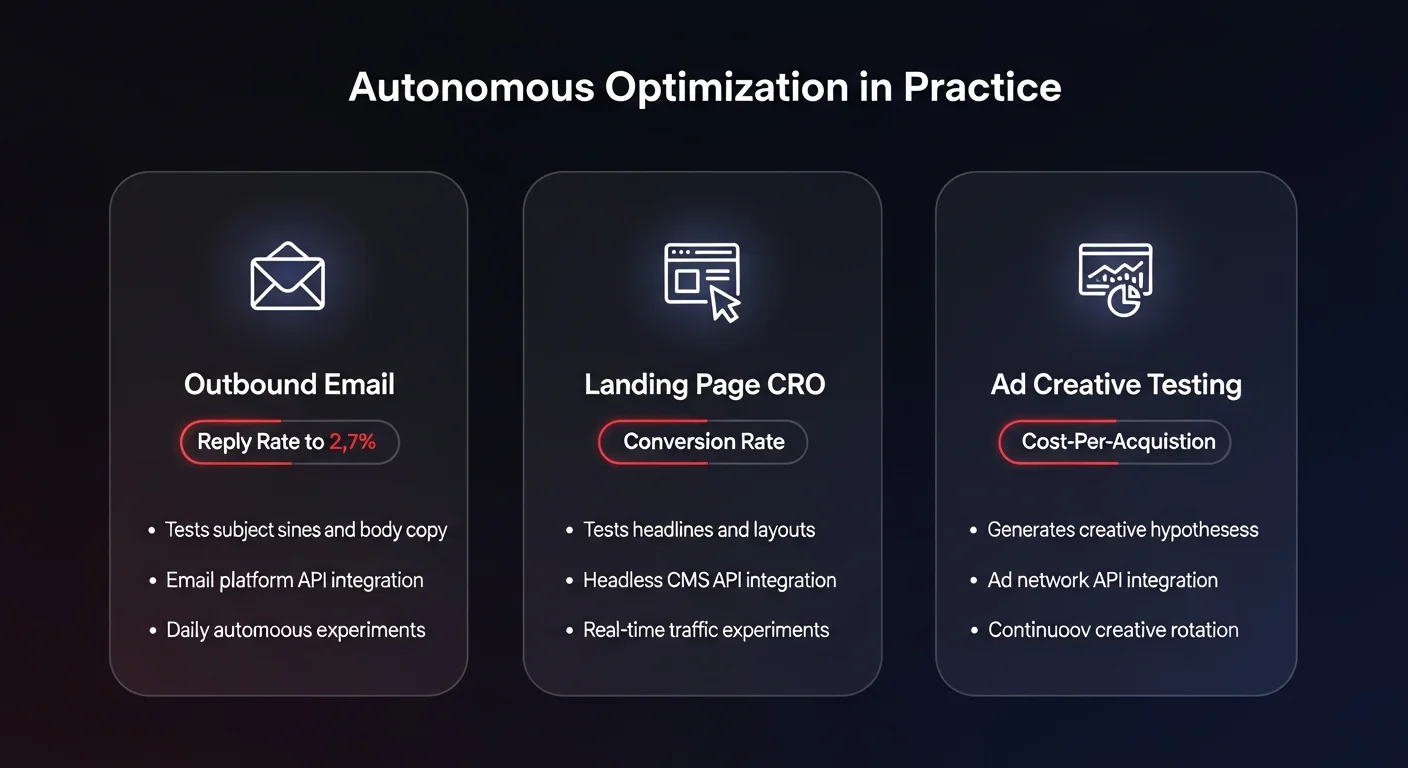
Consider outbound email operations. Using platforms that offer robust developer endpoints, an orchestrator agent can continuously test subject lines, body copy, and risk-reversal statements. Over several days, a baseline reply rate of 1.5 percent might systematically climb to 2.7 percent as the agent identifies the exact messaging nuances that resonate with a specific target audience. The friction of manually segmenting lists, rewriting copy, and tracking A/B tests is entirely eliminated.
Conversion rate optimization for landing pages offers another prime target. By granting an agent API access to a headless content management system, the AI can continuously test headline variations, sub-copy, and structural layouts against incoming web traffic. It measures the conversion rate, discards underperforming elements, and continuously refines the user experience based purely on data rather than human intuition.
Digital advertising creatives follow the exact same logic. While ad networks possess internal optimization algorithms, they rely on the creative assets humans provide. An autonomous orchestrator utilizing top-tier language models can generate radically diverse creative hypotheses, push them to the ad network via API, monitor cost-per-acquisition, and double down on the winning psychological angles.
Governance: securing the autonomous loop
While the operational benefits of self-improving workflows are immense, turning an AI agent loose on corporate systems introduces significant risks. This is the exact intersection where ungoverned AI experiments transform into operational and security liabilities.
When a machine learning pipeline runs autonomously 24 hours a day, speed can become a double-edged sword. If an agent decides that highly aggressive, off-brand messaging yields a marginally higher reply rate, it will blindly optimize for that metric at the expense of your company's reputation. Similarly, giving third-party desktop agents unfettered access to your customer databases and marketing platforms is a data governance nightmare — a risk explored in depth in our analysis of agent reliability metrics and governance.
To safely deploy self-improving AI, businesses must move away from shadow AI tools and adopt governed agent infrastructure. Data sovereignty and observable logic are mandatory. Operations leaders must ensure that orchestrator agents operate within strict, immutable parameters.
Before deploying an autonomous loop, you must establish rigid guardrails. The agent should be forced to validate all generated challengers against a hardcoded corporate brand and compliance framework before deployment. Furthermore, while the execution is autonomous, observability is critical. Implementing automated notification webhooks — such as a real-time messaging ping detailing the exact baseline, challenger, and hypothesis — ensures leadership maintains visibility and auditability over the machine's decision-making process.
Building a self-evolving operational framework
Transitioning from static workflows to governed, self-improving pipelines requires a strategic approach to implementation.
Operations leaders should begin by auditing their current revenue-generating workflows to identify processes that meet the three prerequisites — rapid feedback, objective metrics, and API accessibility. Start with a single, highly measurable workflow like outbound communications or specific paid acquisition channels.
Next, establish the orchestrator environment using secure cloud infrastructure rather than local desktop environments. Utilize reliable scheduling protocols — such as automated cron jobs — to trigger the optimization loop at set intervals, whether that is once an hour or twice a day.
Finally, implement the centralized learning log. This resource document is the true intellectual property generated by your autonomous system. Over hundreds of iterations, this file will become the most accurate, data-backed codification of what actually drives revenue for your specific business.
The future of operations does not lie in building more automations; it lies in building systems that automate their own evolution. By deploying governed, autonomous AI agents, mid-market companies can execute high-velocity experimentation at a scale previously reserved for massive tech enterprises — turning operational complexity into a distinct, self-optimizing competitive advantage.
If you are ready to move from fragmented AI experiments to a governed, self-improving operational system, explore how Ability.ai's operations automation solutions deliver the orchestrator infrastructure, API integrations, and governance guardrails your team needs to get started safely.