
AI marketing agents are autonomous, multi-skill systems that research audiences, generate content, enrich drafts with proprietary data, and self-improve based on performance metrics - replacing ad-hoc human prompting with governed operational infrastructure. Organizations deploying these governed agent systems report up to a 6X productivity advantage over teams relying on manual AI interactions.
The era of manual prompting is coming to an abrupt end. For operations and marketing leaders, the transition from fragmented chatbots to fully autonomous AI marketing agents represents the most significant shift in go-to-market strategy this decade. The reality is stark - traditional marketing teams relying on basic prompt engineering are losing ground to organizations deploying governed, multi-agent systems.
Recent industry analysis reveals a critical evolution in how high-performing companies create content. Rather than relying on humans to manually prompt large language models, sophisticated operators are building entire AI content teams consisting of specialized, interconnected agentic skills. These systems do not just generate text; they research audiences, analyze winning patterns, enrich drafts with proprietary data, and automatically update their own parameters based on monthly performance metrics.
For mid-market and scaling companies, understanding and implementing this architecture is no longer optional. It is the operational baseline for surviving the next evolution of digital distribution.
The end of vibe marketing: why ad-hoc prompting fails
Most organizations are currently stuck in what can be described as "vibe marketing" - an unstructured approach where employees casually interact with AI interfaces to generate one-off assets. They keep Notion documents full of shared prompts, copying and pasting them into tools like ChatGPT or Claude, hoping for a usable result.
From an operational perspective, this approach is deeply flawed. If your team is still copying and pasting prompts from a static document, you are exactly one model update away from losing significant output quality. When underlying models change, ad-hoc prompts break.
As we explored in our analysis of AI marketing agents for operations, the shift from tool-based prompting to system-based orchestration is what separates scaling teams from stagnant ones. The alternative is systems thinking. Instead of workflow tools where users drag and drop elements, or casual chat interfaces, the future belongs to structured agentic systems. These systems treat AI not as a tool, but as a digital workforce with defined inputs, outputs, and handoffs. They operate autonomously within defined operational guardrails, executing complex sequences of tasks without human intervention.
AI marketing agents: the architecture of an 11-skill content team
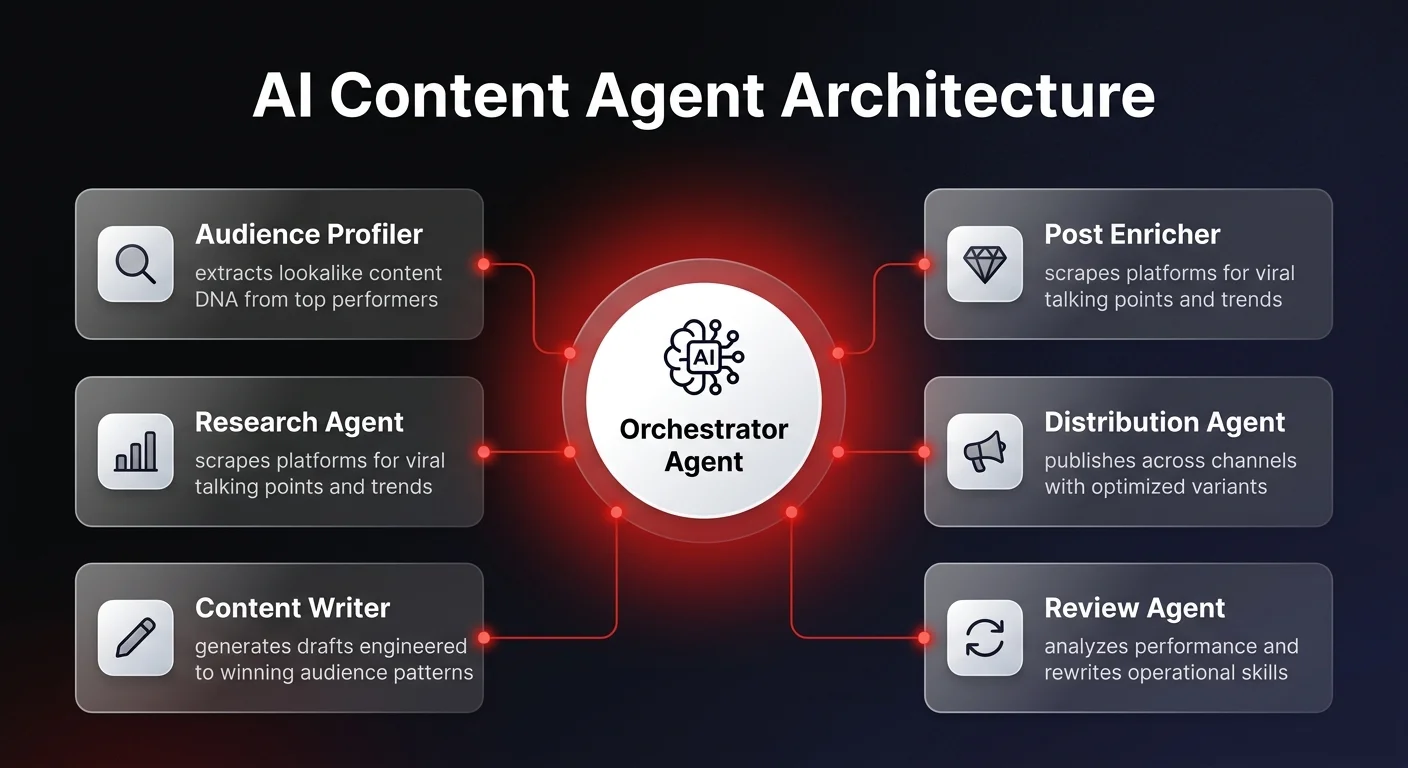
Building an autonomous content engine requires moving beyond single-purpose bots. The most effective systems utilize a primary orchestrator agent that manages a suite of highly specialized sub-skills. In a fully automated environment, the orchestrator can be set to run independently, generating a full pipeline of content overnight without any human initiation.
Audience profiling and lookalike extraction
Generic content fails because generic AI lacks specific audience context. Advanced agentic systems solve this by generating rigid, data-backed audience profiles.
The most powerful capability within this suite is the lookalike content skill. Instead of guessing what works, operators can feed the system a massive data dump - for instance, 51 historical blog posts, top-performing articles, and leadership essays. If the data includes performance metrics, the agent will isolate the top 30 percent of performing content.
It then extracts the structural DNA of those winning pieces. The agent identifies the exact hook formulas, paragraph lengths, embeddable prompts, emotional drivers, and structural patterns that drive engagement. It builds a comprehensive vocabulary library, defining exactly what the target persona does and does not say. This ensures every future piece of content is engineered to match established winning patterns.
Viral talking point extraction
Rather than brainstorming from scratch, specialized research agents continuously scour platforms like Reddit and industry forums to identify trending concepts. They can also ingest existing long-form content, like a YouTube transcript or a PDF whitepaper, and extract highly specific talking points.
These agents categorize their findings into functional buckets:
- Educational frameworks: Step-by-step methodologies
- Spicy takes: Contrarian industry opinions engineered for engagement
- Story sparks: Narrative-driven hooks
- Data nuggets: Hard statistics that validate a specific argument
The post enricher
Perhaps the most critical differentiator between amateur AI usage and professional agentic systems is the enrichment phase. AI inherently writes first drafts that lack depth. The post enricher agent solves this by injecting authority into the content.
When given a baseline concept, the enricher accesses historical case studies, industry data, and specific narratives. For example, if tasked with writing about operational alignment, the enricher might automatically pull in a verified case study about Jeff Bezos's 2022 internal API mandate, complete with dates, quotes, and specific business outcomes. This transforms generic AI text into authoritative thought leadership that resonates with executive buyers.
See how autonomous content automation systems work in practice for mid-market teams looking to scale output without scaling headcount.
The pod model: restructuring your go-to-market operations
The implementation of these multi-agent systems is forcing a fundamental restructuring of marketing departments. We are moving out of the era of traditional functional teams and entering the era of the pod model.
By 2026, the job title of "marketer" will effectively split into two distinct categories. On one side, there will be go-to-market operators - systems thinkers who manage and orchestrate fleets of specialized AI agents. On the other side will be legacy marketers, waiting indefinitely for engineering tickets to be fulfilled or relying on outdated manual execution.
The highest-performing organizations are already proving this concept. A single go-to-market operator, armed with a carefully orchestrated system of 11 AI agents, can output the volume and quality of a traditional 10-person department. They do not hire a marketing team; they onboard one. They define the inputs, set the operational guardrails, and manage the handoffs between an AI analyst, an AI content producer, and an AI researcher.
This structural shift creates a massive competitive advantage. Research indicates a staggering 6X productivity gap between teams using effective, agentic AI systems and those relegated to surface-level AI experimentation.
Closing the loop: the self-improving operational engine
The most glaring vulnerability in standard AI adoption is the lack of a feedback loop. Companies generate content, publish it, and then completely fail to connect the performance data back to the generation engine.
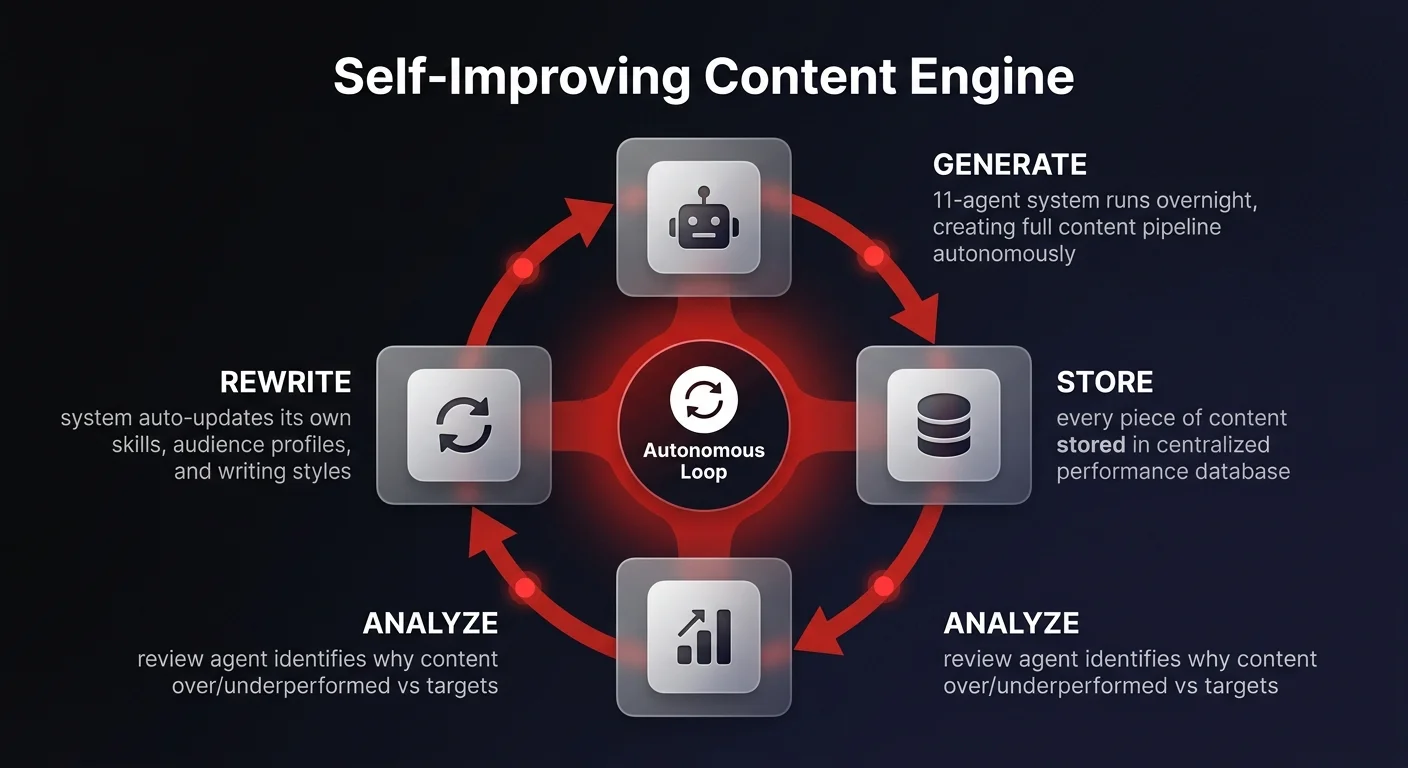
A true agentic system is designed for continuous self-improvement. Through automated feedback loops, the system captures every piece of content it creates and stores it in a centralized database. At the end of the month, performance metrics - engagement rates, conversion data, and qualitative feedback - are imported back into the system.
A dedicated review agent analyzes this performance data against the original outputs. It identifies why certain posts underperformed and why others exceeded expectations. Most importantly, it uses these insights to automatically update the underlying skills, audience profiles, and writing styles.
The system literally rewrites its own operational instructions to ensure the next batch of content is more effective than the last. This creates an autonomous optimization cycle that compounds over time, fundamentally separating your output from competitors who are starting from scratch with every prompt. For more on designing autonomous AI agent workflows with built-in feedback loops, our technical breakdown covers the architectural patterns in detail.
Moving from experiment to governed infrastructure
The capabilities of an 11-skill AI content system are profound, but deploying them safely requires a strategic operational foundation. As CEOs and COOs look to scale these pod models across their organizations, governance becomes the primary bottleneck.
Allowing employees to build localized, ungoverned AI agents using shadow IT tools creates immediate risks regarding data sovereignty, brand voice consistency, and operational security. If a central orchestrator agent is handling proprietary data, customer profiles, and direct API access to social platforms, it cannot live on a single employee's local machine or within an ungoverned consumer application.
This is where the transition to a sovereign AI agent system is required. To truly capitalize on the agentic pod model, organizations must deploy these systems within a governed infrastructure. Leaders must ensure that the structural DNA of their content, their proprietary audience profiles, and their automated feedback loops are observable, secure, and entirely under corporate control. See our complete framework for governing AI marketing agents at scale to understand the governance layers required before deploying autonomous content systems.
The competitive landscape is rapidly dividing. The winners will be those who stop treating AI as a casual drafting tool and start architecting it as a governed, self-improving operational system. By moving from ad-hoc prompting to orchestrated agent pods, scaling companies can achieve unprecedented go-to-market velocity while maintaining the rigorous oversight required for sustainable growth.