
AI agent frameworks are orchestration systems that coordinate multiple AI agents to complete complex, multi-step tasks — but most enterprise implementations generate zero economic value. Arc AGI3 benchmark research confirms that AI still struggles with long-term autonomous operation without drifting off course, making governed, human-directed frameworks essential for any COO deploying AI at scale.
The enterprise AI landscape is currently flooded with complex AI agent frameworks that promise total operational autonomy. From open-source projects to custom-built terminal interfaces, developers and technical leads are racing to build massive, interconnected swarms of autonomous agents. However, when we look past the futuristic hype and examine the actual business value being generated, a stark reality emerges. Most of these elaborate frameworks are producing zero economic value.
Instead of delivering tangible business outcomes, many organizations are falling into the trap of endless tinkering — what industry insiders colloquially refer to as "setup porn." For operations leaders, COOs, and scaling mid-market businesses, this disconnect between technical complexity and operational reality represents a significant governance risk. When internal teams focus on building tools to manage other tools, the core objective of AI — driving efficient, reliable business outcomes — is entirely lost.
Why most AI agent frameworks produce zero business value
If you monitor the current discourse around AI development, you will inevitably encounter engineers boasting about their complex setups. You will see posts detailing how someone spent until 2:10 a.m. running multiple Claude code terminals on a MacBook, configuring tools like Hermes and Paperclip, and piping data through Telegram topics. It looks incredibly sophisticated. It reads like ancient Egyptian hieroglyphs to the average business user. But operations leaders must ask one critical question — what external deliverable did this actually ship?
Consider the rising trend of the "zero human company" setups. In these AI agent frameworks, developers proudly display dashboards showing an array of agents working in tandem. A "community lead agent" might be tasked with researching platforms, while another agent improves the admin dashboard user experience, and a third hardens the reliability of an assessment pipeline.
When we critically analyze these tasks, the illusion shatters. Three out of four of these automated processes are entirely recursive. Building an AI agent to improve an AI dashboard so you can better monitor your AI agents is not a business model — it is a distraction.
We see this same pattern in marketing automation experiments. A developer might use a sophisticated agent framework to research trends on Reddit and Hacker News, compile an SEO audit document, and then turn that document into a project management board full of new tasks for other agents. The framework assigns tasks, delegates responsibilities, and orchestrates workflows. Yet, the only thing the end client or customer actually cares about is the final deliverable. A customer does not care if you orchestrated a swarm of 500 autonomous digital workers; they care if the work was completed accurately, securely, and on time.
By building massive wrappers around simple documents like SEO audits, developers are spending 99% of their time on the orchestration and only 1% on the actual deliverable. It is the digital equivalent of spending forty hours organizing your desk and zero hours doing your actual job. For a grounded analysis of what AI automation actually returns in business value, see our breakdown of AI automation ROI metrics that matter.
AI agent frameworks built on human org charts: a strategic failure
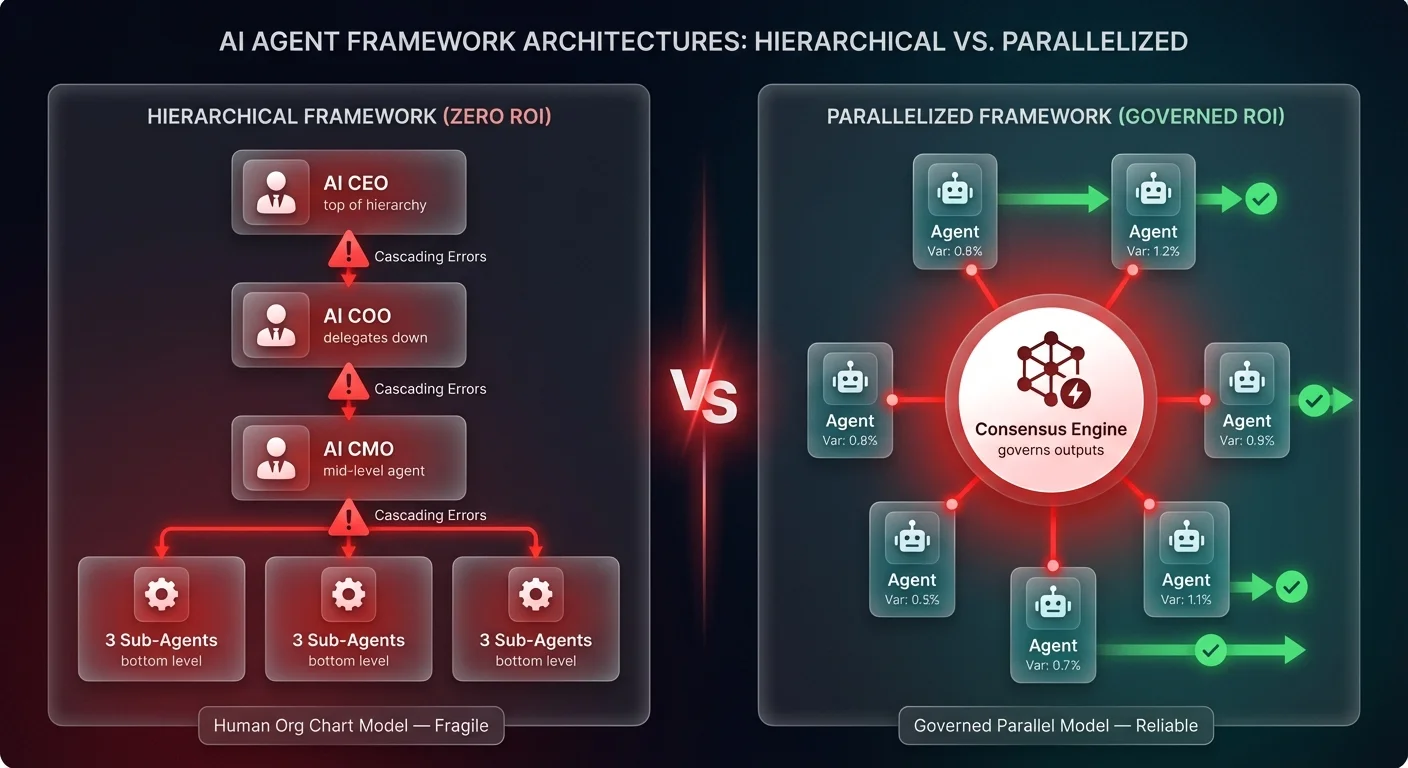
Perhaps the most fundamental flaw in modern AI agent deployment is the attempt to force artificial intelligence into human organizational structures. Many developers are building systems that feature an AI CEO delegating tasks to an AI COO, who in turn delegates to an AI CMO and various specialized sub-agents. This mirrors the hierarchical AI agent structure that most teams reach for by default — and it is exactly the wrong approach.
This approach borrows an organizational hierarchy chart from a hundred years ago. Human beings organize companies in this centralized, hierarchical manner out of biological and cognitive necessity. We are bound by the Dunbar number — a cognitive limit to the number of people with whom one can maintain stable social relationships. We are also restricted by management load; a single human manager can only effectively oversee a handful of direct reports before operational efficiency degrades.
There is absolutely no fundamental reason why an AI system must look like a human company. Artificial intelligence does not have a Dunbar number. It does not suffer from management fatigue in the human sense. By forcing AI into a traditional corporate hierarchy, developers are artificially limiting the technology to match the constraints of human biology.
This is where ungoverned, experimental shadow AI severely damages enterprise efficiency. When internal teams build these hierarchical agent swarms, they introduce layers of unnecessary latency, miscommunication, and point-of-failure risks. An AI CMO agent misunderstanding a prompt from an AI CEO agent creates cascading errors that are nearly impossible to audit. This lack of observable logic makes these systems entirely unsuited for governed, secure enterprise operations.
If your organization is currently running ungoverned agent experiments, see how Ability.ai structures governed AI systems for mid-market operations — the architecture difference directly impacts reliability and measurable ROI.
Parallelization: the AI agent framework architecture that actually works
If hierarchical delegation is the wrong approach to AI agent frameworks, how should scaling companies architect their AI systems? The answer lies in understanding the fundamental nature of machine intelligence.
AI intelligences are incredibly spiky. They are capable of executing specific, tightly scoped tasks thousands of times faster than human beings, but they struggle with broad, ambiguous oversight. Because of this, the most highly efficient, properly governed AI operations look nothing like a traditional company.
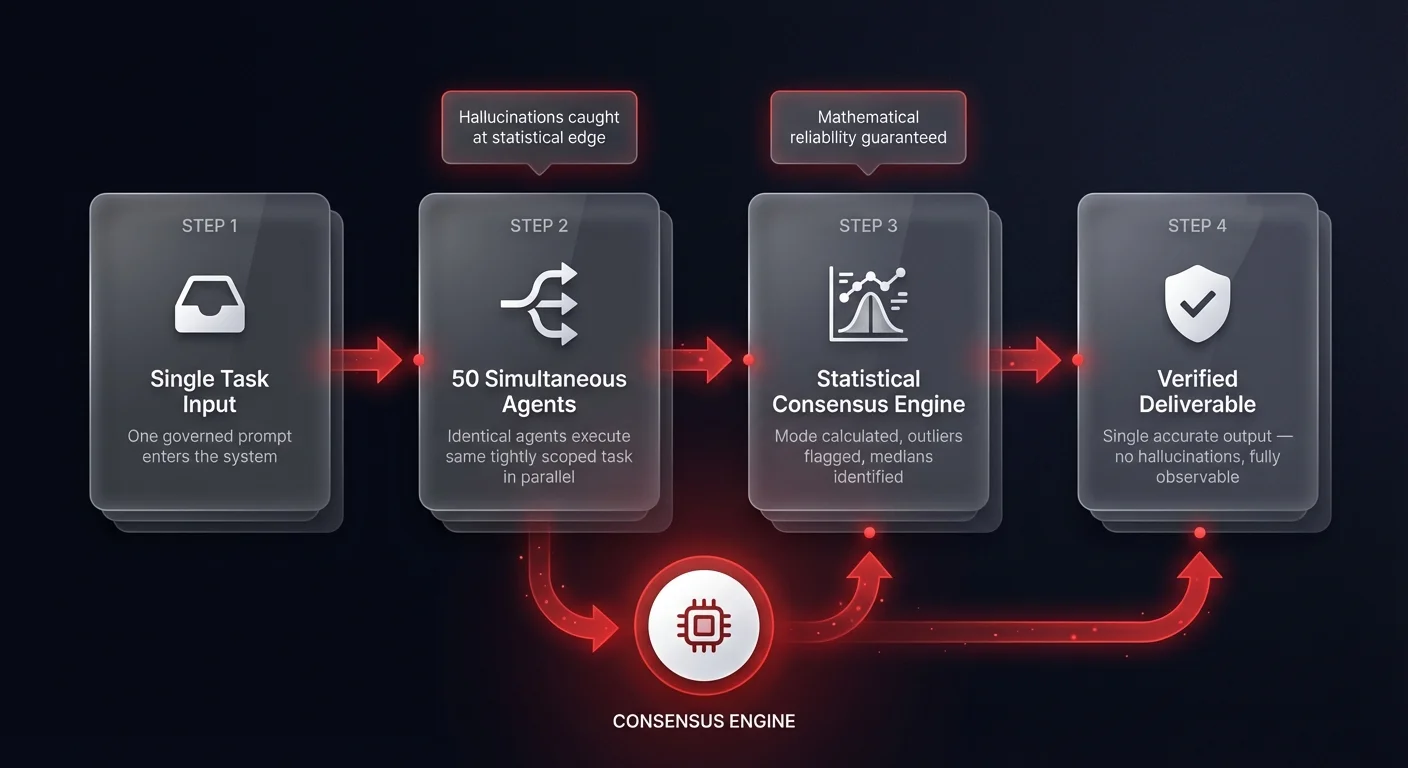
Instead of relying on a single "senior developer agent" to process a complex task sequentially, a truly optimized system leverages massive parallelization. An effective operational architecture would spin up 50 identical agents simultaneously. All 50 agents are given the exact same tightly scoped task and produce their own deliverable with minor statistical variances.
The system then calculates the mode, identifies the median responses, flags the extreme outliers, and collapses all of this validated data into a single, highly accurate formal deliverable.
This parallel consensus model completely eliminates the hallucination risks associated with single-threaded AI workflows. It replaces the fragile, daisy-chained logic of "setup porn" frameworks with mathematically reliable, observable logic. For VPs of Operations who require data sovereignty and absolute reliability, parallelization provides a governed infrastructure where outcomes are mathematically guaranteed rather than hopefully delegated. We explore the full mechanics of this approach in parallel AI workflows for enterprise orchestration.
The human element: why we remain self-adjusting sniper rifles
To effectively deploy AI agent frameworks for business outcomes, leadership must clearly understand the boundary between machine capability and human capability. Recent performance on the Arc AGI3 benchmark — a rigorous test of artificial general intelligence capabilities — highlights a critical reality: AI still struggles profoundly with long-term reliable autonomous operation without drifting off course.
Human beings, on the other hand, are exceptional at zero-shot tasks. We act as self-adjusting sniper rifles. If a human worker notices halfway through a project that the market conditions have changed or the initial premise was flawed, they can instantaneously change trajectory. We are capable of learning on the fly, digesting abstract contextual feedback, and pivoting our strategy in real-time.
AI agents operate more like a standard bullet on a beeline trajectory. Once fired via a prompt or automated trigger, they will execute their designated path relentlessly. If the initial coordinate was wrong, the AI will confidently and rapidly build a highly detailed execution of the wrong strategy.
This is why keeping the human in the loop — not as a micro-manager of 500 agents, but as the strategic director of governed AI workflows — is non-negotiable for enterprise success. The tools are there to amplify human agency, not replace human judgment. As the saying goes: you use the tool; you do not let the tool use you.
From endless setup to governed AI agent frameworks that ship results
There is a famous, heavily documented exchange between former Twitter CEO Parag Agrawal and Elon Musk right before Musk acquired the platform. After receiving a lengthy, complex message detailing structural and technical philosophies, Musk simply replied with a question that cut straight to the core of business operations: "What did you get done this week?"
Every COO, CEO, and Operations VP should be asking their technical teams this exact question regarding their AI initiatives. If the answer involves setting up new agent frameworks, integrating new open-source project management wrappers, or orchestrating theoretical swarms of digital workers — but yields zero external value or revenue — you have an AI governance problem.
The most successful businesses scaling today recognize that the tool is never the main thing. Whether a team member uses a simple native notepad application or a complex stack of interconnected productivity software, the only metric that matters is the output.
For mid-market and scaling companies, transforming fragmented AI experiments into reliable operational systems requires a fundamental shift in perspective. It requires abandoning the fascination with complex agent setups in favor of governed, sovereign AI infrastructure. By focusing on parallelized, tightly scoped tasks with observable logic, businesses can finally stop playing with "setup porn" and start driving actual, measurable monthly recurring revenue.