
The AI adoption gap is the widening divide between what AI can theoretically automate and what businesses are actually deploying in production. Despite modern foundation models crossing the intelligence threshold for most enterprise tasks, observed deployment sits at a fraction of that potential - because the bottleneck is workflow integration, not AI capability.
The AI adoption gap has become the defining operational challenge for mid-market and scaling enterprises this year. Recent data from Anthropic paints a stark picture of the current enterprise AI landscape, highlighting a massive disconnect between what artificial intelligence can theoretically accomplish and what businesses are actually deploying in production.
In this industry research analysis, we examine the widening delta between theoretical AI coverage and observed business integration. The data reveals a critical truth for operations leaders - the primary bottleneck to AI ROI is no longer a lack of raw artificial intelligence, but rather the immense friction of integrating these capabilities into existing operational workflows.
The data behind the AI adoption gap
The research visualizes this adoption gap through two distinct metrics across various industries: theoretical AI coverage (the percentage of industry tasks that models are capable of automating) and observed AI coverage (the actual percentage of work currently being automated by businesses in the real world).
The theoretical capabilities offer no major surprises to those following AI development. Modern foundation models exhibit exceptional proficiency in highly structured, logic-heavy disciplines. The data shows massive theoretical automation potential in coding, mathematics, finance, and engineering roles. Furthermore, these systems demonstrate remarkable capabilities in legal analysis and essentially all general office and administrative work.
However, the observed AI coverage - the reality of what businesses are actually doing - tells a completely different story. Across nearly every sector, the actual deployment of AI sits at a fraction of its theoretical potential. We are witnessing a scenario where the technology is mathematically and logically capable of automating complex tasks, yet operations teams remain stuck manually executing these exact workflows.
This gap represents a massive operational inefficiency and a missed opportunity for scaling businesses. It begs the critical question - if the models are smart enough to do the work, why isn't the work getting done?
The end of the foundation model race for enterprise
For the past two years, the enterprise narrative has been dominated by the foundation model race. Businesses have eagerly awaited the next release from OpenAI, Anthropic, or Google, assuming that smarter models would automatically translate into better business outcomes.
The current data effectively signals the end of this phase for the average enterprise AI user. For a mid-market company scaling between $5 million and $250 million in revenue, it is not going to matter this year if they gain access to a slightly more advanced model. The intelligence threshold required to automate standard business logic has already been crossed.
Operations leaders are experiencing severe model fatigue. A foundation model that scores 5% higher on a standardized legal reasoning benchmark provides zero material value to a Chief Operating Officer if that model cannot securely access the company's contract repository, apply the specific corporate legal playbook, and route the finalized document through the appropriate approval channels.
The raw cognitive power of AI is no longer the variable that dictates success. The intelligence is a commodity; the integration is the competitive advantage.
Why workflow integration is the true operational hurdle
The core reason the AI adoption gap exists is that foundation models do not integrate themselves into your business. They exist as isolated brains, accessible via chat interfaces or basic APIs, entirely disconnected from the nervous system of your company.
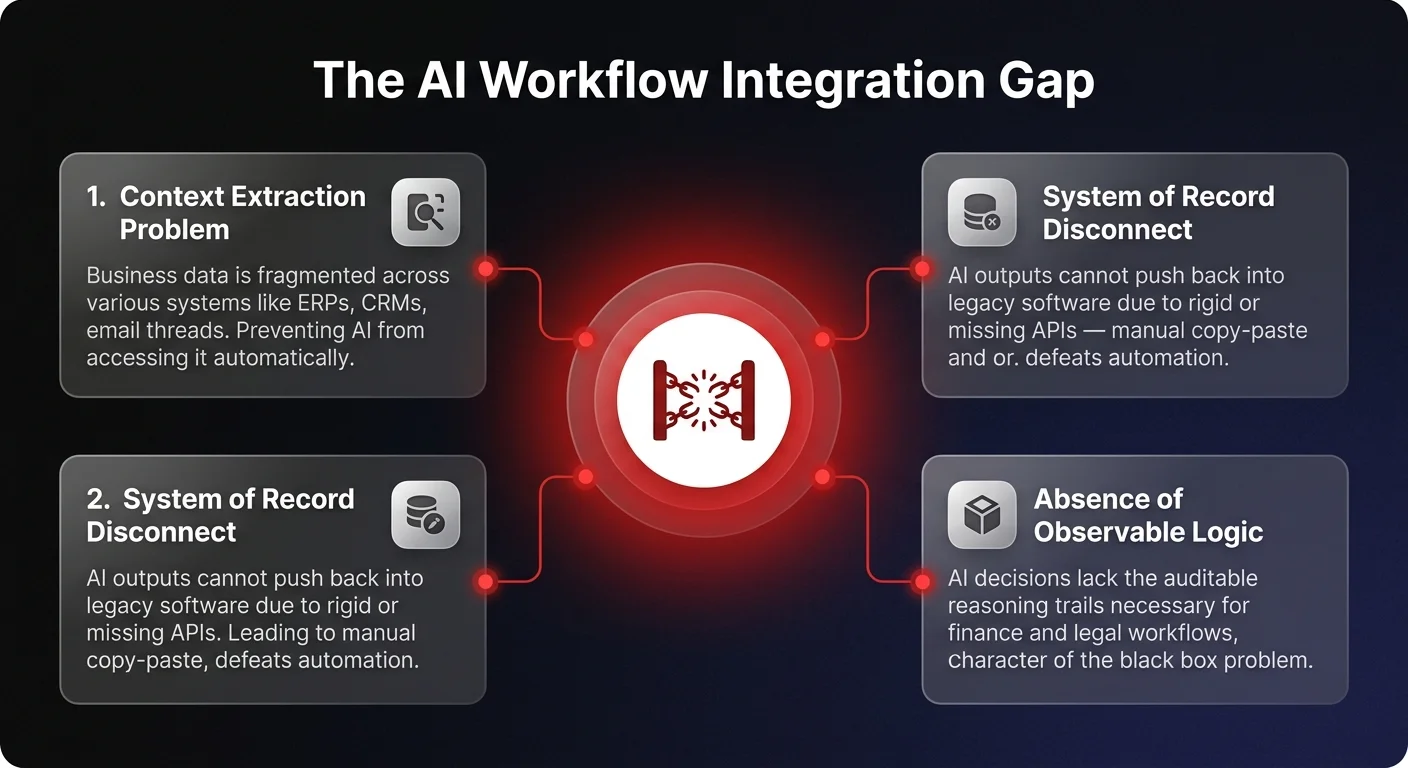
The really hard thing about AI is actually integrating it into your existing workflows. To move a task from theoretical coverage to observed coverage, businesses must overcome a gauntlet of integration challenges:
The context extraction problem
AI models need context to perform administrative, financial, or legal work. In a theoretical lab setting, all context is provided perfectly in the prompt. In reality, a company's context is fragmented across ERPs, CRMs, internal wikis, email threads, and Slack messages. Extracting this data securely and feeding it to an AI model in real-time is a massive engineering hurdle for standard IT teams.
The system of record disconnect
Once an AI model generates a useful output - such as reconciling an invoice, drafting a legal response, or categorizing a customer support ticket - that output must be pushed back into a system of record. Legacy software often features rigid APIs, fragile webhooks, or no programmatic access at all, forcing employees to manually copy and paste AI outputs, entirely defeating the purpose of automation.
The absence of observable logic
When an employee makes a decision, a manager can ask them to explain their reasoning. When a standard LLM makes a decision, it often acts as a black box. Operations leaders cannot deploy AI at scale into finance or legal workflows without observable logic - a clear, auditable trail of how the AI reached its conclusion, what data it referenced, and what rules it followed.
The hidden costs of the deployment gap
When theoretical potential outpaces formal deployment, organizations inevitably experience the rise of shadow AI. Employees read the headlines about AI capabilities and experience the frustration of inefficient internal tools. Consequently, they take matters into their own hands.
Without governed AI systems integrated into corporate workflows, employees resort to pasting sensitive financial data, proprietary source code, and confidential legal documents into public, consumer-grade AI chat interfaces. This creates unprecedented data sovereignty risks that most leadership teams are only beginning to recognize. For a deeper look at this emerging crisis, see shadow AI governance: what leaders need to know.
The AI adoption gap is not just a missed opportunity for efficiency - it is a breeding ground for operational complexity and severe security vulnerabilities. Ungoverned AI tools create fragmented processes where leadership has zero visibility into how work is being augmented, what data is being exposed, and whether the outputs are compliant with corporate standards.
Closing the gap with governed agent systems
To bridge the gap between theoretical AI coverage and actual business outcomes, organizations must shift their focus from acquiring foundation models to deploying governed AI agent architecture.
Sovereign AI agents represent the evolution from chat-based assistants to operational systems. Unlike standard LLMs, governed agents are designed specifically to integrate into existing workflows. They operate within secure, observable frameworks where data sovereignty is guaranteed.
This architectural approach solves the integration bottleneck in several ways:
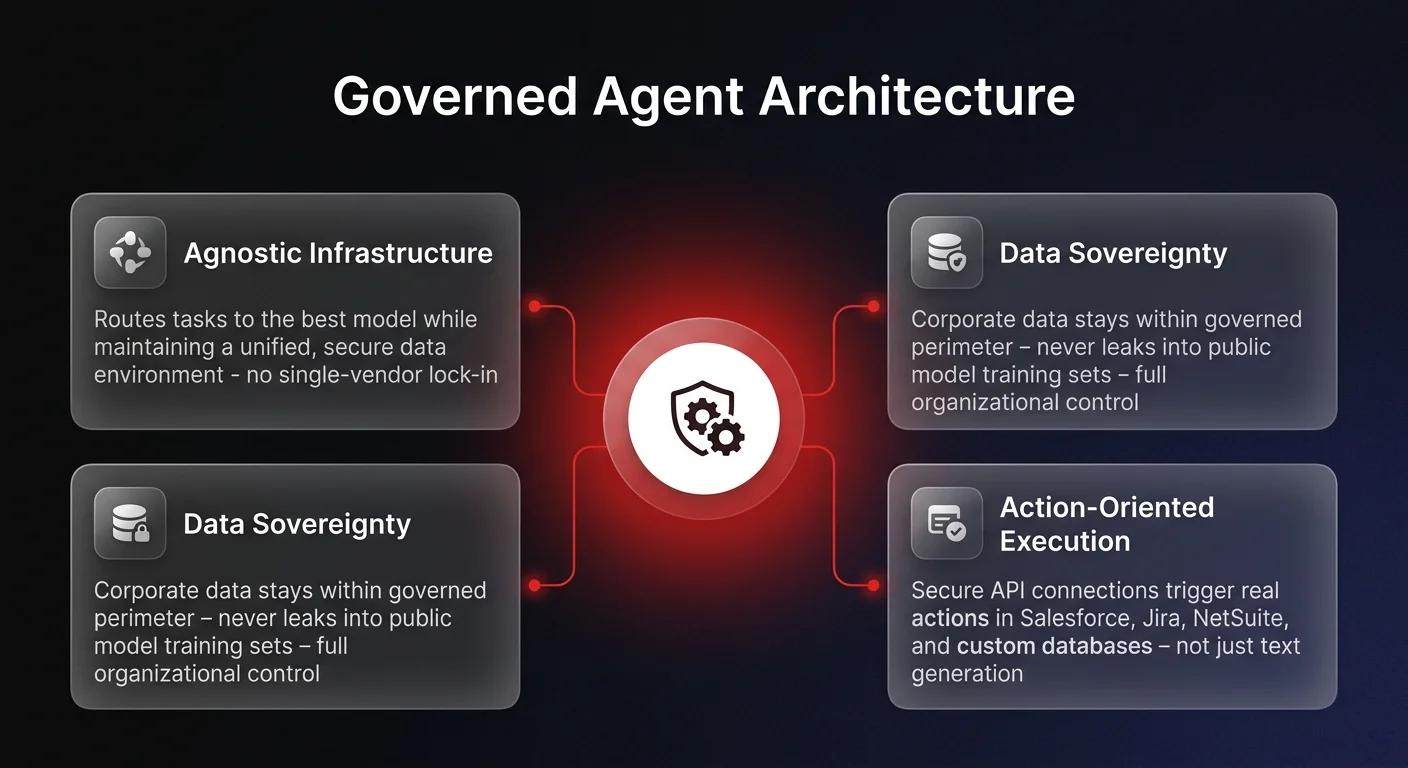
- Agnostic infrastructure: Instead of being locked into a single model provider, governed agent systems can route tasks to the most appropriate model while maintaining a unified, secure data environment.
- Data sovereignty: Sovereign agents operate within a governed perimeter, ensuring that corporate data never leaks into public model training sets and remains entirely under the organization's control.
- Action-oriented execution: Rather than just generating text, integrated agents are equipped with secure API connections to trigger actions within Salesforce, Jira, NetSuite, or custom internal databases.
By focusing on the infrastructure that connects AI to the business, rather than the AI itself, companies can rapidly convert theoretical automation into observed operational efficiency. See how Ability AI's operations automation solutions help mid-market businesses deploy governed agent systems across their existing workflows.
Strategic takeaways for operations leaders
The Anthropic data provides a clear roadmap for CEOs, COOs, and VPs of Operations who want to lead their markets in AI efficiency. The strategy for the remainder of the year should aggressively pivot from experimentation to integration.
Audit your administrative and office workflows
The data clearly identifies general office and admin work as having exceptionally high theoretical coverage. These workflows are typically rules-based, repetitive, and high-volume - the perfect candidates for integrated AI agents. Audit your operations to identify bottlenecks where human capital is wasted on data routing rather than strategic decision-making.
Stop evaluating models and start evaluating architecture
Shift your procurement and IT focus away from benchmarking the latest AI models. Instead, evaluate how well your current data architecture can support automated agents. Do you have clear, documented logic for your internal processes? Are your systems of record accessible via secure APIs?
Establish a sovereign AI perimeter
Before attempting to scale AI adoption to close the observed deployment gap, establish a secure, governed environment. You need a system that allows your teams to leverage AI capabilities without compromising data sovereignty or creating unmanageable shadow AI sprawl. For practical guidance on AI governance structure, read AI workflow automation governance.
Moving beyond theoretical potential
The organizations that win the next decade of business will not be the ones that had access to the smartest AI models - every company will have access to effectively identical intelligence. The winners will be the organizations that successfully cross the AI adoption gap.
Transforming fragmented AI experiments into reliable, governed operational systems is the definitive mandate for scaling businesses today. By recognizing that integration is the true operational hurdle and deploying sovereign AI agent systems to handle specific business outcomes, operations leaders can turn the theoretical promise of artificial intelligence into measurable, secure, and observable business reality. If your organization is still stuck at the proof-of-concept stage, see why AI projects fail and how to escape the PoC graveyard for a practical framework for crossing the implementation threshold.