
Autonomous AI agents are AI systems that independently execute complex operational tasks end-to-end — reading inputs, reasoning, acting, and reporting without constant human supervision. Unlike traditional chatbots that generate text for humans to act on, autonomous agents handle entire workflow lifecycles: receiving a request, accessing systems, executing changes, and confirming completion. As of 2026, leading deployments run on local private infrastructure, giving organizations complete data sovereignty and control over their AI operations.
For operations leaders, this evolution signals a move away from AI as a novelty and toward AI as a reliable infrastructure component. Understanding the mechanics of these locally run agents is essential for anyone looking to build a resilient, future-proof operational stack. For a deeper look at the technical environment that makes this possible, see our guide on containerized autonomous agent environments.
The shift to local infrastructure for autonomous AI agents
One of the most significant differentiators in the next generation of AI agents is the environment in which they operate. Traditional AI tools often function as "wrappers" around public Large Language Model (LLM) APIs, where data is sent to a third-party server for processing. While effective for general tasks, this architecture poses challenges for businesses with strict data governance requirements or those handling sensitive intellectual property.
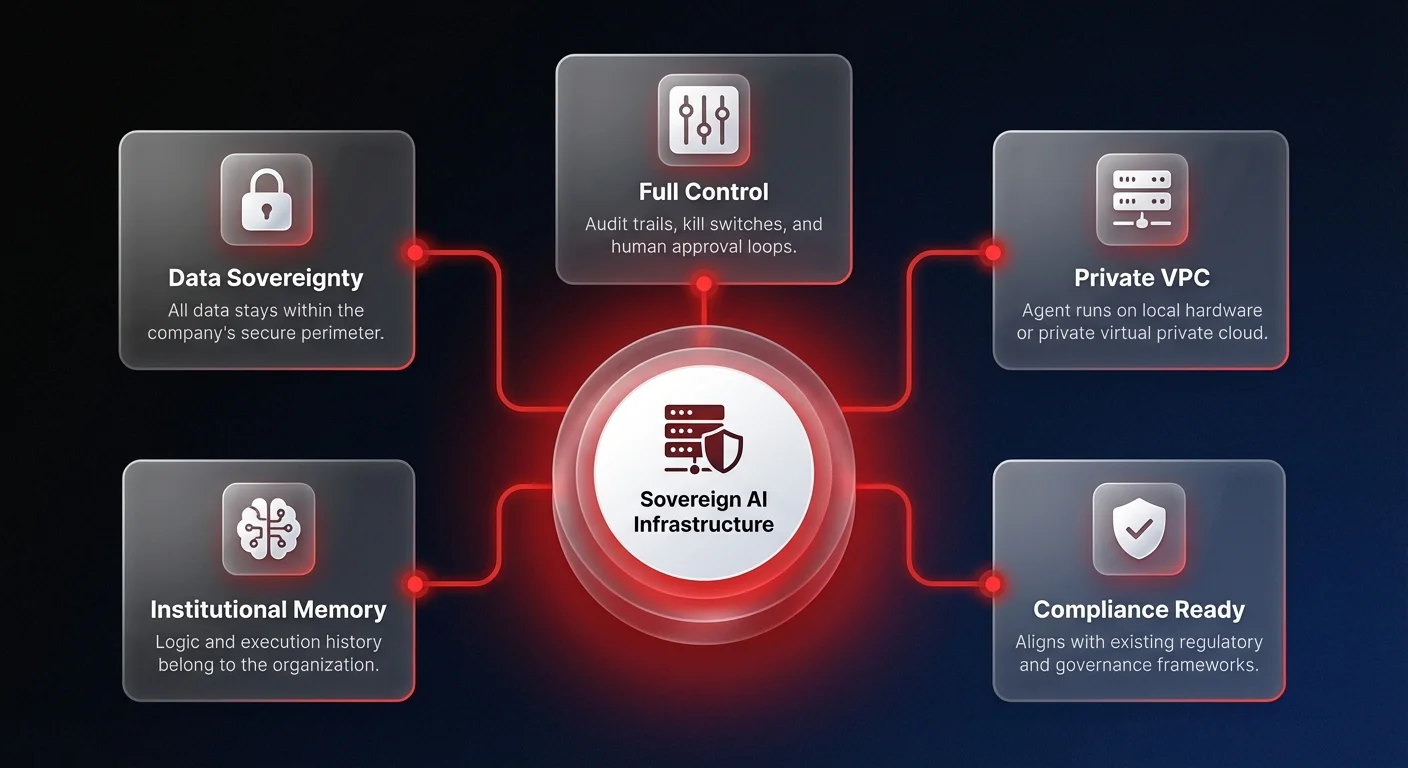
The emerging standard focuses on autonomous AI agents that run on "a computer or a server that you can control." This distinction is vital for mid-market and scaling enterprises. By hosting the agent on local hardware or a private virtual private cloud (VPC), organizations retain complete custody of their data. The agent operates within the company's secure perimeter, accessing files, emails, and internal systems without necessarily exposing that information to the broader internet or public model training sets.
This architectural choice supports the concept of "sovereign AI." It ensures that the logic, the context, and the execution history of the agent belong entirely to the organization. For a COO or VP of Operations, this reduces the surface area for security risks and aligns AI adoption with existing compliance frameworks. It transforms the agent from a rented service into a proprietary asset that appreciates in value as it learns the specific nuances of the business. Our deeper analysis of local AI agents and sovereign execution covers how organizations implement this in practice.
The invisible interface: integrating via messaging platforms
The user experience of autonomous agents is also undergoing a dramatic simplification. Early AI implementations often required users to log into specialized dashboards or learn complex prompting interfaces. However, the most effective operational agents today are designed to be "invisible" — living entirely within the communication channels where work already happens.
Leading examples of this technology connect directly to messaging platforms such as WhatsApp, Slack, Telegram, and Discord. This integration allows the agent to function as a virtual team member rather than a separate software tool. The interaction model is conversational and asynchronous. A manager might message the agent saying, "Hey, go send some emails to these folks," or ask it to manage a calendar invite.
By embedding the agent into these existing channels, organizations eliminate the friction of context switching. Employees do not need to leave their primary collaboration environment to leverage AI capabilities. This "headless" approach to software design ensures higher adoption rates and allows the agent to monitor ongoing context — such as project updates in a Slack channel — to trigger autonomous actions without explicit human prompting.
Moving from conversation to execution
The true value of this new class of agents lies in their ability to perform "employee work" autonomously. Unlike a standard chatbot that might draft an email for a human to review and send, an autonomous agent handles the entire lifecycle of the task. It monitors inboxes, researches competitors, creates reports, checks in for flights, and manages complex logistics without constant supervision.
A compelling example of this capability can be found in a recent case study involving a web agency in Belgium. The agency deployed a locally hosted agent to manage client relations and fulfillment. In one instance, a client sent an email request to update a menu on their website. The agent, which had access to the necessary systems, received the email, interpreted the request, logged into the website's Content Management System (CMS), made the specific updates, and then replied to the client to confirm the task was complete.
This workflow occurred without human intervention. The agent did not just summarize the email or create a ticket for a human developer; it executed the work end-to-end. This level of autonomy — specifically the ability to read, reason, act, and report — changes the unit economics of service businesses. It allows high-value human talent to focus on strategy and creative work while the agent handles repetitive fulfillment tasks with speed and precision — the kind of end-to-end operations automation that transforms the unit economics of service delivery.
The operational imperative for governance
While the capabilities of locally hosted autonomous agents offer immense potential for efficiency, they also introduce new operational challenges. When an AI system is given permission to "act" — to write code, update live websites, or send external communications — the need for governance becomes paramount.
In the Belgian agency example, the agent acted perfectly. However, for an operations leader, the question is always: "How do we ensure it acts perfectly every time?" If an agent runs locally and autonomously, it requires a robust layer of observability. Leaders must be able to audit the agent's logic, understand why it made a specific decision, and have "kill switches" or approval loops for high-stakes actions.
The shift to local execution makes this governance easier in some respects (because the data is local) but harder in others (because the centralized safety rails of public SaaS platforms might be absent). Therefore, deploying these agents requires a strategy that balances autonomy with control. It is not enough to simply install the software; organizations must define the boundaries of the agent's authority. Our post on agent reliability metrics and governance outlines the key measures that operations leaders use to maintain oversight.
Strategic takeaways for leadership
For business leaders evaluating the role of AI in their operations, the rise of locally hosted, execution-focused autonomous AI agents offers a clear path forward. The technology has matured beyond drafting text to performing actual labor.
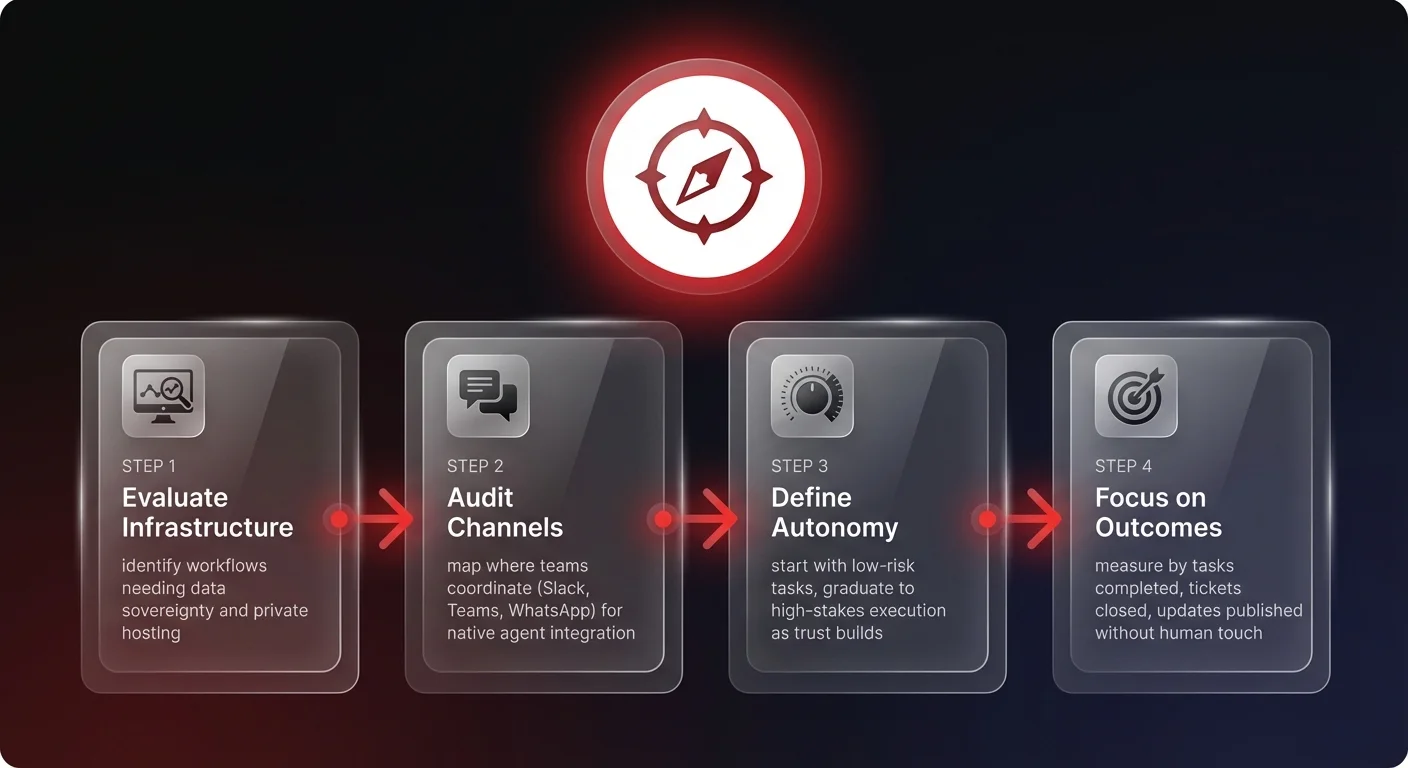
To capitalize on this shift, consider the following strategic steps:
-
Evaluate infrastructure needs: Determine which workflows require data sovereignty. If a process involves sensitive client data or proprietary IP, a locally hosted or private cloud agent is likely the superior architectural choice over public SaaS wrappers.
-
Audit communication channels: Assess where your team currently coordinates work. If your operations run on Slack or Teams, prioritize agent frameworks that integrate natively into these environments rather than introducing new interfaces.
-
Define autonomy levels: Start with low-risk autonomous tasks (like calendar management or internal research) before graduating to high-risk execution (like updating client websites). Build trust in the system's logic before granting full write access to external-facing systems.
-
Focus on outcomes, not outputs: Measure the success of an agent not by how many words it generates, but by the tangible outcomes it achieves — tickets closed, updates published, or emails processed without human touch.
The era of the passive chatbot is ending. The era of the sovereign, autonomous worker has arrived. For companies willing to invest in the right infrastructure and governance, the productivity gains will be transformative.