
Claude Managed Agents are Anthropic's native AI automation infrastructure - sandboxed server environments that execute complex knowledge workflows without traditional middleware platforms like Zapier, Make, or n8n. Instead of static API connections that require manual rewiring when processes change, Claude Managed Agents dynamically interpret unstructured inputs, centralize credential management, and orchestrate parallel operations - while introducing vendor lock-in and governance challenges that operations leaders must address before scaling.
The landscape of business automation is undergoing a fundamental rewrite. With the introduction of Claude Managed Agents, we are witnessing a decisive shift from legacy, rules-based integration tools to native, AI-driven automation infrastructure. For operations leaders, Claude Managed Agents represent both a massive leap forward in capabilities and a new frontier of governance challenges.
Historically, automating knowledge processes required connecting disparate tools through platforms like Zapier, Make, or n8n. These platforms rely on rigid, drag-and-drop visual interfaces and static API connections. When a business process changes, a human operator must manually rewire the logic. Today, foundational AI models are bypassing these middleware platforms entirely by offering to host, execute, and govern automated workflows directly on their own backend infrastructure.
This evolution forces mid-market executives to rethink their operational tech stacks. While the speed of deployment is unprecedented, adopting model-specific infrastructure introduces complex questions around data sovereignty, vendor lock-in, and enterprise security.
How Claude Managed Agents redefine automation infrastructure
Managed Agents function by automating the process of automating processes. Instead of merely generating code or text for a user to implement elsewhere, Anthropic's new infrastructure spins up a standardized, sandboxed server environment directly on its backend. This container is equipped with limited networking for safety reasons, providing a reusable ecosystem that maintains exact parameters for testing and deployment.
Consider a standard post-sales call workflow. In a traditional setup, routing a meeting transcript into actionable project management tasks requires multiple parsing steps, complex conditional logic, and formatting nodes.
Testing reveals that with Managed Agents, an operations manager can simply define a natural language specification - instructing the agent to parse meeting transcripts, identify action items, and create structured tasks in a system like ClickUp. The system instantly generates an agent configuration, bypassing the need for middleware orchestration.
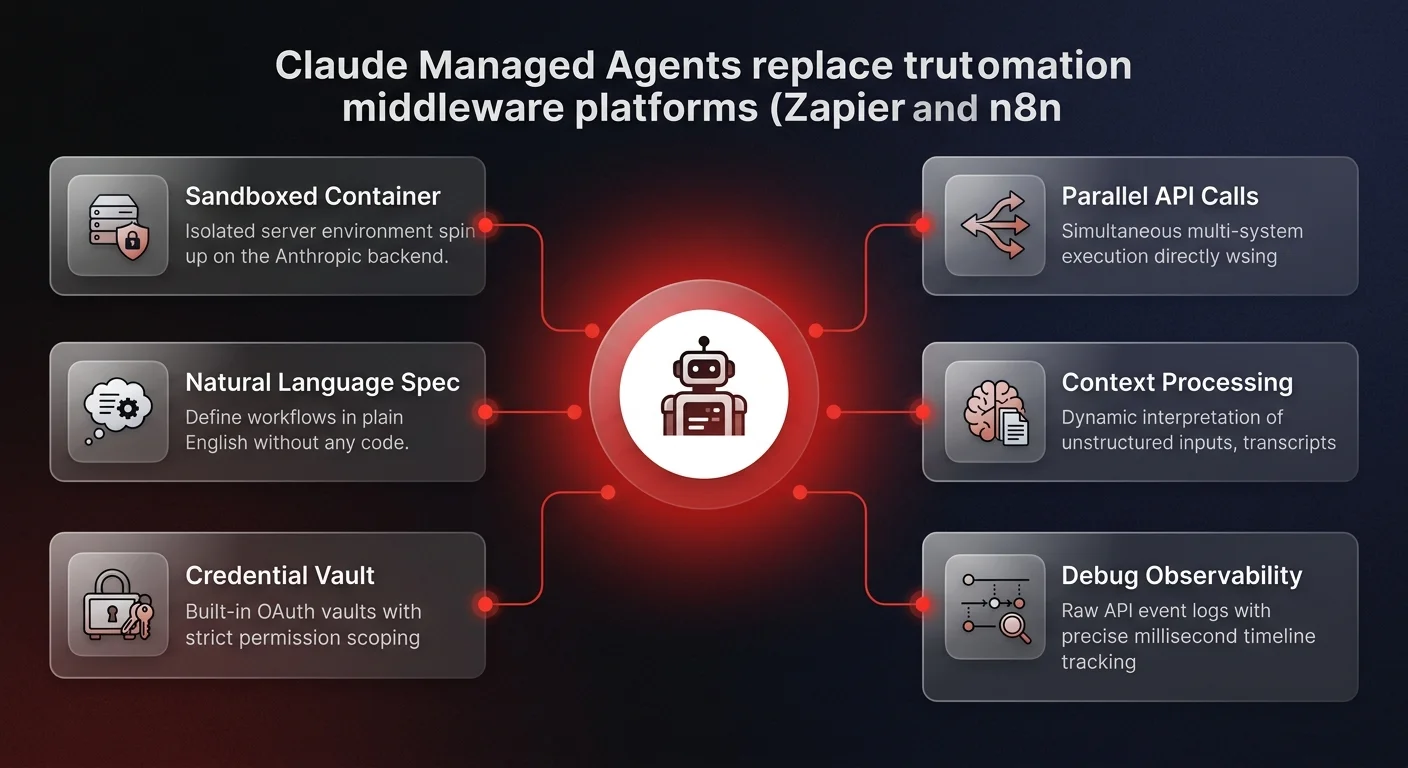
During execution, the model contextualizes the unstructured data dynamically. For example, if a team standup transcript notes that "Alice will set up the staging environment" and "Bob needs to review the API design doc," the agent autonomously structures these inputs, identifies the correct assignees, and executes parallel API calls to populate the project management workspace.
Solving the API credential bottleneck with enterprise vaults
A significant barrier to entry for scaling AI automation has historically been credential management. Dealing with raw API keys across a mid-market organization is a security nightmare, often resulting in fragmented shadow AI deployments.
Managed Agents address this through built-in credential vaults. When an agent is instructed to interact with an external platform, the infrastructure prompts the user to create an isolated vault to store the integration data. By utilizing built-in OAuth connections rather than exposing raw API keys, the system allows operators to authenticate securely.
This centralized vault system provides explicit organizational scoping. Environments can be strictly permissioned - for instance, an environment might be granted access exclusively to a specific endpoint like a company's ClickUp instance, with all other network access explicitly denied. This highly limited networking is precisely the type of disambiguation required for serious mid-market business use cases, distinguishing enterprise-grade automation from reckless, open-ended AI experimentation.
For organizations building their credential governance strategy, our analysis of AI context infrastructure and governance covers the architectural decisions that keep enterprise data inside sovereign boundaries.
Deep observability and token tracking for operations
As AI agents take over critical knowledge processes, observability becomes a non-negotiable requirement for operations leaders. Operating "black box" AI systems introduces unacceptable operational risk.
Research into this new architecture demonstrates a heavy emphasis on full interpretability. Operators have access to granular debug panels that display every raw API event. This allows technical teams to see exactly when a model starts processing, when it finishes, and how it translates natural language into structured data.
The infrastructure provides visual timeline views of conversational checkpoints. Leaders can analyze specific segments of an automated workflow - seeing exactly how many milliseconds were spent on "agent thinking" versus idle time or message passing.
Furthermore, this architecture offers total oversight of resource consumption. Dashboards track wall clock time, token input, and token output across all managed workspaces. With deep visibility into cache reads - such as tracking 27,000 input tokens utilized for system prompts - organizations gain complete cost transparency and accountability for their automated processes.
Front end deployment and the threat to legacy platforms
The speed at which these managed backend environments can be connected to custom front-end interfaces is staggering. A developer can prompt an AI coding assistant to write a front-end web application, spin up a local server, and connect it directly to the Managed Agent via API in under a minute.
The result - a fully functional internal application where team members can paste transcripts and automatically generate CRM tasks, completely bypassing legacy no-code builders. Our deeper look at agentic web applications and operations shows how teams are already building internal tools that replace entire SaaS subscriptions using this exact architecture.
Industry projections suggest that foundational model providers will soon release visual, node-based accompaniments to these text-driven systems. Because human cognition naturally gravitates toward visual representations of complex systems, a drag-and-drop interface native to an LLM provider's backend would likely serve as a complete replacement for traditional automation infrastructure. If an organization can visually map an AI workflow that is natively hosted, executed, and authenticated by the intelligence layer itself, the need for third-party middleware evaporates.
The strategic trap of AI vendor lock-in
While the technical capabilities of Claude Managed Agents are undeniably impressive, operations leaders must analyze the strategic trade-offs. Building your company's core knowledge process automation directly on a specific AI vendor's proprietary infrastructure introduces a massive risk - vendor lock-in.
When a company builds its credential vaults, routing logic, and operational workflows exclusively inside Anthropic's backend, they become tethered to that specific ecosystem. Currently, these managed workflows are heavily optimized for specific model versions, such as Sonnet 4.6.
But the AI landscape is volatile. If a competitor releases a faster, more accurate, or significantly cheaper model next quarter, an organization locked into a specific vendor's managed infrastructure cannot simply swap the underlying intelligence engine. They would have to tear down their automation infrastructure and rebuild it elsewhere.
This dynamic perfectly illustrates why scaling operations require a technology-agnostic approach. Our analysis of AI vendor lock-in risks documents how organizations that built on proprietary automation platforms are now paying significant migration costs as the AI market evolves. While the market demands the security and vaulting capabilities demonstrated by Managed Agents, relying on the model provider to also act as the sovereign orchestrator is a strategic misstep.
Strategic imperatives for scaling operations
To transform fragmented AI experiments into reliable operational systems, executives must separate the intelligence layer from the orchestration layer.
Operations leaders who want to capture the benefits of managed automation while preserving strategic flexibility can explore our sovereign AI governance framework - a sovereign, governed approach that lets your organization leverage Claude Managed Agents without ceding control of your data or workflows.
Based on the rapid evolution of managed automation infrastructure, operations leaders should prioritize the following actions:
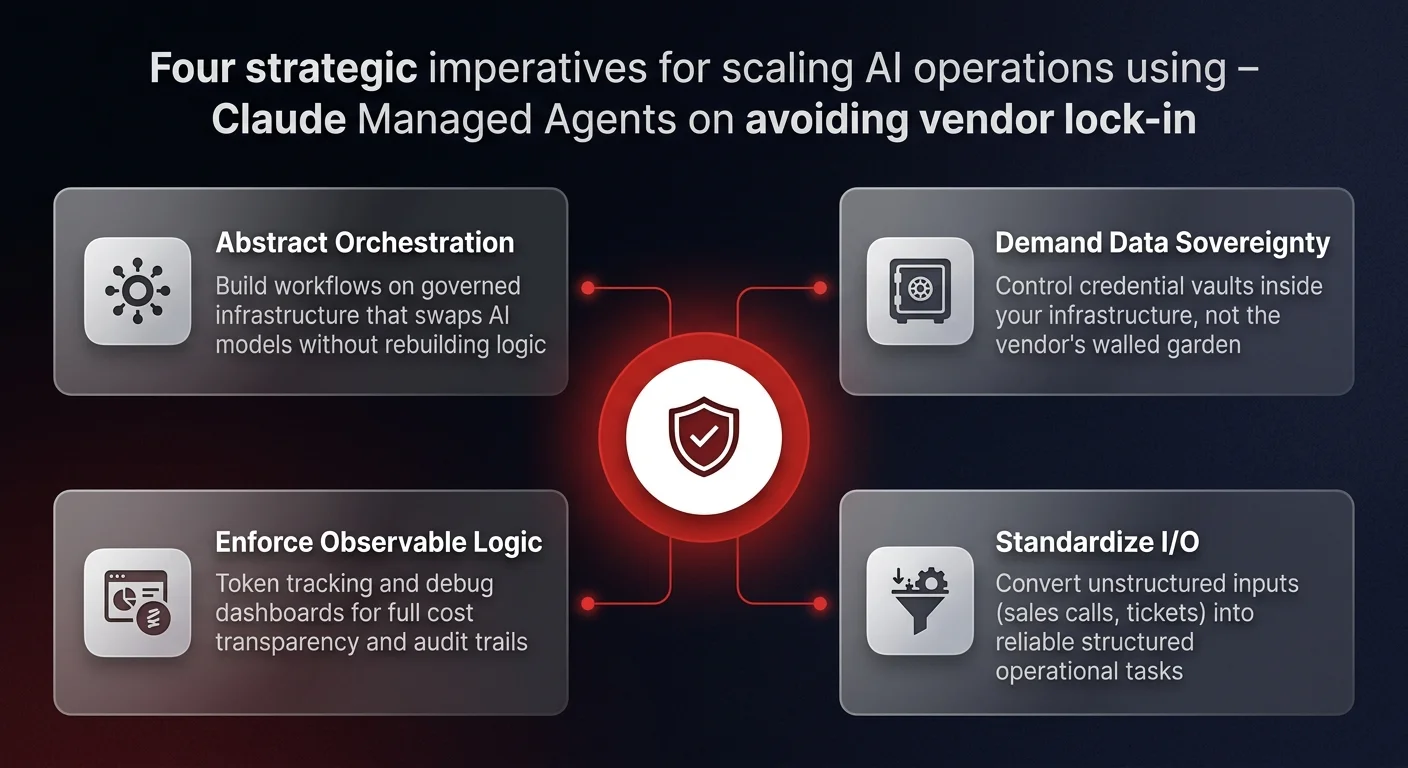
- Abstract your orchestration - Build your workflows on governed agent infrastructure that allows you to swap foundational models seamlessly without rebuilding the operational logic.
- Demand data sovereignty - Utilize credential vaulting and strict permission scoping, but ensure those vaults are controlled by your organization's infrastructure, not locked inside an LLM provider's walled garden.
- Enforce observable logic - Capitalize on the detailed debugging and token-tracking capabilities to monitor AI ROI, ensuring every automated action is transparent, auditable, and cost-effective.
- Standardize inputs and outputs - Focus on structuring your organization's unstructured data. The true value of AI agents lies in their ability to take messy inputs - like sales calls or support tickets - and reliably convert them into structured operational tasks.
Securing the future of automated operations
The release of Claude Managed Agents proves that the future of business automation is intelligent, autonomous, and natively integrated. The days of manually stringing together rigid API endpoints are ending, replaced by AI systems capable of understanding context and executing complex, parallel actions.
However, the ultimate winner in the AI automation race will not be the company that adopts the newest model the fastest. The winner will be the organization that builds a resilient, governed AI architecture. By deploying sovereign AI agent systems that retain operational independence while leveraging these advanced execution capabilities, operations leaders can safely scale their automation efforts without sacrificing security, observability, or strategic control.
Read our deeper look at agentic AI risks and governance challenges for a practical framework on building observable, auditable agent infrastructure - and see how Ability AI helps operations leaders govern AI automation at enterprise scale.