
Custom AI agents are purpose-built automation workflows that let operations teams deploy functional minimum viable products in under an hour - bypassing traditional multi-month software procurement cycles entirely. Instead of writing lengthy project proposals, business leaders now prototype bespoke applications using frontier models like Claude Code and validate operational value before any budget commitment.
In the modern enterprise, the traditional software procurement cycle is being bypassed entirely. Operations leaders are witnessing a fundamental shift in how teams solve problems and build workflows. The catalyst for this change is the rapid deployment of custom AI agents. Instead of writing lengthy project proposals or requesting budget for niche SaaS point solutions, business leaders are live-building functional minimum viable products (MVPs) to automate complex tasks.
Recent industry experiments demonstrate exactly how fast this acceleration is happening. In under forty minutes, marketing professionals are now able to architect, prompt, and deploy bespoke applications - like a fully automated creator discovery hub - using tools like Perplexity Computer and Claude Code.
For VPs of Operations and COOs, this presents a unique duality. The speed to value is unprecedented, but the resulting tool fragmentation requires a new operational framework. Here is a deep dive into how teams are building bespoke AI workflows, and what it means for enterprise governance.
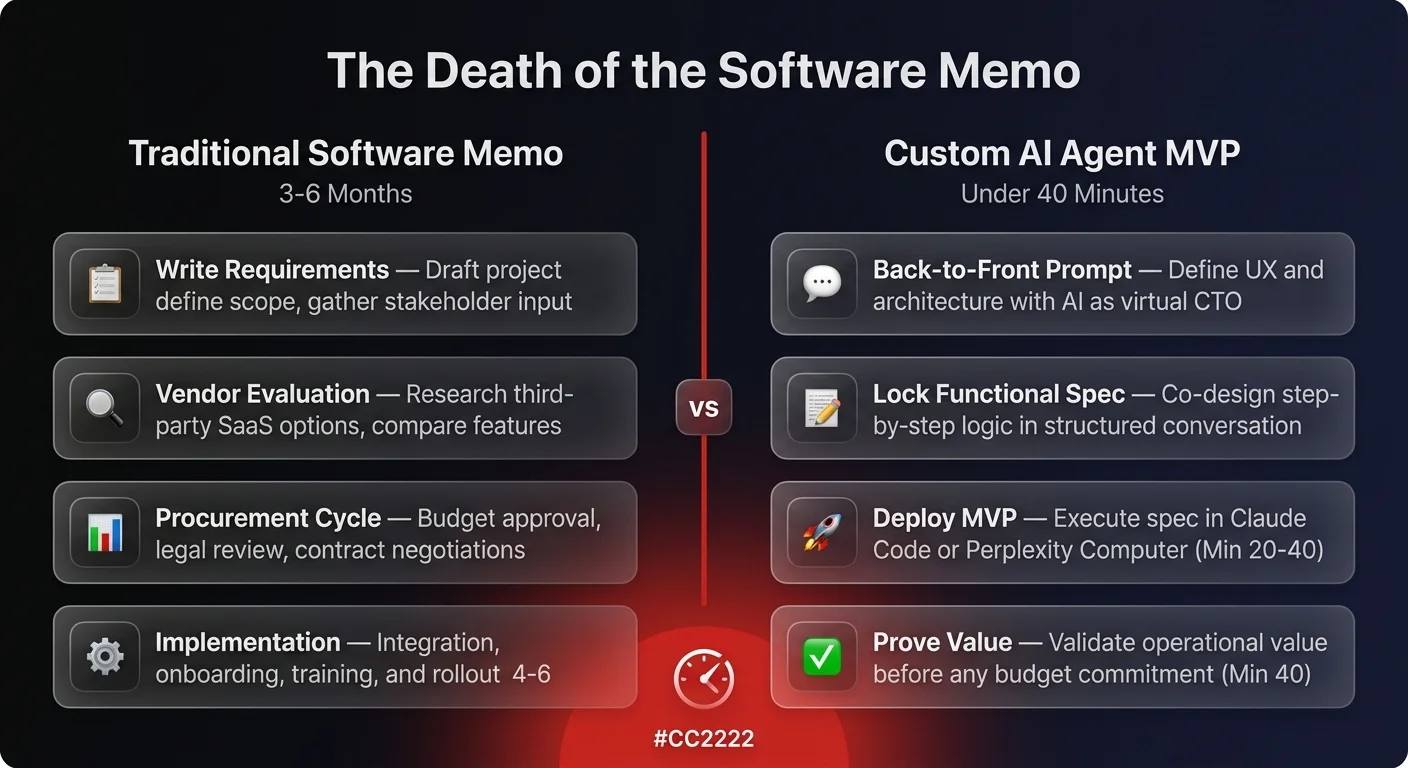
The death of the software project memo
Historically, identifying a workflow bottleneck resulted in a predictable corporate process. A team would draft a memo, define the requirements, evaluate third-party vendors, and endure a multi-month procurement cycle.
Today, that cultural norm is disappearing. The new standard is prototyping and MVPing solutions instantly so stakeholders have a tangible application to evaluate. If the prototype proves valuable, the organization can then decide to invest in scaling it.
Take the example of building a partner or creator discovery tool. Rather than buying a bloated influencer marketing platform, teams are deploying custom agents that execute highly specific sequences:
- The user inputs a target company domain.
- The agent researches the company to establish the exact buyer persona.
- It stack-ranks relevant social platforms (like LinkedIn or Reddit) based on where that specific buyer consumes information.
- It discovers notable creators and thought leaders on those platforms, filtering out irrelevant accounts.
- It drafts highly personalized outreach proposals and queues them directly in Gmail.
This entire application can be conceptualized and deployed in a single afternoon. The MVP replaces the memo, allowing teams to prove operational value before asking for budget.
Back-to-front workflow architecture for custom AI agents
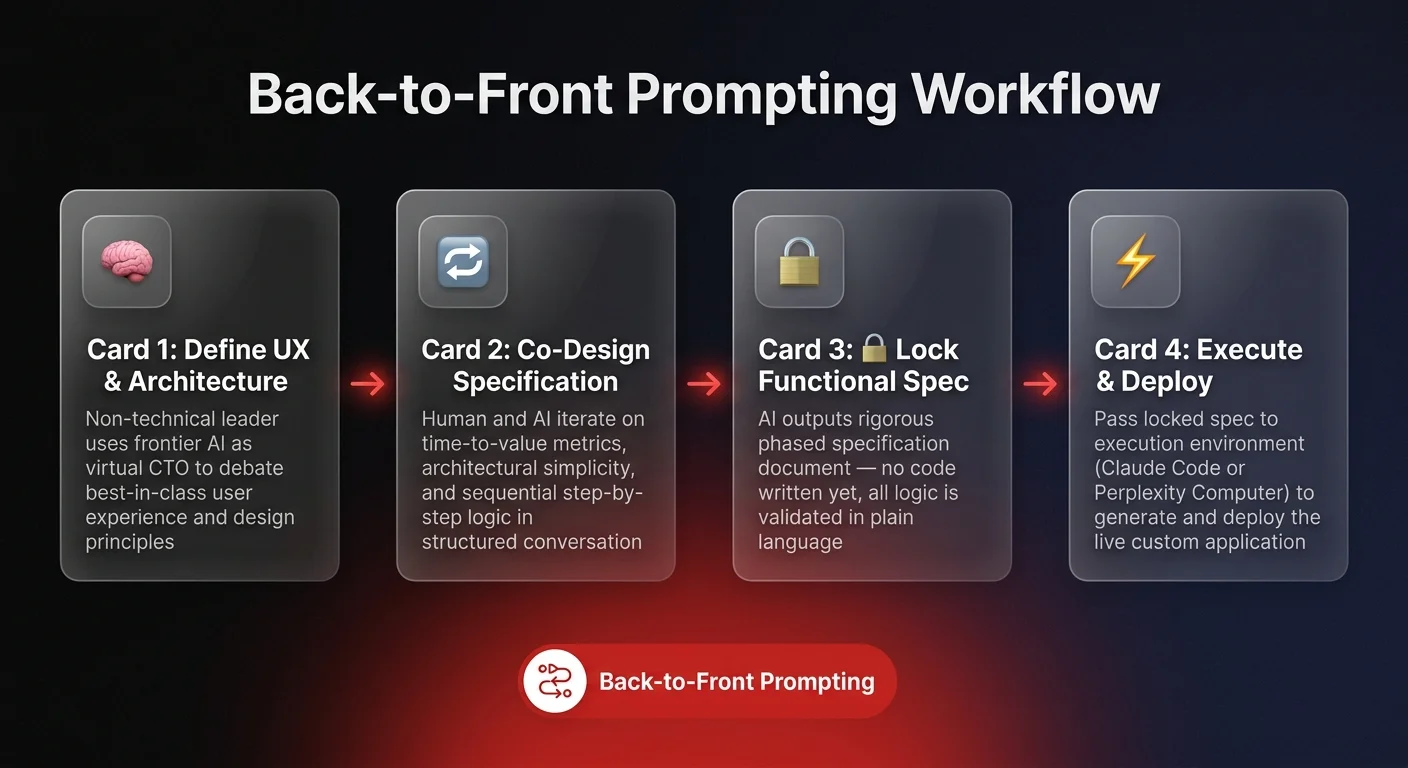
The secret to building effective operational tools without traditional engineering backgrounds lies in a technique called back-to-front prompting.
When non-technical leaders attempt to build custom AI agents, they often make the mistake of jumping straight into execution, giving the model a massive list of disparate tasks. The optimal workflow is entirely conversational and deeply structured.
Before writing a single line of code or deploying an application environment, power users leverage frontier models like Claude Opus to act as an elite Chief Technology Officer. The human and the AI go back and forth to debate best-in-class user experience principles, time-to-value metrics, and architectural simplicity.
The goal is to force the AI to output a rigorous, phased functional specification document. By aligning on the sequential, step-by-step logic first, the human operator ensures the resulting agent behaves predictably. Once the functional spec is locked in, it can be passed to an execution environment - like Perplexity Computer - to generate the actual application.
Proprietary context drives application logic
The stark difference between a generic AI output and a highly valuable operational tool comes down to context injection. When agents rely solely on their baseline training data, they produce average workflows. When they are fed deep, proprietary context, they become specialised business assets.
In recent industry tests, developers fed a 20-page proprietary strategy document into an AI coding environment. Because the model had access to this deep, highly specific context, the resulting application was vastly superior to a zero-shot prompt.
Instead of just a basic search tool, the agent automatically generated a custom fit-score algorithm for evaluating partners, built a contact discovery module, and created a nuanced partnership proposal generator based entirely on the strategic framework provided in the document.
For operations leaders, the takeaway is clear - your proprietary data, internal documentation, and strategic playbooks are the most valuable assets you possess in the AI era. Feeding this data securely into an agent is what transforms it from a generic assistant into a customised operational engine. For a deeper look at how AI agent harnesses structure this context injection for enterprise automation, see how leading operations teams are building scalable agent architectures.
The governance crisis of tool fragmentation
While the ability to spin up custom applications in 30 minutes is a massive operational advantage, it introduces a significant risk that operations leaders must confront. The current landscape is defined by rampant AI sprawl.
Teams are currently jumping between Claude, Perplexity, and various other multi-modal tools. They are engaging in what power users casually refer to as token maxing - ripping through API credits across disjointed platforms with little to no centralized oversight. Furthermore, these isolated desktop applications are inherently disconnected from the company's core systems.
The immediate next step for any team that builds a successful AI prototype is attempting to connect it to their source of truth. They want the agent to pull campaign data automatically from a CRM, cross-reference data in a data warehouse, and post status updates in Slack.
When individual employees attempt to build these complex API integrations using consumer-grade AI tools, they create massive security, data sovereignty, and logic observability risks. This is the definition of Shadow AI - powerful, ungoverned systems operating outside of IT and operational control. According to recent enterprise security research, over 70% of organizations report employees using unauthorized AI tools that interact with sensitive business data. The shadow AI governance crisis is accelerating alongside the very tools that make rapid prototyping possible.
Deploying governed systems for operational scale
The desire to build custom, lightweight AI tools for specific workflows is incredibly valid. Business units do not want bloated point solutions; they want agile workflows that solve their exact problems. However, mid-market and scaling companies cannot run their operations on fragmented desktop experiments.
To capture the value of these custom AI agents without the associated risks, organizations must shift from isolated prototyping to governed infrastructure. This is where a Sovereign AI Agent System becomes critical.
By centralising these workflow automations within a governed framework, operations leaders can ensure that proprietary context remains secure and data sovereignty is maintained. Instead of individuals manually porting JSON files or building fragile integrations, a governed system allows agents to connect securely to CRMs, data warehouses, and communication channels through standardised, observable logic.
The era of the software memo is indeed over. The future belongs to teams that can rapidly prototype custom AI workflows and seamlessly deploy them into a reliable, governed operational environment. If your team is already building custom AI agents but lacks the governance layer to scale them safely, our AI workflow automation solutions show how enterprises are bridging that gap without vendor lock-in or long contracts.