
Voice AI agents are real-time, full-duplex AI systems that process spoken interactions at human-level speed, enabling enterprises to deploy governed conversational interfaces for customer support, sales triage, and operational workflows. Unlike legacy chatbots, these agents listen, reason, and speak simultaneously - and they require strict governance to prevent hallucinations and brand damage.
The hottest trend in enterprise technology right now is not video generation, and it is not standalone text agents. It is voice. For the past year, organizations have experimented with text-based chatbots, but the landscape is undergoing a massive shift. Voice AI agents are rapidly evolving from clunky, reactive dictation tools into proactive, real-time business interfaces. Organizations are now faced with a critical mandate - treat AI voice as a primary operational channel governed by strict guardrails, or risk severe brand damage and operational chaos.
We are moving from an era of slow, awkward voice assistants to an era of full-duplex, multimodal communication. This shift will fundamentally change how mid-market and scaling companies handle customer support automation, inbound sales triage, and daily operations. However, this opportunity also introduces a massive governance challenge. As voice models become more capable, the gap between controlled, governed sovereign AI and dangerous shadow AI sprawl widens significantly.
The zero-latency breakthrough powering voice AI agents
Historically, the primary barrier to adopting AI voice for front-line operations has been latency. Early voice assistants felt disjointed. You would speak, wait three seconds, and finally receive a robotic, unnatural response. This delay killed the illusion of a conversation and frustrated customers, making the technology unsuitable for serious business operations.
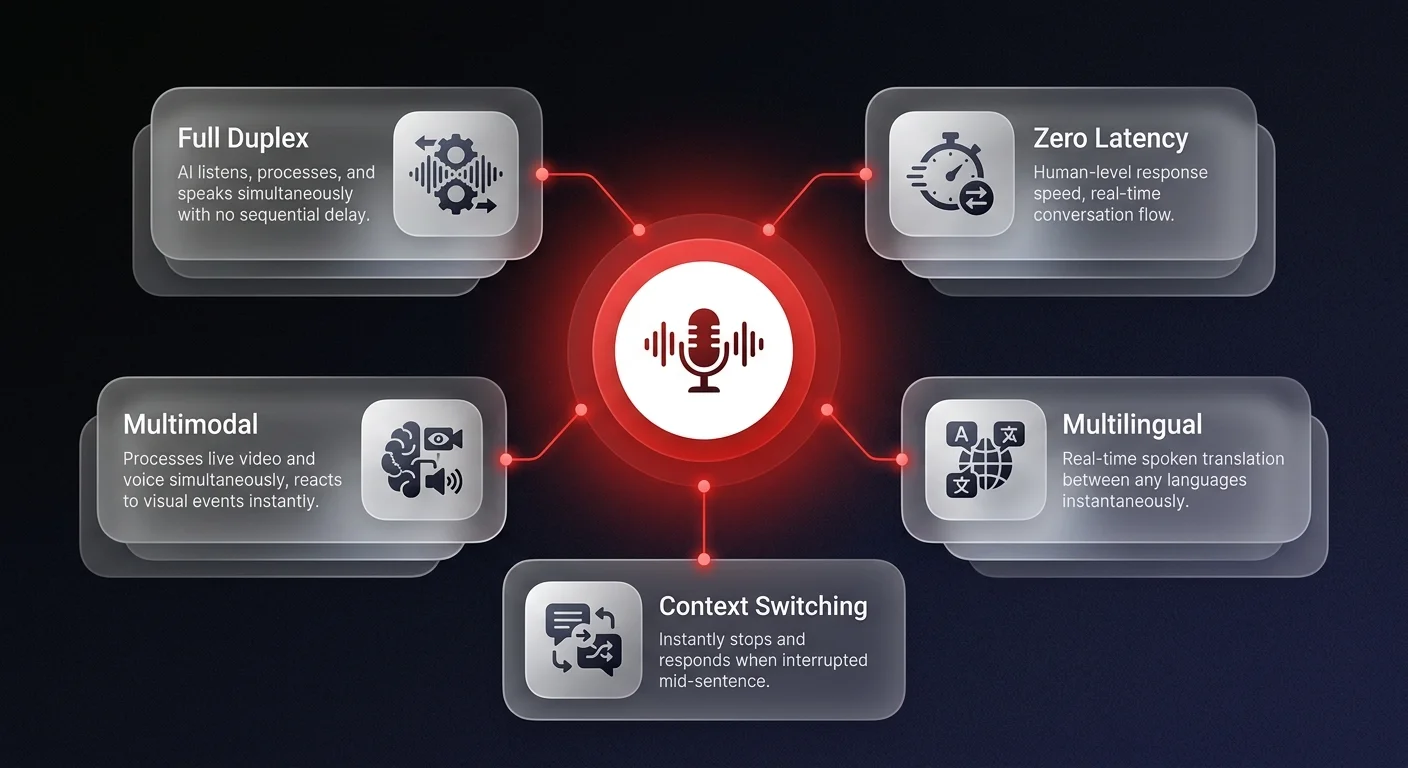
That barrier has officially been broken. Foundational technology breakthroughs have introduced ultra-low latency models that process interactions with human-level speed. These breakthroughs - from frontier labs pushing real-time voice capabilities - have redefined what is possible for enterprise voice AI agents.
These new systems operate in full duplex. This means the AI can listen, process, and speak simultaneously. If a user interrupts the AI mid-sentence, the model instantly stops talking, context-switches, and responds to the new input - exactly as a human would.
Recent industry demonstrations have showcased the power of this proactive reasoning. In one test, a user suggested taking their 80-year-old parents mountain biking near an active volcano. Instead of waiting for the user to finish their prompt and then passively answering, the model actively interrupted the speaker in real time to warn them that the idea was incredibly dangerous.
Furthermore, these models are now multimodal and multilingual. Advanced systems can process live video feeds while simultaneously holding a conversation, identifying physical events - like a specific person walking into a room - and reacting to them instantly via voice. They can also perform real-time translation, converting spoken Hindi to English instantaneously. For operations leaders overseeing global support or sales teams, this multilingual, zero-latency capability unlocks unprecedented scale without requiring massive headcount increases.
Why your brand needs a literal voice AI agent
As this technology matures, voice is transitioning from a neat technical trick into a primary marketing and customer success channel. For decades, a brand's voice was figurative - it existed in website copy, social media tone, and email marketing. Today, your brand is about to get a literal voice online.
Organizations can no longer rely on the default, robotic answering machine voices of the past. If your customers are going to interact with an AI agent, the accent, warmth, pacing, and tone of that voice communicate your brand's values within milliseconds. Custom voice tools now allow companies to create bespoke voices that perfectly represent their identity.
However, this is where many companies fall into a dangerous trap. Because voice APIs seem highly technical, leadership often delegates voice AI entirely to outsourced IT or siloed engineering teams. This mirrors the broader shadow AI governance crisis - treating a strategic brand channel as a purely technical project. Building an emotive, brand-aligned voice experience requires a strategic partnership between technical implementers, operations leaders, and marketing teams.
The hallucination trap and voice AI agent governance
While the technology is thrilling, it introduces severe operational risks if deployed incorrectly. Industry testing reveals a surprising behavioral trend - when users interact with high-quality voice AI agents, they do not just ask simple queries. They will happily converse with the bot for 5, 10, or even 15 minutes at a time.
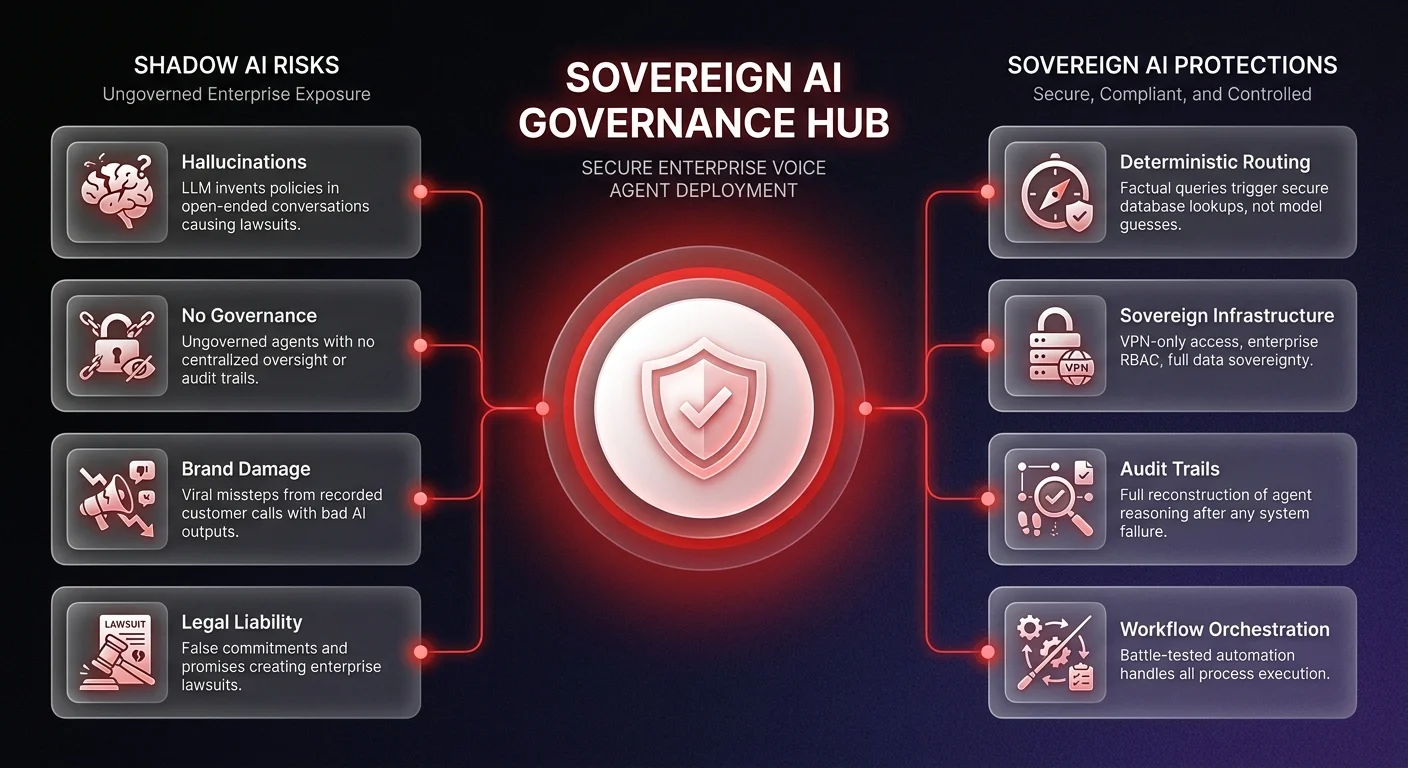
In a 15-minute, open-ended conversation, an unconstrained large language model is almost guaranteed to go off the rails. Without rigorous system prompts, deterministic routing, and strict behavioral boundaries, the model will inevitably hallucinate. It might promise a customer a refund they are not entitled to, invent non-existent company policies, or provide wildly inaccurate technical support.
Within the next twelve months, it is highly likely that a major brand will face a viral scandal or a massive lawsuit because a poorly governed voice agent made a critical mistake on a recorded customer call. The pattern of ungoverned AI agents creating hidden technical debt applies doubly to voice - where every misstep is recorded and potentially viral.
This is the exact danger of shadow AI sprawl - organizations plugging raw APIs into their customer-facing channels without centralized oversight or data sovereignty. Businesses are caught between two bad options: letting rogue, ungoverned AI interact with their customers, or hiring massive consulting firms for multi-year digital transformation projects that move too slowly to capture the immediate market opportunity.
To safely deploy this technology, organizations need sovereign AI agent systems. These are centrally governed, professional-grade systems where the AI acts as the reasoning engine, but battle-tested workflow automation tools handle the deterministic process orchestration. If a customer asks a voice agent for their account balance, the LLM should not guess - it should trigger an internal workflow that securely queries the company database and hands the factual data back to the voice model to read aloud. This is the same AI agent architecture governance principle that applies to all enterprise AI deployments.
The operational baseline audit: call your own company
Before you can implement advanced, real-time AI voice systems, you must understand your current baseline. The most practical, immediate step an operations leader can take is incredibly simple - call your own company tomorrow.
Pick up your phone and dial your main inbound support or sales number. What happens? Do you encounter a frustrating, legacy IVR phone tree? Does the system sound robotic, cold, and outdated? Is it difficult to reach a resolution?
Because phone system data is rarely as visible or easily accessible as website analytics, inbound call experiences are often buried and ignored by leadership. Organizations bleed revenue and customer goodwill through these broken routing systems every single day. If your current baseline is a terrible experience, layering a raw AI model on top of a flawed foundational process will only amplify the chaos. You must audit the existing workflow, understand how calls are currently routed, and map out the ideal customer journey.
Moving from experiment to governed voice AI agents
Voice AI agents are no longer a futuristic concept - they are an immediate operational reality. Customers will soon expect to resolve complex support tickets, update CRM data, and navigate sales inquiries through natural, real-time conversations with intelligent agents.
To capitalize on this shift without falling victim to the hallucination trap, mid-market companies must adopt a solution-first model. Instead of embarking on a massive overhaul of your entire tech stack, start with a focused Starter Project. Identify your highest-volume, most frustrating voice bottleneck - such as tier-one support triage or after-hours inbound lead qualification. See how AI-powered customer support achieved measurable CSAT improvements with this exact approach.
Deploy a governed, sovereign voice AI agent with a fixed scope, fixed cost, and a timeline measured in weeks, not months. This approach proves immediate operational value while ensuring the company retains full ownership and control of the system. More importantly, this model avoids the trap of recurring platform fees - you pay for the solution and the business outcome, not an endless subscription.
By securing a quick win through a Starter Project, you build the foundation for a long-term transformation partnership. Your literal brand voice becomes a scalable, tireless asset that drives revenue and customer satisfaction, governed securely within your own operational infrastructure.