

Perplexity Computer is a super agent platform that gives businesses autonomous AI systems capable of connecting to entire software stacks and executing complex, multi-step workflows without human intervention. Unlike chatbots that require step-by-step guidance, super agents receive a goal and run it to completion in the background — performing parallel research, generating code, auditing content, and delivering structured outputs at speeds impossible for human teams.
At Ability AI, our research into the latest wave of AI deployment reveals a clear convergence in the market. Every major player is racing toward the same core use case: a primary interface where agents connect to your entire software stack and autonomously execute complex, multi-step workflows.
However, this capability brings a new operational risk. As building AI workflows becomes frictionless, organizations are rapidly accumulating what we call "AI clutter" — half-baked, unreliable tools that generate noise rather than business value. To harness these super agents effectively, leaders must move away from fragmented experimentation and adopt a governed, systems-level approach.
Autonomous AI agents for business: the super agent convergence
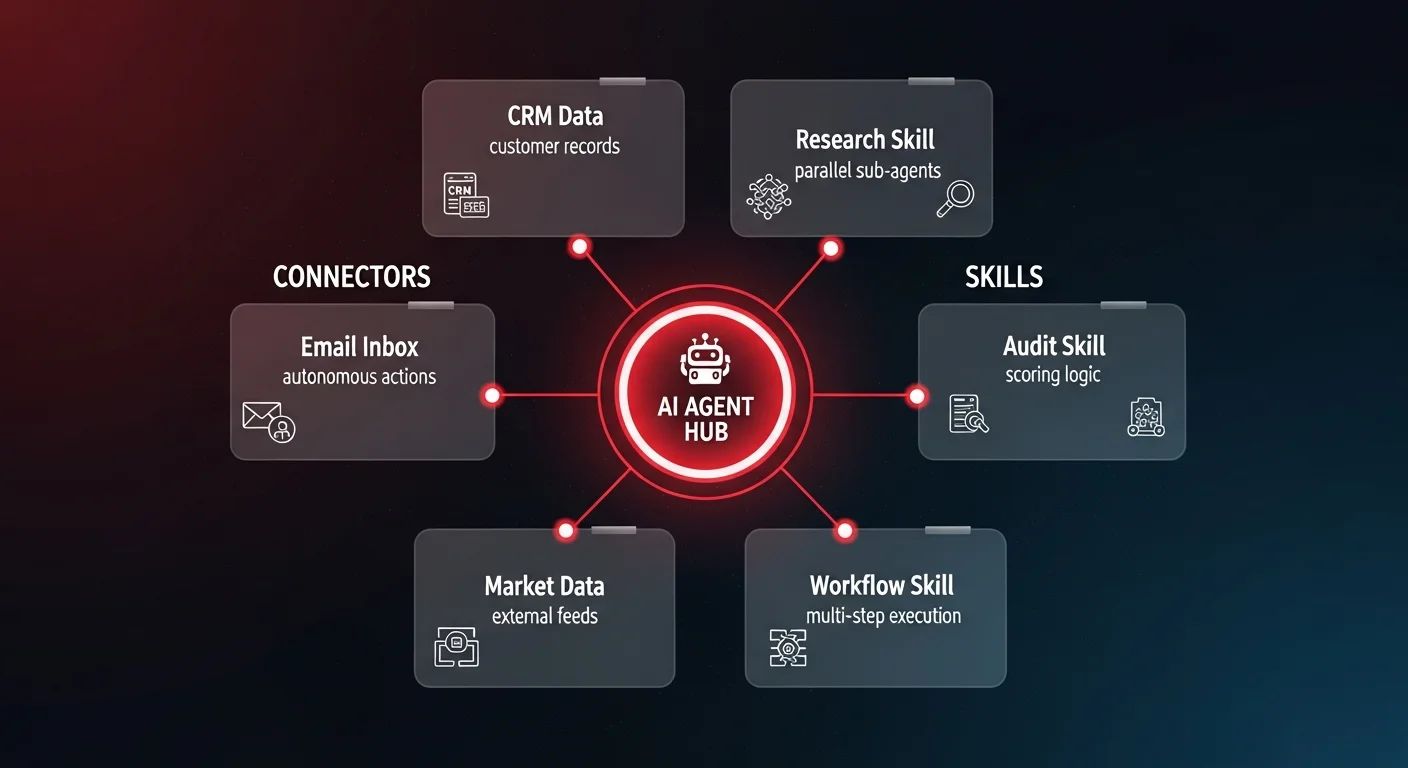
If you analyze the current AI landscape — looking at tools like Perplexity computer, Claude Code, and Open Claw — a standardized architecture is emerging. The market is converging on the "super agent" model, which is defined by two core components: connectors and skills.
Connectors provide the agent with access to your internal tools and data sources. Whether it is your CRM data, your email inbox, or external market data, the agent can observe and interact with these environments. Skills are the specific instructional frameworks that tell the agent how to execute a task within those connected environments.
What differentiates these new super agents from previous iterations is their autonomy. You no longer have to guide the AI step by step. You provide a prompt or a goal, and the task simply runs in the background until it is completed — much like executing a script in a local terminal, but with advanced reasoning capabilities.
How autonomous deep research transforms operations
One of the most powerful applications of these super agents is autonomous deep research at scale. Previously, gathering competitive intelligence or market data required hours of manual scraping, compilation, and analysis.
Consider a real-world workflow using Perplexity computer to reverse engineer design trends. The system was instructed to analyze the covers of the top 100 business books sold over the last 24 months, extract design insights, and build a reusable skill file to generate new concepts based on those trends.
To execute this, the agent did not just run a simple search. It compiled the ranking, scraped the images, and then spawned four parallel sub-agents. Each sub-agent was responsible for analyzing 25 book covers in depth. By batching the work and running it in parallel, a task that would have taken an hour of sequential processing was completed in just ten minutes. This parallel orchestration model is the foundation of effective parallel AI workflows in modern operations.
Crucially, systems like Perplexity computer are model agnostic. They route specific sub-tasks to the best available foundational model — for instance, calling Claude 3.5 for complex reasoning and a different model for data extraction. This orchestration ensures best-in-class results for every micro-step of the workflow.
Disposable artifacts and dynamic reporting
Another profound shift driven by super agents is the concept of disposable software and dynamic reporting. Historically, if operations leaders wanted a specific dashboard or data visualization, it required an IT request, engineering resources, and maintenance.
Now, agents can generate live, interactive artifacts on demand. In one tested workflow, Perplexity computer was asked to visualize the state of US politics using live betting data from Polymarket. The agent gathered the specific data points, structured the information, and wrote the code to generate a fully functional, interactive website to display the data.
This represents the era of the disposable web. Operations teams can spin up bespoke applications or reporting sites for a single five-minute meeting, share the link, and then discard the asset entirely. Code has become a disposable utility rather than a permanent asset to be maintained.
Continuous automated auditing at scale
For mid-market COOs and VPs of Operations, auditing internal assets — whether it is website copy, sales call adherence, or product marketing positioning — is a constant pain point. It is manual, time-consuming, and prone to human bias. Super agents offer a solution through continuous automated auditing.
In a recent deployment, an agent was used to audit a massive enterprise software company's entire product marketing strategy. The process involved three steps:
- The agent was fed extensive data on what constitutes "great" product marketing to build a master skill file.
- It used connectors to crawl the company's entire website, cataloging every product and feature page.
- It autonomously graded every single page against the master skill file, providing a scored ranking of strengths and weaknesses.
Within minutes, the agent identified that while primary product pages were highly optimized, secondary feature pages — like sales forecasting and analytics — were falling behind. This level of insight previously required weeks of manual review. By automating the audit layer, operations teams can instantly identify weaknesses and seamlessly pass those insights to another agent designed to execute the necessary fixes — a workflow pattern documented in our marketing operations automation case study.
Reverse engineering competitive strategy
Beyond internal auditing, super agents excel at what we call the "marketing Turing test" — discovering and reverse-engineering complex market growth strategies.
In this workflow, an agent was instructed to identify the fastest-growing, non-obvious B2B companies in the market and reverse engineer the unique strategies driving their growth. The agent had to autonomously source traffic data, filter out outlier legacy companies, and analyze the underlying mechanics of their success.
After processing the data, the agent generated a comprehensive report identifying seven distinct patterns driving modern B2B growth, including product-led growth dominance, programmatic SEO, user-generated content loops, and near-zero ad spend strategies. It successfully cross-referenced direct traffic metrics with product architectures to deliver strategic intelligence that would typically require an expensive consulting engagement to uncover.
The operational risk: from AI slop to AI clutter
The technological barriers to using AI are disappearing. At a $200 per month price point, platforms like Perplexity Max put super computing power on the desktop of any employee. But this ease of use introduces a severe operational threat.
We have moved past the problem of "AI slop" — generating low-quality text or images. The new crisis is "AI clutter." Because it is so easy to build agents, skills, and workflows, employees are generating an overwhelming amount of digital junk. They experience the dopamine hit of creating an automated workflow, but they never actually integrate it into their daily habits. The result is a corporate environment littered with dozens of abandoned, half-built agents that no one uses. This challenge sits at the intersection of agentic AI risks and enterprise governance challenges that every operations leader must now navigate.
The harsh reality is that building an agent is only 10 percent of the work. Making it reliable is the other 90 percent. A custom skill or agent workflow is not ready for deployment until it can execute its task with near-zero human edits. Getting a skill to that level of precision typically requires 20 to 40 hours of focused iteration. You must feed it edge cases, correct its logic, and refine its constraints repeatedly.
Deploying 50 mediocre agents creates operational chaos. Deploying one highly refined, governed agent creates operational leverage — the foundation of enterprise operations automation that scales with your business.
The workflow extraction method
To avoid AI clutter and build systems that actually drive business outcomes, organizations must change how they develop automations. Instead of asking an LLM to invent a workflow from scratch, operations teams should utilize the workflow extraction method.
The process is simple but highly effective:
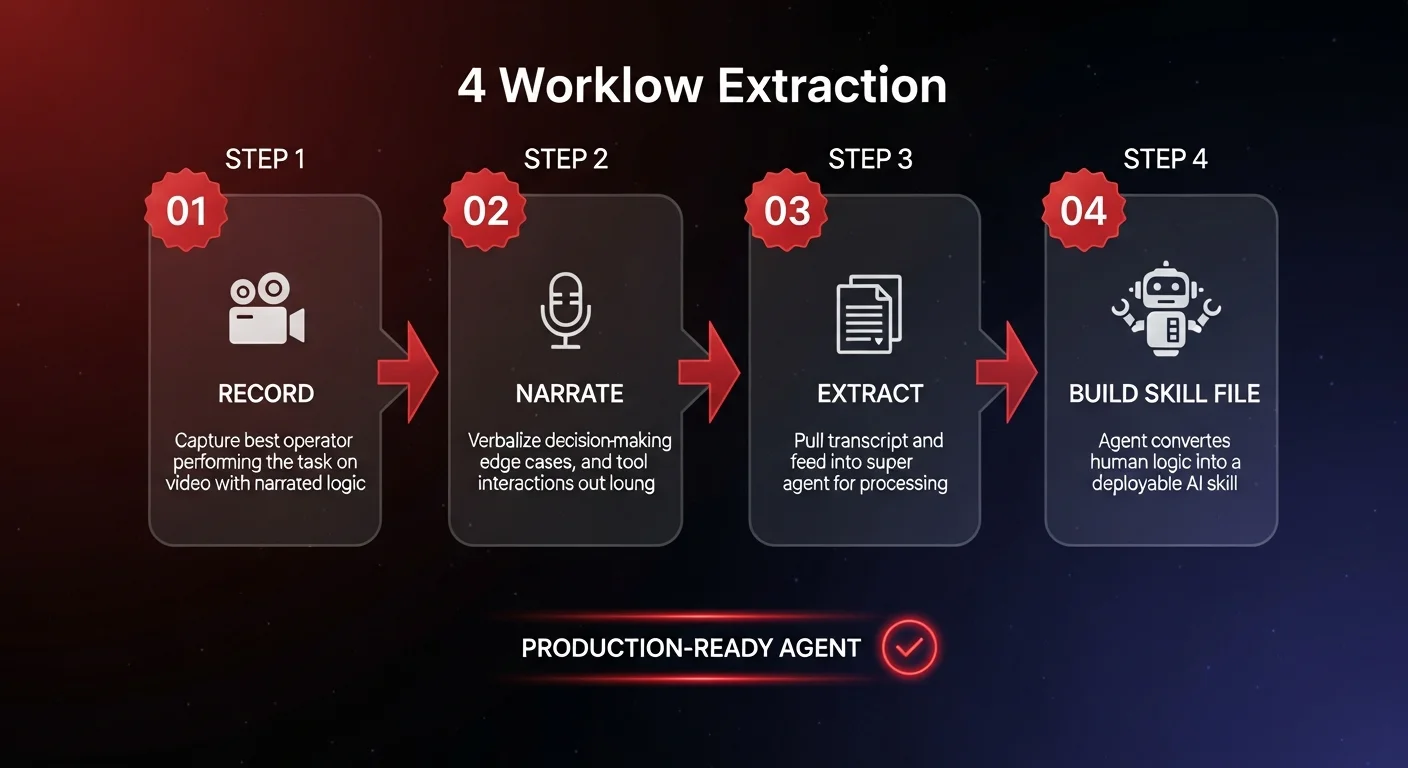
- Have your best human operator record themselves executing a complex task via video.
- Narrate the exact decision-making logic, edge cases, and tool interactions out loud during the recording.
- Extract the transcript and feed it into a super agent.
- Instruct the agent to build a comprehensive skill file based entirely on the human's documented logic.
This grounds the AI in reality rather than assumption. However, the most critical step is discipline — teams must focus on perfecting one workflow at a time. Only when the first agent is executing flawlessly should the organization move on to automating the next process.
Building governed autonomous AI systems
The rise of Perplexity computer and parallel super agents proves that the future of business operations is autonomous execution. The technology is no longer the bottleneck; implementation and governance are the true challenges.
If you allow your teams to experiment wildly with disconnected tools, you will inevitably drown in AI clutter. The companies that win this next era will be those that treat AI not as a collection of individual desktop novelties, but as sovereign, governed infrastructure.
By prioritizing observability, defining strict logic frameworks, and maintaining data sovereignty across model-agnostic systems, organizations can transform fragmented AI experiments into reliable operational engines. The goal is not to have the most AI tools — it is to have the most reliable business outcomes. See how leading operations teams are solving this exact challenge in our analysis of enterprise AI agents and governed deployment strategies.